All species › Passerines › Tyrant flycatchers and allies › Tropical Kingbird
Tropical Kingbird | Tyrannus melancholicus
Tropische koningstiran | Tirano tropical | Suiriri
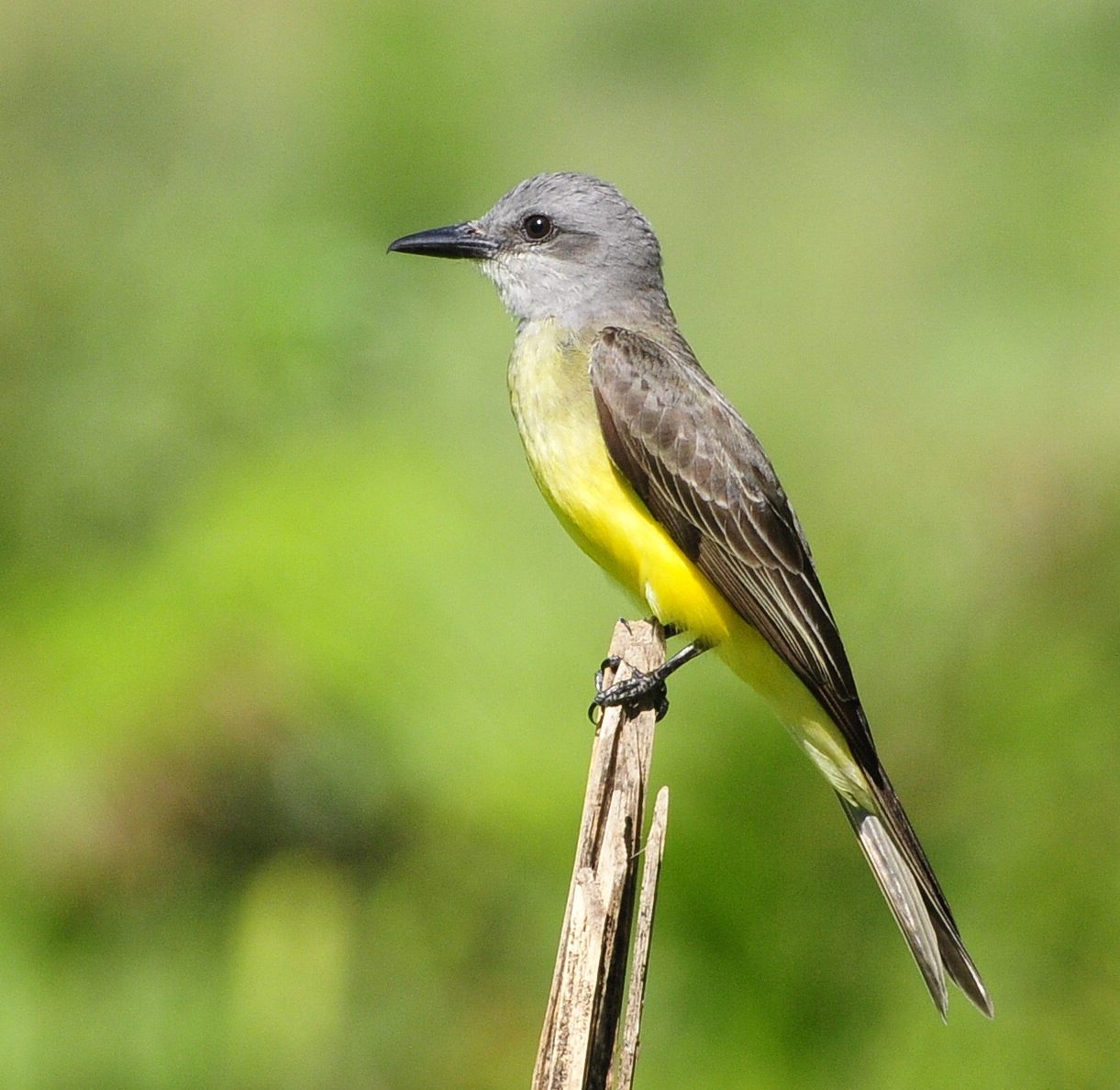
The Tropical Kingbird is one of the most widespread birds of the Neotropics, from the southern United States to Argentina. In the guide area it occurs in almost every open or semi-open landscape with trees, from the coast into the Andean valleys, also in towns. It often perches on power lines and catches insects in the air from there.
Voice
A high, twittering pip-pip-pip-pirrrr and short, high peet calls; at dawn a repeated, high song of short notes.
Recording: JAYRSON ARAUJO DE OLIVEIRA — CC BY-NC-SA 4.0 · xeno-canto
Identification
22 cm. A large flycatcher with a heavy black bill and a slightly forked greyish-brown tail. The head is grey, with a darker mask through the eye and a concealed orange crown patch. The back is greyish olive-green, the wings greyish-brown. The throat is pale grey, the breast olive-yellow, merging into the bright yellow belly. Sexes alike; the male has more deeply notched outer primaries. Juveniles have pale edges to the wing coverts.
Confusion species
White-throated Kingbird Tyrannus albogularis has a paler head with a sharper mask, a white throat and no olive wash on the breast. Snowy-throated Kingbird Tyrannus niveigularis west of the Andes has a white throat, a grey breast and a paler yellow belly. Grey Kingbird Tyrannus dominicensis is grey and white, without yellow. Social Flycatcher Myiozetetes similis and Great Kiskadee Pitangus sulphuratus have a head with white and dark stripes.
Habitat
Forest edges, open woodland, savanna, pasture with trees, plantations, river islands, parks and gardens, from sea level to about 2500 m in the Andean valleys, sometimes higher. It catches insects in the air with long sallies from an open perch and also eats fruit. It builds a shallow, loose cup of twigs on a horizontal branch.
Where the bird is most at home, classified by the vegetation units of the Andes and the west coast.


Range and movements
Colombia: throughout almost the whole country, including the Andean valleys. Ecuador: widespread on both sides of the Andes and in the inter-Andean valleys. Peru: widespread in the Amazonian lowlands, on the west slope, in the north also along the coast, and in the Andean valleys. Bolivia: widespread in the lowlands and the Yungas. Not a breeding bird on the Galápagos. Outside the guide area from the southern United States through Central America to Argentina and Uruguay.
- Resident
- dark = core range, pale = thinly spread
How and when to look
Check power lines and bare branches along roads and in villages in the lowlands; the species calls mainly at dawn.
Conservation status
Least Concern. Very widespread and common; increasing in cleared and built-up areas.
Scientific name
Tyrannus melancholicus | Vieillot, 1819
Vieillot described the species in 1819 and placed it straight away in the genus where it still stands. The genus Tyrannus was introduced in 1799 by De Lacépède. The genus name is the Latin word tyrannus, 'tyrant'. The specific name is Latin melancholicus (from Greek melankholikos), 'melancholic', here in the sense of 'bad-tempered'. Vieillot based the name on the Suirirí-guazú of Félix de Azara. The specimen the first description was based on came from Paraguay.