All species › Passerines › Tyrant flycatchers and allies › White-throated Kingbird
White-throated Kingbird | Tyrannus albogularis
Witkeelkoningstiran | Tirano gorjiblanco | Suiriri-de-garganta-branca
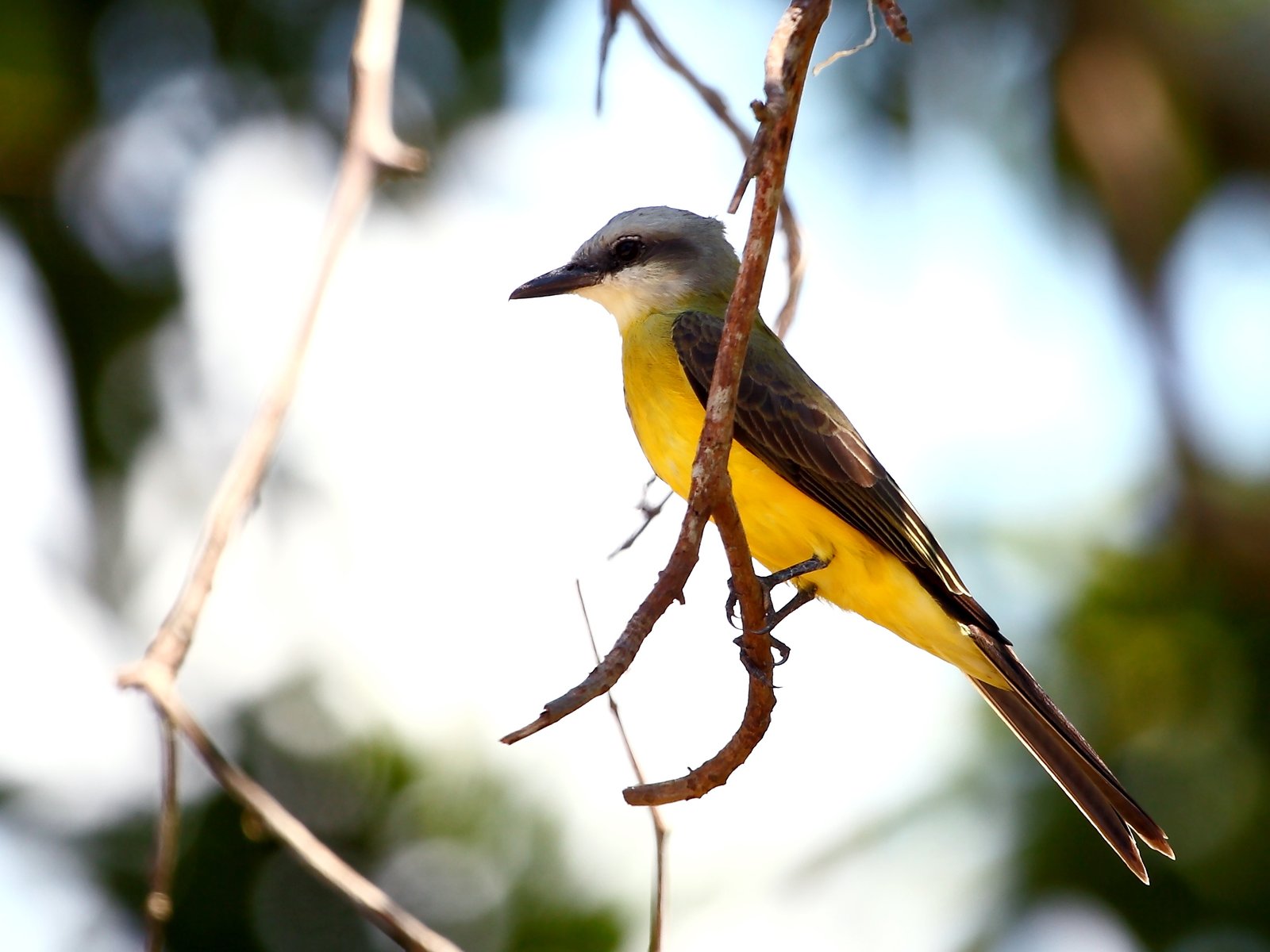
The White-throated Kingbird closely resembles Tropical Kingbird, but has a paler head with a white throat and a dark mask. It breeds in the savannas of central South America and moves to Amazonia in the austral winter. There it mainly perches on river islands and along riverbanks.
Voice
High, thin, twittering calls, higher and weaker than those of Tropical Kingbird, roughly peet-peet-pirr.
Recording: JAYRSON ARAUJO DE OLIVEIRA — CC BY-NC-SA 4.0 · xeno-canto
Identification
21 cm. A kingbird with a fairly heavy black bill and a slightly forked dark tail. The head is pale grey, with a dark mask through the eye and a concealed orange-yellow crown patch; the throat is pure white and contrasts sharply with the bright yellow breast and belly. The back is olive-green, wings and tail greyish-brown. Sexes alike.
Confusion species
Tropical Kingbird Tyrannus melancholicus has a darker grey head with a less sharply defined mask, a pale grey throat and an olive wash across the breast. Snowy-throated Kingbird Tyrannus niveigularis lives only west of the Andes and has a grey breast and a paler yellow belly. Sulphury Flycatcher Tyrannopsis sulphurea has a shorter bill, a streaked throat and a darker head.
Habitat
River islands, riverbanks with young Cecropia trees, várzea edges and semi-open country along water; on the breeding grounds savanna and cerrado with scattered trees. In the guide area mostly below 500 m. It catches large insects in the air from an open perch. It builds a shallow cup in a tree.
Where the bird is most at home, classified by the vegetation units of the Andes and the west coast.


Range and movements
Colombia: austral winter visitor east of the Andes, mainly along the large rivers of the south-east. Ecuador: rare austral winter visitor in the eastern lowlands. Peru: austral winter visitor along the large rivers of the Amazonian lowlands. Bolivia: breeds in the savannas of the north and east; in the austral winter mainly in the north. Absent from the Galápagos. Outside the guide area in Brazil, and locally in Venezuela and the Guianas.
- Resident
- Summer visitor (c. Apr–Sep)
- Winter visitor (c. Oct–Mar)
- Passage (Mar–Apr, Oct–Nov)
- dark = core range, pale = thinly spread
How and when to look
Search between May and September on river islands and along the banks of the Amazon and the Ucayali in Peru. Among kingbirds on open branches, look for the white throat and the dark mask.
Conservation status
Least Concern. Widespread, but local in the guide area.
Scientific name
Tyrannus albogularis | Burmeister, 1856
Burmeister described the species in 1856 and placed it straight away in the genus where it still stands. The genus Tyrannus was introduced in 1799 by De Lacépède. The genus name is the Latin word tyrannus, 'tyrant'. The specific name comes from Latin albus, 'white', and gula, 'throat': 'white-throated'. The specimen the first description was based on came from Lagoa Santa, Minas Gerais, Brazil.