All species › Passerines › Tyrant flycatchers and allies › Fork-tailed Flycatcher
Fork-tailed Flycatcher | Tyrannus savana
Vorkstaartkoningstiran | Tijereta sabanera | Tesourinha
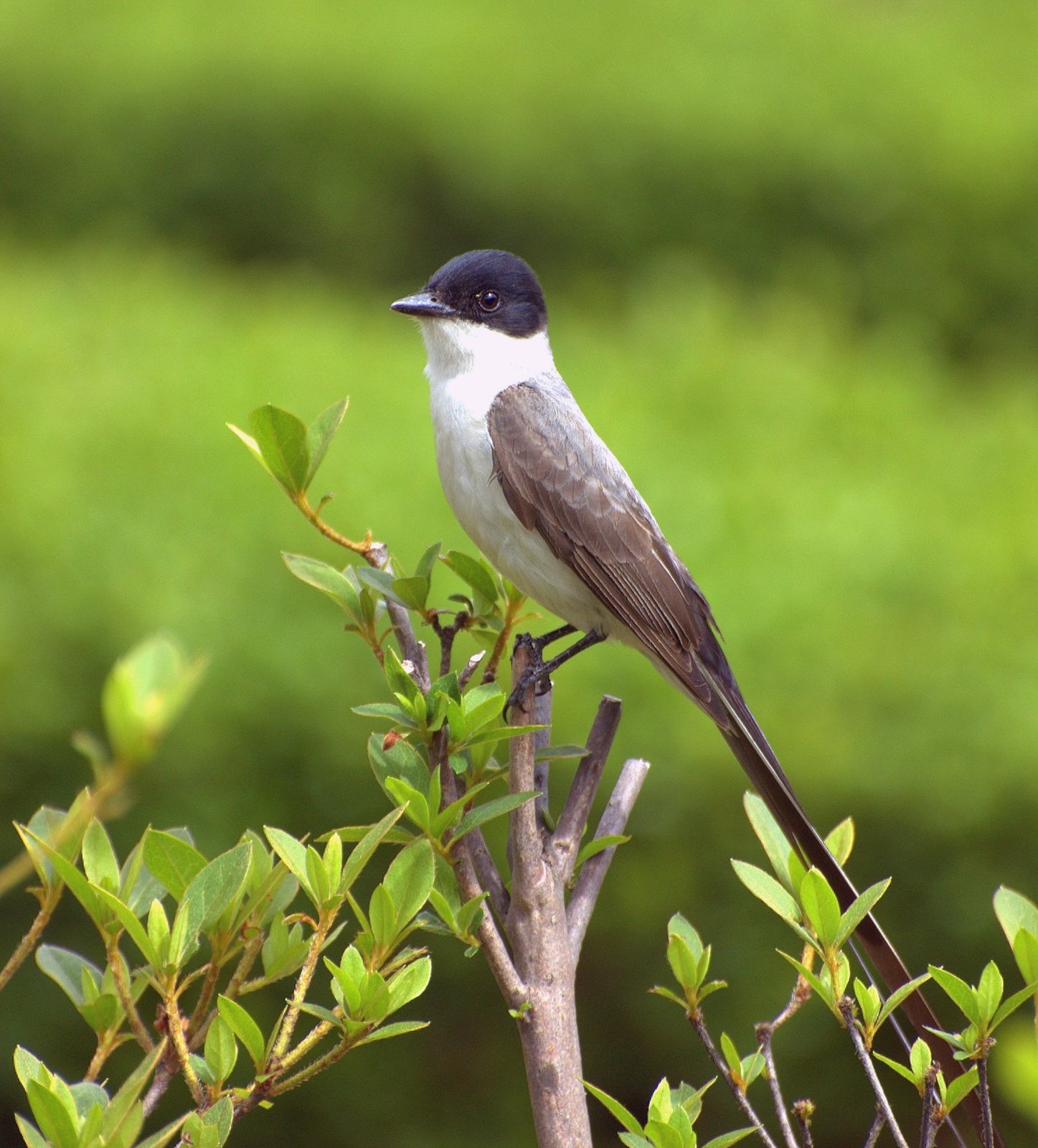
The Fork-tailed Flycatcher is a kingbird of open country with a very long, deeply forked tail, which in the male is more than twice the length of the body. Southern birds breed from Bolivia to Argentina and move north in flocks in the austral winter; they then sometimes roost by the hundreds. In addition there are resident birds in northern Colombia.
Voice
Dry, sharp tik calls and rapid, sputtering series, roughly tik-tik-tchrrr, often in flight. The male makes a rattling sound with its wings in display flight.
Recording: rudy gelis — CC BY-NC-SA 4.0 · xeno-canto
Identification
Male 37–40 cm, female 28–30 cm, including the tail. The head is black, with a concealed yellow crown patch; the back is pale grey, the wings dark greyish-brown. The underparts are white. The tail is black and deeply forked, with very long outer tail feathers. The female has a shorter tail; juveniles have a brownish-black head and a much shorter tail, and moulting birds sometimes lack the long feathers altogether.
Confusion species
Scissor-tailed Flycatcher Tyrannus forficatus, a vagrant from North America, has a pale grey head and salmon-pink flanks and underwings. Streamer-tailed Tyrant Gubernetes yetapa in eastern Bolivia is grey, with a white throat, a chestnut breast band and rufous patches in the wing. Short-tailed juveniles resemble Eastern Kingbird Tyrannus tyrannus, which has a dark back and a white terminal band on the tail.
Habitat
Savanna, pasture, marshy grassland, riverbanks and open country with scattered trees and shrubs, mostly in the lowlands; migrants sometimes also higher in the Andes. It catches insects in the air from a low perch and also eats fruit. It builds a cup of plant material in a shrub or tree.
Where the bird is most at home, classified by the vegetation units of the Andes and the west coast.


Range and movements
Colombia: resident birds in the north, including the Caribbean lowlands and the Magdalena valley; in addition austral winter visitors east of the Andes. Ecuador: austral winter visitor in the eastern lowlands; scarce and irregular west of the Andes. Peru: austral winter visitor in the Amazonian lowlands. Bolivia: common breeder in the lowland savannas, from September to March. Absent from the Galápagos. Outside the guide area from southern Mexico through Central America to Venezuela, the Guianas, Brazil, Paraguay, Uruguay and Argentina.
- Resident
- Summer visitor (c. Apr–Sep)
- Winter visitor (c. Oct–Mar)
- Passage (Mar–Apr, Oct–Nov)
- dark = core range, pale = thinly spread
How and when to look
Search between September and March in the Beni savanna or around Santa Cruz, or in the austral winter along rivers in the Amazonian lowlands, where flocks fly to communal roosts in the evening.
Conservation status
Least Concern. Very widespread and common; locally increasing where forest gives way to pasture.
Scientific name
Tyrannus savana | Daudin, 1802
Daudin described the species in 1802 and placed it straight away in the genus where it still stands. The genus Tyrannus was introduced in 1799 by De Lacépède. The genus name is the Latin word tyrannus, 'tyrant'. The specific name comes from Buffon's name 'le savana' (1780), chosen because the bird lives in (flooded) savannas. The specimen the first description was based on came from Río de la Plata near Montevideo, Uruguay.