All species › Passerines › Tyrant flycatchers and allies › Rufous-sided Scrub Tyrant
Rufous-sided Scrub Tyrant | Euscarthmus rufomarginatus
Geelbuikdwergtiran | Tiranuelo flanquirrufo | Maria-corruíra
The Rufous-sided Scrub Tyrant is a small tyrant of open, humid grassland with low shrubs in the cerrado and savannas of eastern Bolivia. It lives low among grass and shrubs and gives itself away by a sustained, dry rattle. Within the guide area it is local and little known.
Voice
A sustained, toneless, fast and dry rattle. When alarmed, buzzy trills and a squeaky, rattling chatter.
Recording: Tulio Dornas — CC BY-NC-SA 4.0 · xeno-canto
Identification
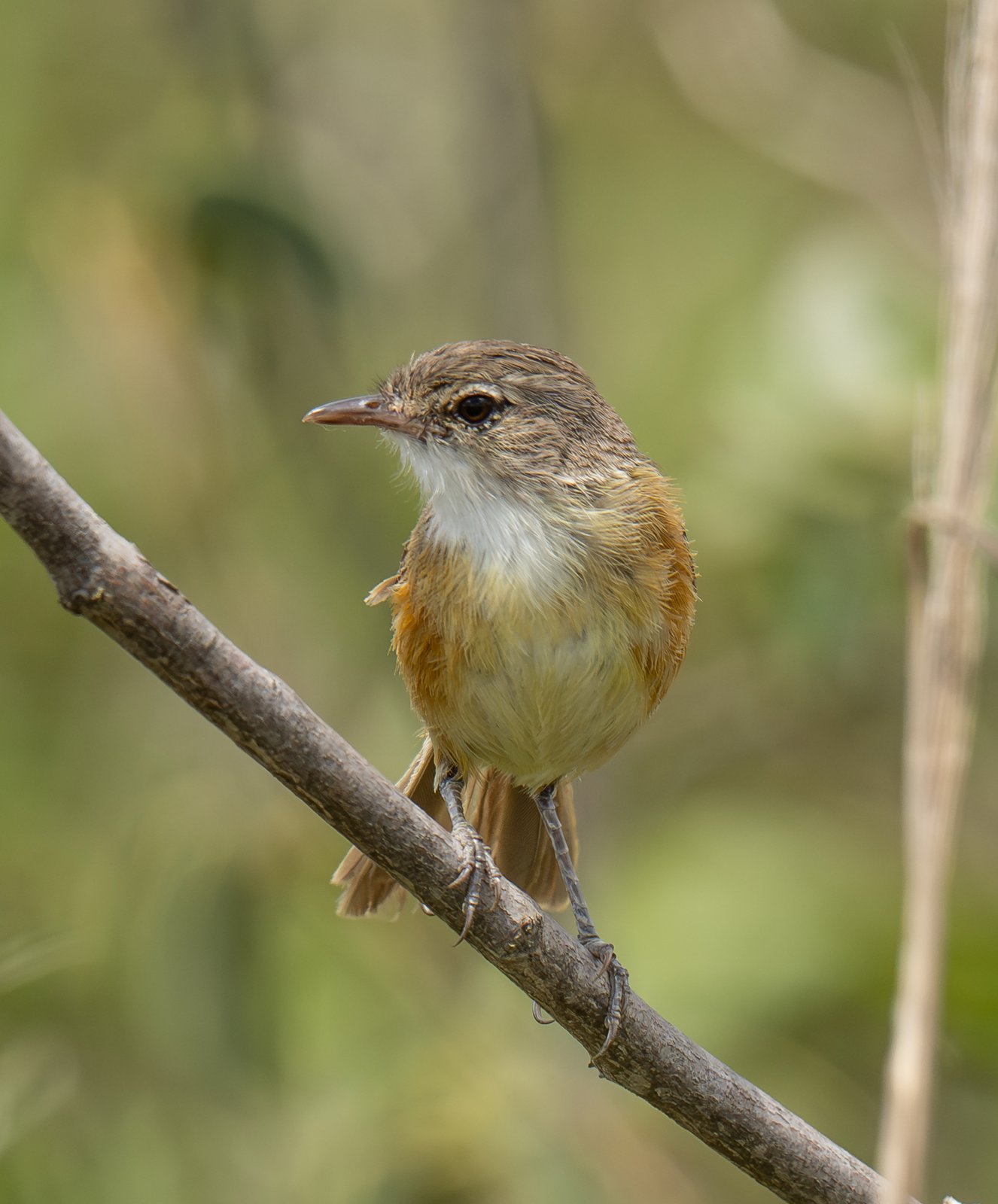
10.5 cm, with a short, pointed bill. The crown is brown, with a small, partly concealed cinnamon-rufous patch. There is a whitish supercilium and eye-ring on a light brown face. The upperparts are brown, the wings darker brown, with ochre tips to the coverts forming two wing bars. The throat is white, the underparts pale yellow, with warm ochre-buff breast sides, flanks and undertail coverts. The sexes are alike.
Confusion species
Fulvous-crowned Scrub Tyrant Euscarthmus meloryphus is whiter below, without ochre-buff flanks, and lives in dry scrub. Sharp-tailed Grass Tyrant Culicivora caudacuta has a streaked crown and a long, pointed tail. Bearded Tachuri Polystictus pectoralis is warmer buff, and the male has a black-speckled throat.
Habitat
Open, humid grassland with low shrubs, campo and savanna in the cerrado, in Bolivia between about 150 and 750 m. It searches for insects low in grass and shrubs. It avoids heavily grazed or ploughed grassland. Little is known about the nest.
Where the bird is most at home, classified by the vegetation units of the Andes and the west coast.


Range and movements
Bolivia: in the savannas and cerrado of the north and east of the lowlands, in Beni and Santa Cruz. Peru: known only from the savanna of the Pampas del Heath in Madre de Dios. Absent from Colombia, Ecuador and the Galápagos. Outside the guide area mainly in the cerrado of Brazil, also in north-eastern Paraguay and southern Suriname.
- Resident
- dark = core range, pale = thinly spread
How and when to look
Search wet grasslands with scattered low shrubs in eastern Santa Cruz, for example in the Noel Kempff Mercado area, and listen for the dry rattle from a grass tussock or small shrub.
Conservation status
Least Concern, but treated as Near Threatened until 2024. The population is probably declining through conversion of cerrado to farmland; the species is local everywhere.
Scientific name
Euscarthmus rufomarginatus | (Pelzeln, 1868)
Pelzeln described the species in 1868 as Hapalocercus rufomarginatus; because it was later moved to another genus, the author and year stand in brackets. The genus Euscarthmus was introduced in 1831 by Wied-Neuwied. The genus name comes from Greek euskarthmos, 'nimbly leaping', from eu, 'well', and skarthmos, 'leap'. The species name comes from Latin rufus, 'rufous', and marginatus, 'edged', referring to the rufous sides. The specimen the first description was based on came from Calção de Couro and Rio das Pedras, São Paulo, Brazil.