All species › Passerines › Tyrant flycatchers and allies › Fulvous-crowned Scrub Tyrant
Fulvous-crowned Scrub Tyrant | Euscarthmus meloryphus
Witbuikdwergtiran | Tiranuelo copetón | Barulhento
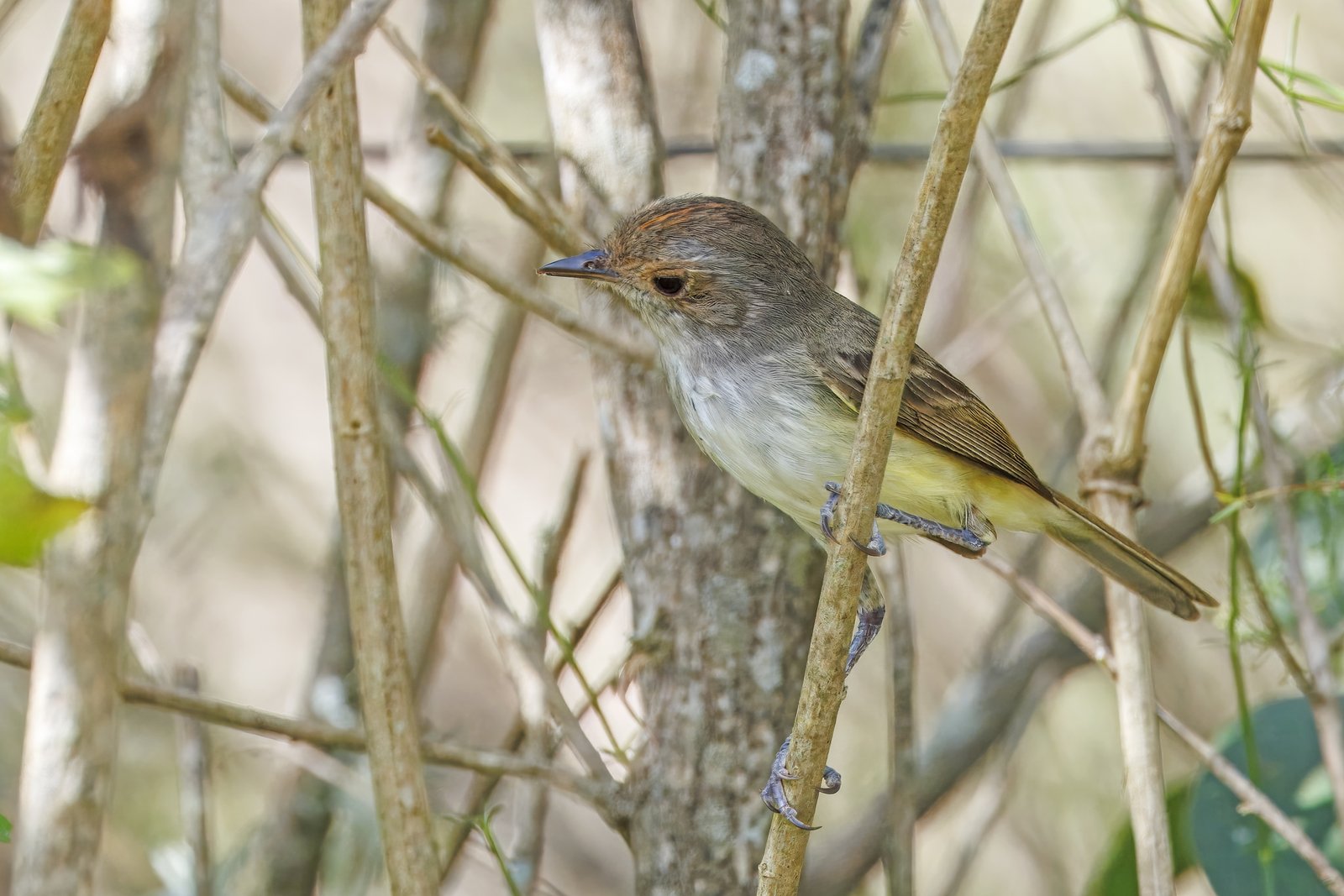
The Fulvous-crowned Scrub Tyrant is a small, brownish tyrant of dry scrub east of the Andes, with an isolated form in northern Colombia. It is heard more often than seen: the dry, scratchy song usually comes from deep in cover. Southern birds move north in the austral winter.
Voice
A dry, scratchy, repeated phrase, often from dense vegetation. Pairs often sing in duet.
Recording: Jacob Wijpkema — CC BY-NC-SA 4.0 · xeno-canto
Identification
10.5 cm, with a short, pointed bill and a fairly long tail. The crown and upperparts are brownish, with a weak crest and a partly concealed rufous crown patch. The face is buffy brown, with pale lores and eye-ring; in the Colombian form the face is more fulvous. The wings are dark brown, with rufous tips to the coverts. The throat and breast are greyish white, with a brownish wash on the flanks; the belly is creamy yellow. The sexes are alike.
Confusion species
Fulvous-faced Scrub Tyrant Euscarthmus fulviceps lives west of the Andes and has a more strongly fulvous face. Rufous-sided Scrub Tyrant Euscarthmus rufomarginatus has ochre-buff flanks and a yellower belly and lives in open grassland. Southern Beardless Tyrannulet Camptostoma obsoletum has a ragged crest and a shorter bill. Pearly-vented Tody-Tyrant Hemitriccus margaritaceiventer has a pale iris, a longer, flat bill and a streaked breast.
Habitat
Dry scrub, dense thorn bushes, dry forest edges and pasture with dense shrubs, in Colombia up to about 1000 m, in Bolivia up to about 1200 m. In Peru mainly in riverside thickets. It searches for small insects in low, dense vegetation. The nest is a small cup low in a shrub.
Where the bird is most at home, classified by the vegetation units of the Andes and the west coast.


Range and movements
Colombia: in the dry Magdalena valley. Peru: only in the far south-east, mainly in the austral winter. Bolivia: in the north and east of the lowlands and in the lower dry valleys; records in the north fall mainly in the austral winter. Absent from Ecuador and the Galápagos. Outside the guide area in northern Venezuela, and from eastern and central Brazil to Paraguay, Uruguay and northern Argentina.
- Resident
- dark = core range, pale = thinly spread
How and when to look
Listen for the scratchy song in dry scrub and at forest edges and wait patiently; the bird sometimes comes briefly to the outside of a shrub.
Conservation status
Least Concern. The species is widespread and tolerates disturbed scrub and overgrown pasture.
Scientific name
Euscarthmus meloryphus | Wied-Neuwied, 1831
Wied-Neuwied described the species in 1831 and placed it straight away in the genus where it still stands. He introduced the genus Euscarthmus in that same work. The genus name comes from Greek euskarthmos, 'nimbly leaping', from eu, 'well', and skarthmos, 'leap'. The species name comes from Greek mēlo-, 'ruddy' (from mēlon, 'apple'), and koruphē, 'crown of the head', referring to the fulvous crown patch. The specimen the first description was based on came from Bahia, Brazil.