All species › Passerines › Tyrant flycatchers and allies › Fulvous-faced Scrub Tyrant
Fulvous-faced Scrub Tyrant | Euscarthmus fulviceps
Okerkopdwergtiran | Tiranuelo caripardo | Barulhento-de-cara-fulva
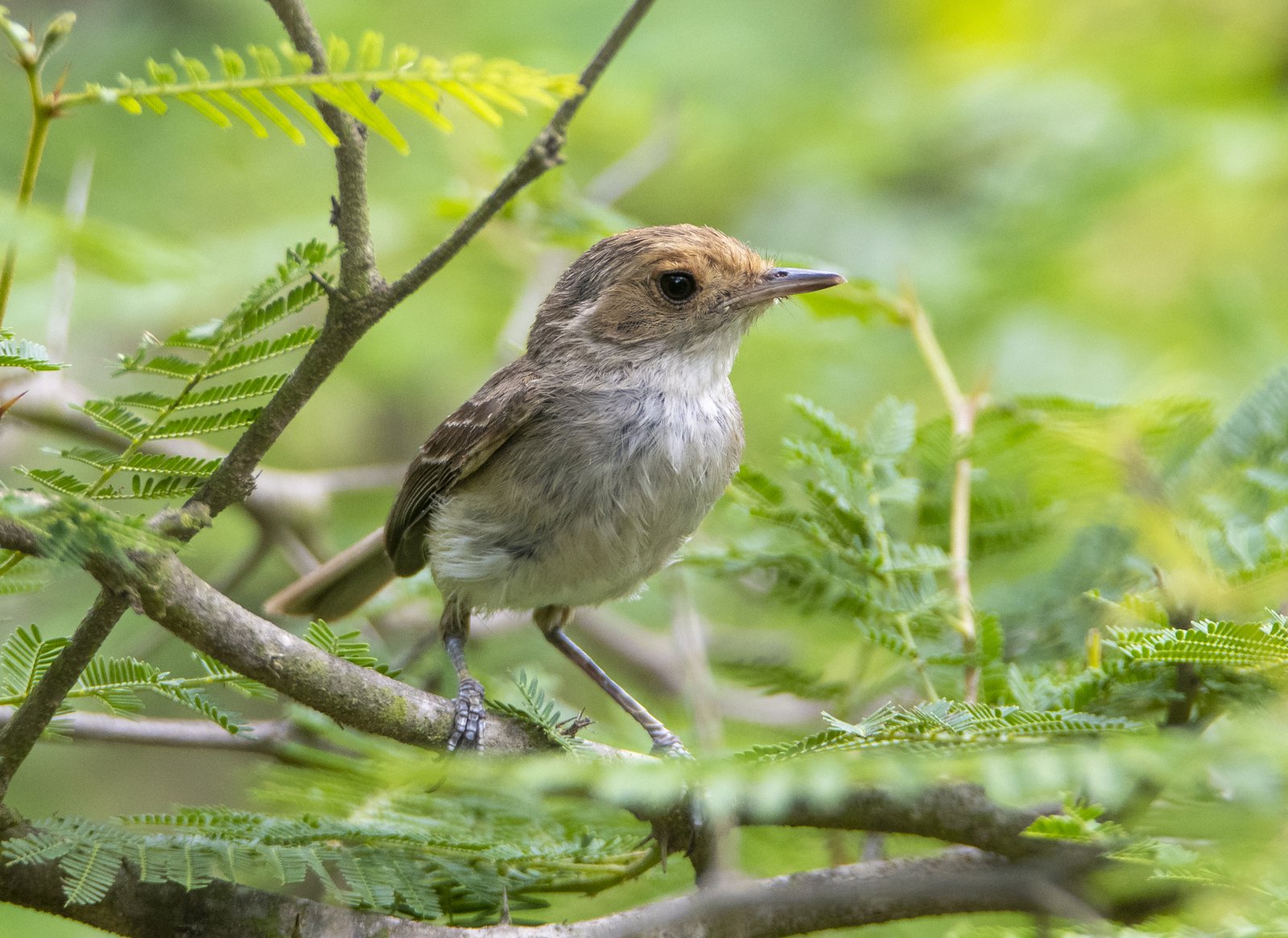
The Fulvous-faced Scrub Tyrant is a small, brownish tyrant with a fulvous face of dry scrub west of the Andes in Ecuador and Peru. It keeps to dense, low vegetation and is usually detected by its dry, scratchy song. It was formerly treated as a form of Fulvous-crowned Scrub Tyrant.
Voice
A dry, scratchy, short phrase repeated often, usually from cover. Also dry rattles; pairs often sing in duet.
No recording with a suitable Creative Commons licence is available for this species yet.
Identification
10.5 cm, with a short, pointed bill and a fairly long tail. The upperparts are olive-brown. The forehead and face are fulvous; the crown has a mostly concealed orange-rufous patch. The wings are dusky, with two buff wing bars. The throat is whitish, the breast pale grey with a brownish tinge, and the belly pale yellow. The sexes are alike.
Confusion species
Southern Beardless Tyrannulet Camptostoma obsoletum has a ragged crest, a shorter bill and no fulvous face, and often cocks its tail. Mouse-colored Tyrannulet Nesotriccus murinus is larger and plainer greyish brown, without a fulvous face. Grey-and-white Tyrannulet Pseudelaenia leucospodia is greyer and whiter, with a white crown patch. Fulvous-crowned Scrub Tyrant Euscarthmus meloryphus lives east of the Andes and has a less fulvous face.
Habitat
Dry scrub, dense thorn bushes, the undergrowth of dry forest and overgrown fields and pastures with shrubs, from sea level to about 2000 m in the dry inter-Andean valleys. It searches for small insects among leaves and twigs in low, dense vegetation. The nest is a small cup low in a shrub.
Where the bird is most at home, classified by the vegetation units of the Andes and the west coast.


Range and movements
Ecuador: in the dry west and south-west, from Manabí and Guayas to El Oro and Loja. Peru: in the west, from Tumbes and Piura south along the coast and the western slope, and in the dry Marañón valley. Absent from Colombia, Bolivia and the Galápagos. Does not occur outside the guide area.
- Resident
- dark = core range, pale = thinly spread
How and when to look
Listen for the scratchy song in dry scrub in Tumbes, Piura or south-western Ecuador and wait for the bird to show itself in the outer branches of a shrub.
Conservation status
Least Concern. The species tolerates disturbed scrub, but the dry forest west of the Andes is being cleared in many places.
Scientific name
Euscarthmus fulviceps | Sclater, 1871
Sclater described the species in 1871 and placed it straight away in the genus where it still stands. The genus Euscarthmus was introduced in 1831 by Wied-Neuwied. The genus name comes from Greek euskarthmos, 'nimbly leaping', from eu, 'well', and skarthmos, 'leap'. The species name comes from Latin fulvus, 'tawny, fulvous', and -ceps, 'headed'. The specimen the first description was based on came from Babahoyo, Los Ríos, Ecuador.