All species › Passerines › Thrushes and allies › Black-billed Thrush
Black-billed Thrush | Turdus ignobilis
Zwartsnavellijster | Zorzal piquinegro | Caraxué-de-bico-preto
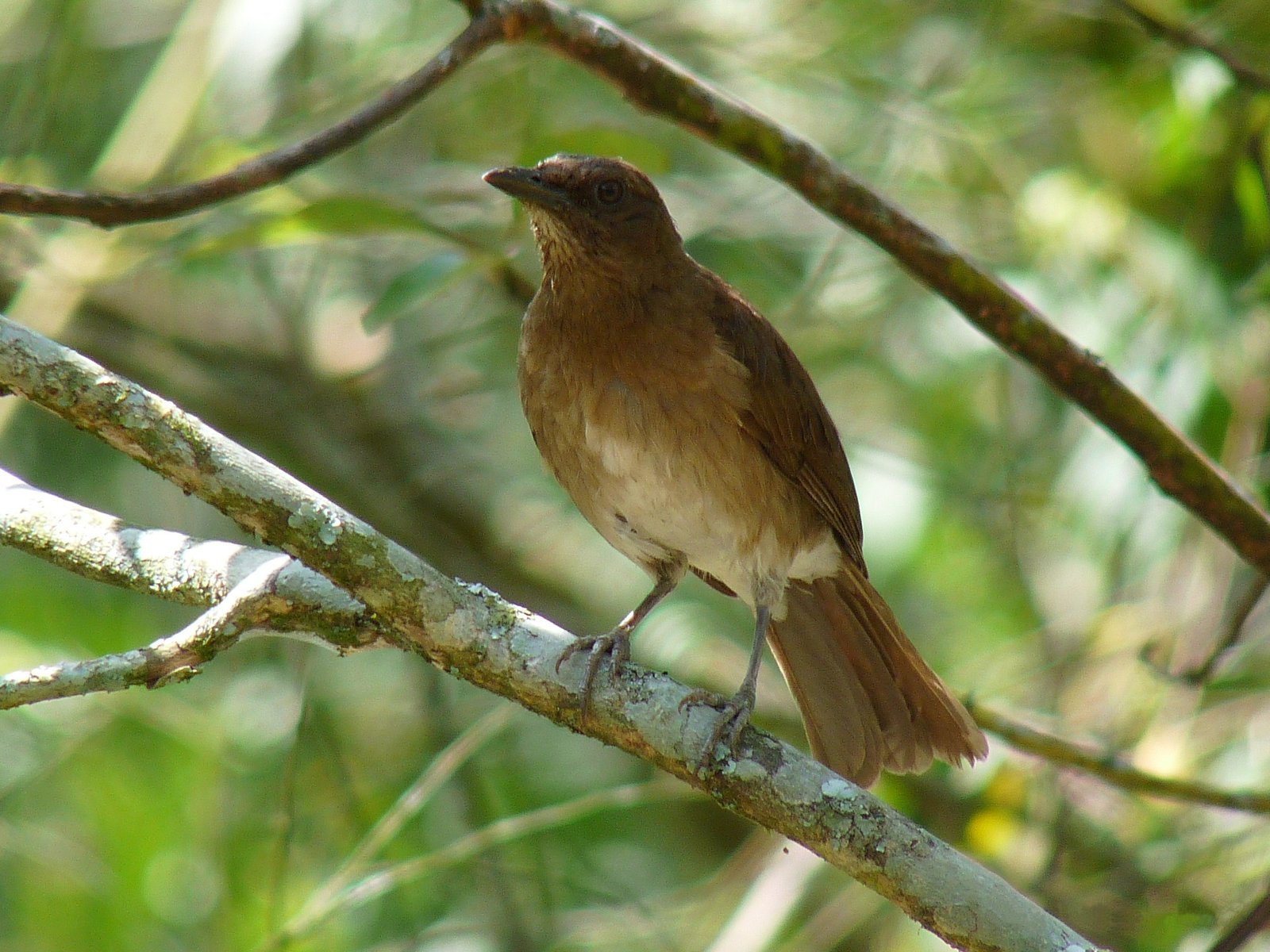
The Black-billed Thrush is a plain, olive-brown thrush with a dark bill, widespread in northern South America. It lives in semi-open landscapes: forest edges, clearings, gardens, plantations and riverbanks. In the Amazonian lowlands it is one of the most frequently heard thrushes around villages and clearings.
Voice
The song is a rather weak, monotonous series of short, fluty phrases, often kept up for a long time in the early morning and evening. The call is a rising wheep and a dry chuk.
Recording: JAYRSON ARAUJO DE OLIVEIRA — CC BY-NC-SA 4.0 · xeno-canto
Identification
21–23 cm. The upperparts are plain olive-brown to greyish brown. The throat is whitish with brown streaks, the breast and flanks pale greyish brown, and the centre of the belly and the undertail coverts white. The bill is blackish and the legs dark greyish brown; there is no eye-ring. The sexes are alike. Young birds have pale spots on the upperparts and dark spots on the breast. The Andean populations in Colombia are somewhat darker and greyer than those of the lowlands.
Confusion species
Hauxwell's Thrush Turdus hauxwelli is warmer rufous-brown, with buff flanks, and lives more in the forest interior. Pale-vented Thrush Turdus obsoletus is darker brown, with a more sharply defined white belly. Cocoa Thrush Turdus fumigatus is rufous-brown. Lawrence's Thrush Turdus lawrencii has a yellow bill and eye-ring. Creamy-bellied Thrush Turdus amaurochalinus has blackish lores and, in the breeding season, a yellow bill.
Habitat
Forest edges, clearings with scattered trees, riparian woodland, várzea, riverbanks, plantations, gardens and villages, from the lowlands up to about 2500 m in the Colombian Andes. It searches the ground for insects and earthworms and the trees for fruit. The nest is a cup in a tree, shrub or on a building.
Where the bird is most at home, classified by the vegetation units of the Andes and the west coast.


Range and movements
In Colombia widespread in the Andean valleys and on the slopes, such as in the Cauca and Magdalena valleys, and in the lowlands east of the Andes. In Ecuador in the Amazonian lowlands and the foothills of the eastern slope. In Peru in the Amazonian lowlands and the foothills. In Bolivia in the northern and central lowlands. Absent from the Galápagos. Outside the guide area in Venezuela, the Guianas and western Brazil.
- Resident
- dark = core range, pale = thinly spread
How and when to look
Look in gardens, around houses and along forest edges in villages of the Amazonian lowlands or in the Colombian Andean valleys; birds often sing from a visible perch in the early morning.
Conservation status
Not Evaluated in its current circumscription. Common and widespread, and benefits from semi-open landscapes around settlements.
Scientific name
Turdus ignobilis | Sclater, 1858
Sclater described the species in 1858 and placed it straight away in the genus where it still stands. The genus Turdus was introduced in 1758 by Linnaeus. The genus name comes from Latin turdus, 'thrush'. The species name comes from Latin ignobilis, 'undistinguished, obscure'. The specimen the first description was based on came from Bogotá, Colombia.