All species › Passerines › Thrushes and allies › Maranon Thrush
Maranon Thrush | Turdus maranonicus
Marañónlijster | Zorzal del Marañón | Sabiá-do-marañón
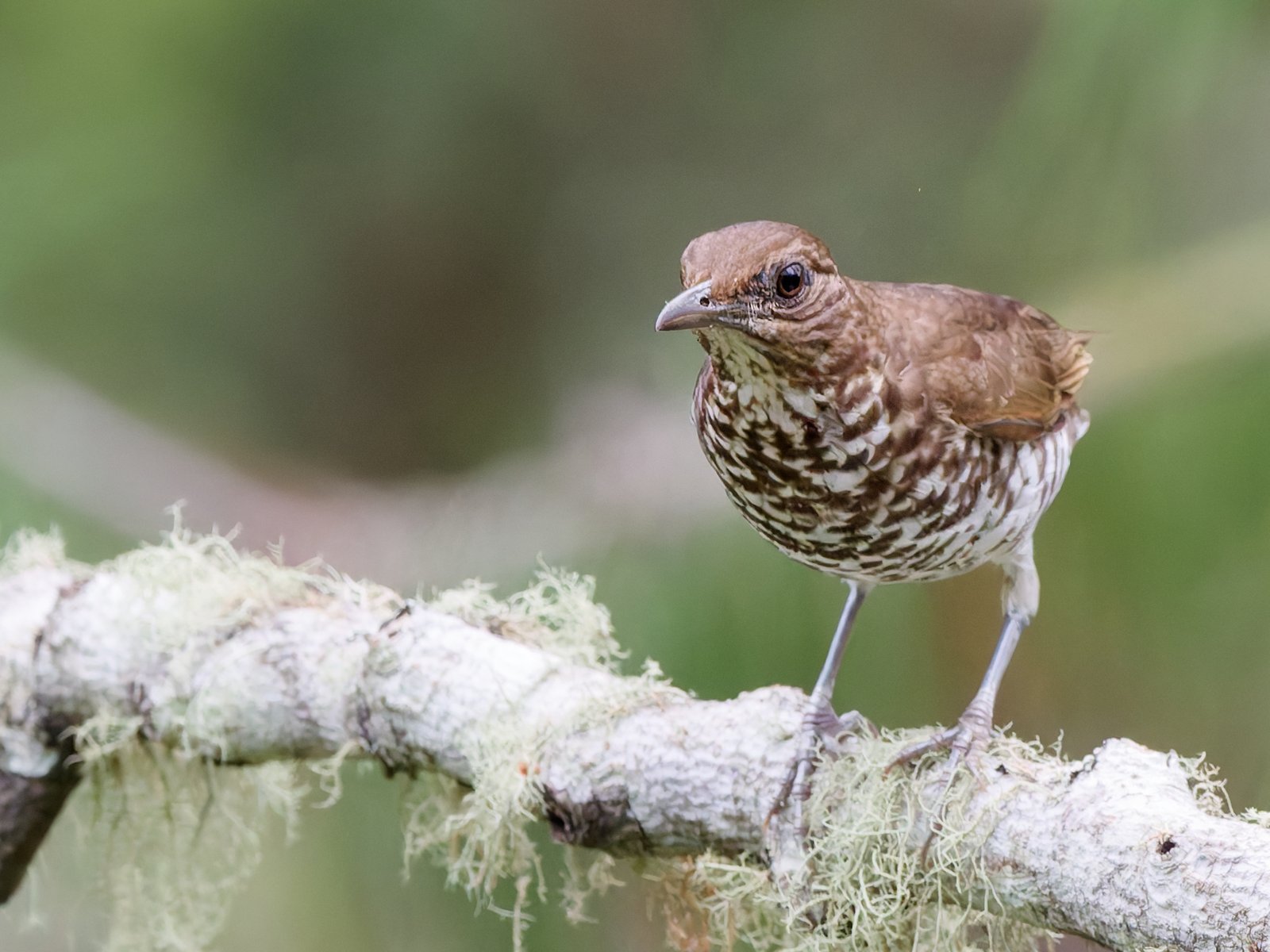
The Maranon Thrush is the only Turdus in the guide area with white, heavily dark-scaled underparts. It occurs only in the valley of the Marañón and its tributaries in northern Peru and the far south of Ecuador. There it lives in dry forest, riparian woodland and orchards.
Voice
The song is a series of clear, fluty phrases, varied and often kept up for a long time, mainly in the rainy season. The call is a dry chuk.
Recording: Lelis Navarrete — CC BY-NC-SA 4.0 · xeno-canto
Identification
21–22 cm. The upperparts are plain brown to olive-brown. The underparts are white, covered on the throat, breast and flanks with large, dark brown, scale-like spots; the belly is whiter. The bill is dark with a paler lower mandible, and the legs are greyish. There is no eye-ring. The sexes are alike. Young birds also have pale spots on the upperparts.
Confusion species
Swainson's Thrush Catharus ustulatus, a northern winter visitor, is smaller, with a buff eye-ring and spots confined to the breast. Grey-cheeked Thrush Catharus minimus is also smaller, with grey cheeks and few spots on the flanks. Ecuadorian Thrush Turdus maculirostris and Chiguanco Thrush Turdus chiguanco, which occur in the same valley, lack scaled underparts.
Habitat
Dry and semi-humid deciduous forest, riparian woodland along rivers and streams, scrub with trees, orchards, coffee plantings and gardens, roughly between 300 and 2400 m. It searches the ground and trees for insects and fruit. The nest is a cup in a tree or shrub.
Where the bird is most at home, classified by the vegetation units of the Andes and the west coast.


Range and movements
In Peru in the Marañón valley and its side valleys, in Cajamarca, Amazonas, La Libertad and adjacent departments. In Ecuador only in the far south, in the Chinchipe valley in Zamora-Chinchipe. Absent from Colombia, Bolivia and the Galápagos. It does not occur outside the guide area.
- Resident
- dark = core range, pale = thinly spread
How and when to look
Look in the dry Marañón valleys, for example around Jaén and Bagua in Peru, or near Zumba in Ecuador, in orchards and riparian woodland, mainly in the early morning.
Conservation status
Least Concern. The species has a small range, but tolerates semi-open farmland with trees.
Scientific name
Turdus maranonicus | Taczanowski, 1880
Taczanowski described the species in 1880 and placed it straight away in the genus where it still stands. The genus Turdus was introduced in 1758 by Linnaeus. The genus name comes from Latin turdus, 'thrush'. The species name refers to the Marañón valley in northern Peru, not necessarily the type locality. The specimen the first description was based on came from Callacate, Peru.