All species › Jacamars and puffbirds › Puffbirds › Black-breasted Puffbird
Black-breasted Puffbird | Notharchus pectoralis
Zwartborstbaardkoekoek | Buco pechinegro | Macuru-de-peito-preto
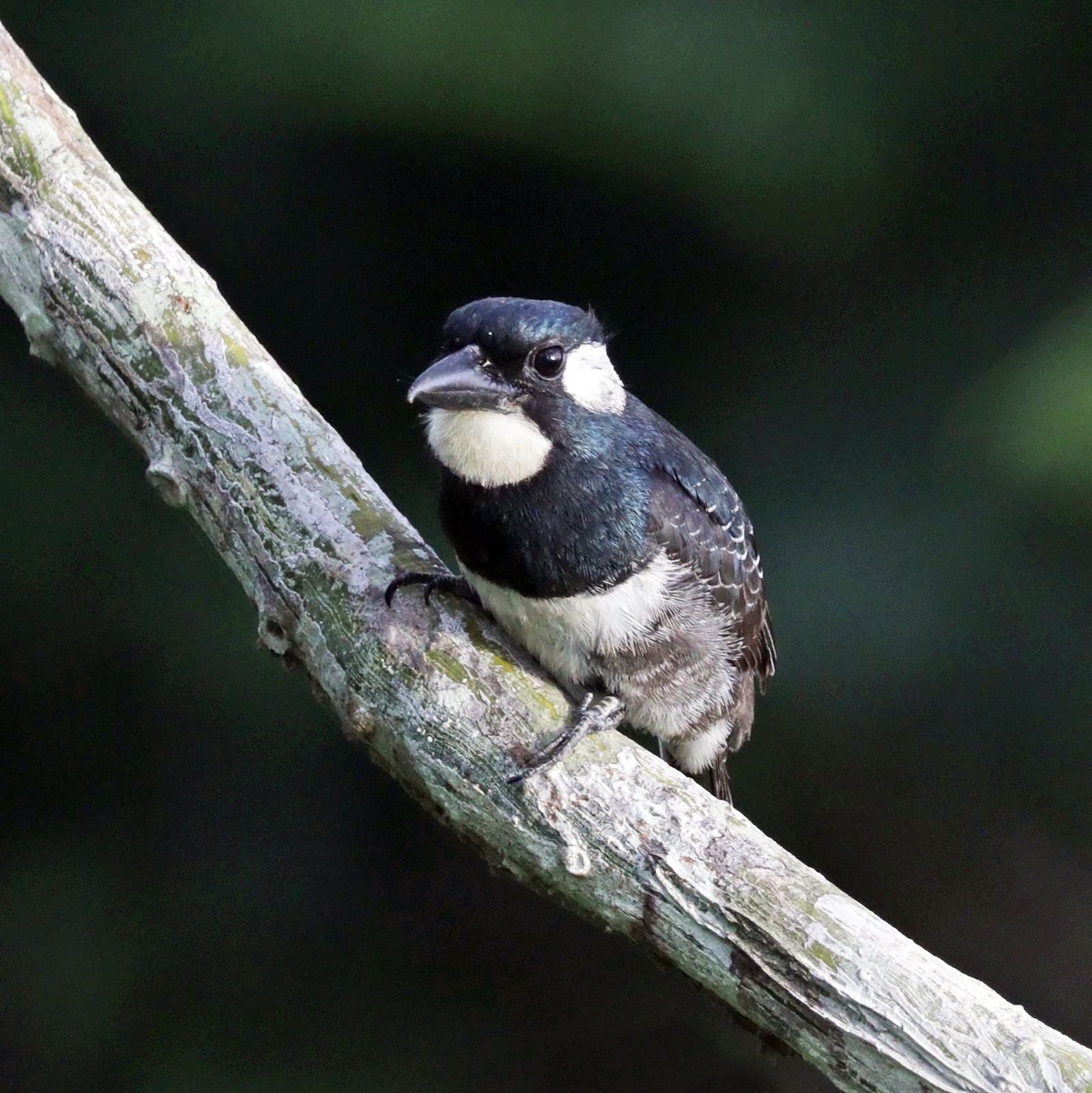
The Black-breasted Puffbird is a glossy blue-black puffbird with a white cheek patch, of the humid lowland forest of the Chocó. It sits motionless high in the canopy or at the forest edge and draws attention mainly through its long, whistled song. In the guide area it is restricted to western Colombia and north-western Ecuador.
Voice
A long series of clear, whistled notes like kwee-kwee-kwee, which first rises, then slowly falls and slows down, ending in a few drawn-out, falling notes.
Recording: Tuomas Seimola — CC BY-NC-SA 4.0 · xeno-canto
Identification
19–20 cm, with a large head and a heavy, hook-tipped black bill. The head and upperparts are glossy blue-black, with a large white patch on the ear coverts. The throat is white. A broad black band covers the breast; the belly is white with a buff wash and the flanks are lightly barred. The sexes are alike.
Confusion species
White-necked Puffbird Notharchus hyperrhynchus is larger, with a white forehead, a broad white collar and a narrower breast band. Pied Puffbird Notharchus tectus is much smaller, with a narrow white eyebrow, a white scapular stripe and no large white cheek patch.
Habitat
The canopy and edges of humid and very wet lowland forest, tall secondary forest and clearings with tall trees, up to about 1000 m. It perches high on an open branch and sallies for large insects and other invertebrates. It nests in a cavity in an arboreal termite nest.
Where the bird is most at home, classified by the vegetation units of the Andes and the west coast.


Range and movements
In Colombia in the Pacific lowlands and in the north-west, east to the lower Cauca and Magdalena valleys. In Ecuador only in the north-west, mainly in Esmeraldas. Absent from Peru, Bolivia and the Galápagos. Outside the guide area in central and eastern Panama.
- Resident
- dark = core range, pale = thinly spread
How and when to look
In the Chocó, search for birds on bare branches from roads and clearings with a view over the canopy; the song is heard mainly in the morning.
Conservation status
Least Concern. The range is fairly small; locally the species suffers from the logging of lowland forest in the Chocó.
Scientific name
Notharchus pectoralis | (Gray, 1846)
Gray described the species in 1846 as Bucco pectoralis; because it was later moved to another genus, the author and year stand in brackets. The genus Notharchus was introduced in 1863 by Cabanis & Heine. The genus name combines Greek nōthēs, 'sluggish', and arkhos, 'leader' or 'chief'. The species name pectoralis comes from Latin pectus, 'breast', and refers to the black breast band. The specimen the first description was based on came from (per the description).