All species › Jacamars and puffbirds › Puffbirds › Brown-banded Puffbird
Brown-banded Puffbird | Notharchus ordii
Bruinbandbaardkoekoek | Buco pechipardo | Macuru-de-peito-marrom
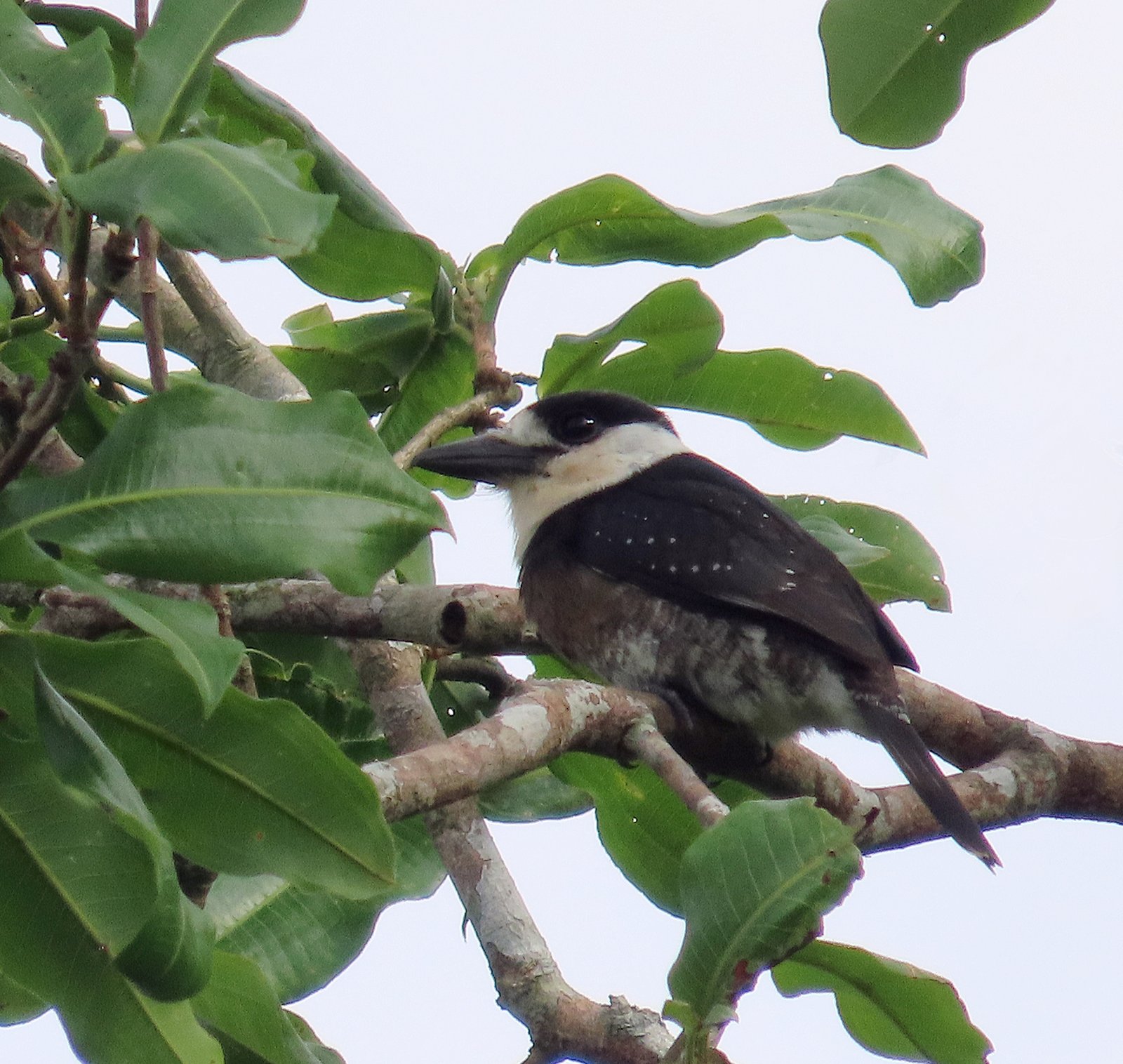
The Brown-banded Puffbird is a black-and-white puffbird of Amazonia, recognisable by the brown band below the black breast band. It is patchily distributed and local, with a preference for forest on poor white-sand soils. Like its relatives it sits still for long periods high in the canopy.
Voice
A series of clear whistles that first rises in pitch and then falls again, sometimes as a duet; also single, plaintive whistles.
Recording: JAYRSON ARAUJO DE OLIVEIRA — CC BY-NC-SA 4.0 · xeno-canto
Identification
20–21 cm, with a large head and a heavy, hook-tipped black bill. The crown, eye area, back, wings and tail are black; the forehead is white. The throat and sides of the neck are white. A black band crosses the breast, with a broader brown band below it. The belly is white and the flanks are barred black. The sexes are alike.
Confusion species
White-necked Puffbird Notharchus hyperrhynchus is larger, with a broad white collar and no brown band on the breast. Pied Puffbird Notharchus tectus is smaller, with a narrow white eyebrow, a white scapular stripe and white spots in the tail.
Habitat
The canopy and edges of tall lowland forest, especially white-sand forest and its low, open forms, locally also terra firme and várzea edges, up to about 500 m. It perches high on an open branch and sallies for large insects. It probably nests, like related species, in a cavity in a termite nest.
Where the bird is most at home, classified by the vegetation units of the Andes and the west coast.


Range and movements
In Colombia very locally in the far east. In Peru locally in the north-eastern Amazonian lowlands. In Bolivia very locally in the northern lowlands. Absent from Ecuador and the Galápagos. Outside the guide area in southern Venezuela and patchily in Amazonian Brazil.
- Resident
- dark = core range, pale = thinly spread
How and when to look
In white-sand forest, such as around Iquitos in Peru, search for birds on bare branches above the canopy from clearings or a canopy tower.
Conservation status
Least Concern. The species is patchy and local, but the range is large and still largely forested.
Scientific name
Notharchus ordii | (Cassin, 1851)
Cassin described the species in 1851 as Bucco Ordii; because it was later moved to another genus, the author and year stand in brackets. The genus Notharchus was introduced in 1863 by Cabanis & Heine. The genus name combines Greek nōthēs, 'sluggish', and arkhos, 'leader' or 'chief'. The species name ordii honours George Ord (1781–1866), American naturalist, collector and philologist. The specimen the first description was based on came from Venezuela.