All species › Jacamars and puffbirds › Puffbirds › Pied Puffbird
Pied Puffbird | Notharchus tectus
Bonte baardkoekoek | Buco pío | Macuru-pintado
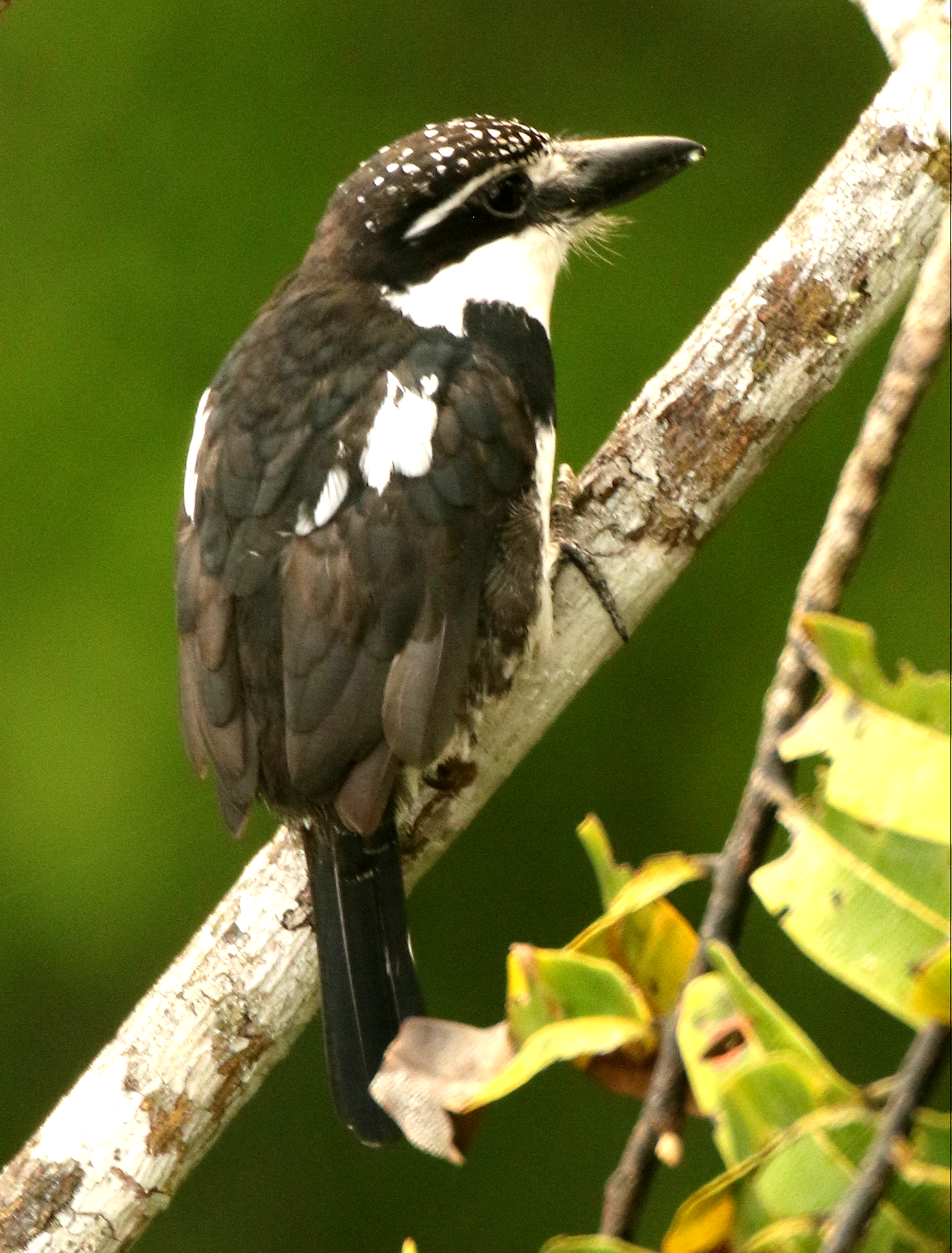
The Pied Puffbird is the smallest black-and-white puffbird of the guide area. It often sits in pairs on open branches at forest edges and above clearings. There are two separate groups, one west and one east of the Andes, which are treated as separate species in some classifications.
Voice
A series of high, thin whistles like pee-pee-pee-pee-peew-peew, often falling at the end; often sung by two birds together.
Recording: JAYRSON ARAUJO DE OLIVEIRA — CC BY-NC-SA 4.0 · xeno-canto
Identification
14–16 cm, with a large head and a heavy, hook-tipped black bill. The upperparts are black; a narrow white eyebrow runs back from the forehead and the crown is finely dotted white. There is a white stripe on the scapulars and the tail has white spots. The throat and underparts are white, with a black breast band and black-barred flanks. The sexes are alike.
Confusion species
White-necked Puffbird Notharchus hyperrhynchus is much larger, with a broad white forehead and a white collar, and lacks the white scapular stripe. Black-breasted Puffbird Notharchus pectoralis in the west is larger, with a large white cheek patch and a broader black breast. Brown-banded Puffbird Notharchus ordii in the east is larger, with a brown band below the black breast band.
Habitat
Forest edges, clearings with tall trees, várzea and riverine forest, secondary forest, shaded plantations and mangrove edges, in the lowlands up to about 600 m. It perches on an open branch in the middle or upper storey and sallies for insects. It nests in a cavity in an arboreal termite nest.
Where the bird is most at home, classified by the vegetation units of the Andes and the west coast.


Range and movements
In Colombia in the Pacific lowlands and in the eastern lowlands east of the Andes. In Ecuador in the western lowlands and in the eastern lowlands. In Peru in the Amazonian lowlands, mainly in the north. In Bolivia unknown or barely known. Absent from the Galápagos. Outside the guide area in Costa Rica and Panama in the west and in Venezuela, the Guianas and Amazonian Brazil in the east.
- Resident
- dark = core range, pale = thinly spread
How and when to look
Look along riverbanks, forest edges and clearings with tall, bare trees for small black-and-white birds sitting upright; they often stay on the same branch for a long time.
Conservation status
Not Evaluated in the classification followed here, which combines the western and eastern groups. The species as a whole is widespread and tolerates semi-open country well.
Scientific name
Notharchus tectus | (Boddaert, 1783)
Boddaert described the species in 1783 as Bucco tectus; because it was later moved to another genus, the author and year stand in brackets. The genus Notharchus was introduced in 1863 by Cabanis & Heine. The genus name combines Greek nōthēs, 'sluggish', and arkhos, 'leader' or 'chief'. The species name tectus is Latin for 'covered' or 'concealed', from tegere, 'to cover'. The specimen the first description was based on came from Cayenne, French Guiana.