All species › Woodpeckers and allies › New World barbets › Lemon-throated Barbet
Lemon-throated Barbet | Eubucco richardsoni
Citroenkeelbaardvogel | Cabezón golilimón | Capitão-de-bigode-limão
The Lemon-throated Barbet is the small barbet of the Amazonian lowlands at the foot of the Andes. It lives high in the canopy and often travels with mixed flocks of tanagers and other songbirds. With its thick, pale bill it searches clusters of dead leaves for insects, and it also eats much fruit.
Voice
The song is a rapid, low, frog-like trill lasting a few seconds, repeated at intervals. Also soft, hoarse calls.
Recording: John V. Moore — CC BY-NC-SA 4.0 · xeno-canto
Identification
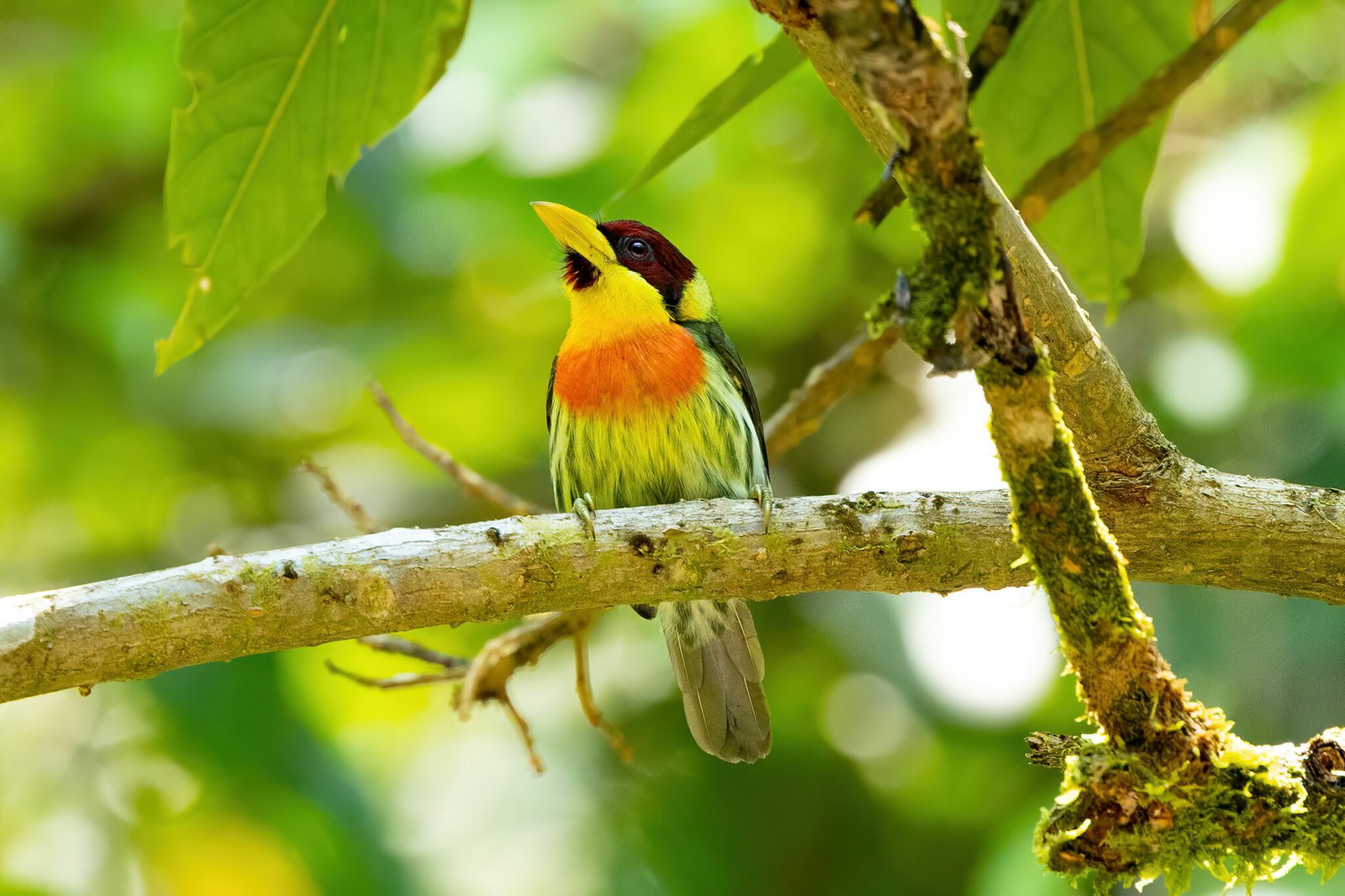
15 cm, stocky, with a short tail and a thick, conical, yellowish-green bill. The male has a black forehead and face, a red crown, a blue-grey nape, a lemon-yellow throat and an orange to orange-red breast; the belly is yellowish with green streaks on the flanks and the upperparts are green. The female has a black forehead, a blue-grey face, an olive-green crown, a greyish-yellow throat and a yellow-orange breast band. South of the Amazon birds are warmer orange on the breast. Juveniles are duller.
Confusion species
Scarlet-hooded Barbet Eubucco tucinkae is larger; the male has an all-red head and a yellow nape band, and the species lives mainly in riverine forest in south-eastern Peru and northern Bolivia. Red-headed Barbet Eubucco bourcierii lives higher, in montane and foothill forest; the male has an all-red head and breast without a black face. Gilded Barbet Capito auratus is larger, with a heavier bill and black upperparts.
Habitat
Humid lowland rainforest on terra firme and in várzea, forest edges and tall secondary forest, from the lowlands up to about 1000 m, locally higher in the foothills. It forages in the middle and upper canopy, often in mixed flocks, eating fruit, insects and spiders, which it pulls from curled dead leaves. It nests in a self-excavated cavity in dead wood.
Where the bird is most at home, classified by the vegetation units of the Andes and the west coast.


Range and movements
In Colombia in the Amazonian lowlands east of the Andes (Caquetá, Putumayo, Amazonas, Vaupés). In Ecuador throughout the eastern lowlands and foothills. In Peru in the Amazonian lowlands over almost the whole country. In Bolivia in the northern lowlands (Pando, Beni and northern La Paz). Absent from the Galápagos. Outside the guide area in western Amazonian Brazil.
- Resident
- dark = core range, pale = thinly spread
How and when to look
Follow mixed canopy flocks along forest edges and from canopy towers, for example at the lodges along the Napo or in Manu and Tambopata. Watch for birds working upside down in dead-leaf clusters; the trilling song gives the species away.
Conservation status
Not evaluated in its current circumscription. The species has a large range in the Amazonian lowlands and is fairly common in suitable forest; forest loss is the main threat.
Scientific name
Eubucco richardsoni | (Gray, 1846)
Gray described the species in 1846 as Capito richardsoni; because it was later moved to another genus, the author and year stand in brackets. The genus Eubucco was introduced in 1850 by Bonaparte. The genus name combines Greek eu, 'good' or 'true', with the genus name Bucco (Latin bucca, 'cheek'). The species name honours Sir John Richardson (1787–1865), Scottish surgeon, explorer, zoologist, botanist and geologist. The specimen the first description was based on came from Ecuador.