All species › Woodpeckers and allies › New World barbets › Scarlet-hooded Barbet
Scarlet-hooded Barbet | Eubucco tucinkae
Carabayabaardvogel | Cabezón de Carabaya | Capitão-de-colar-amarelo
The Scarlet-hooded Barbet is a barbet of the south-western Amazon basin, with the core of its range in south-eastern Peru. Its Spanish and Dutch names refer to the province of Carabaya in Puno, where the species was discovered. More than its relatives it is tied to forest along rivers.
Voice
A rapid, low, frog-like trill, similar to that of Lemon-throated Barbet. Also soft, hoarse calls.
Recording: Felipe Arantes — CC BY-NC-SA 4.0 · xeno-canto
Identification
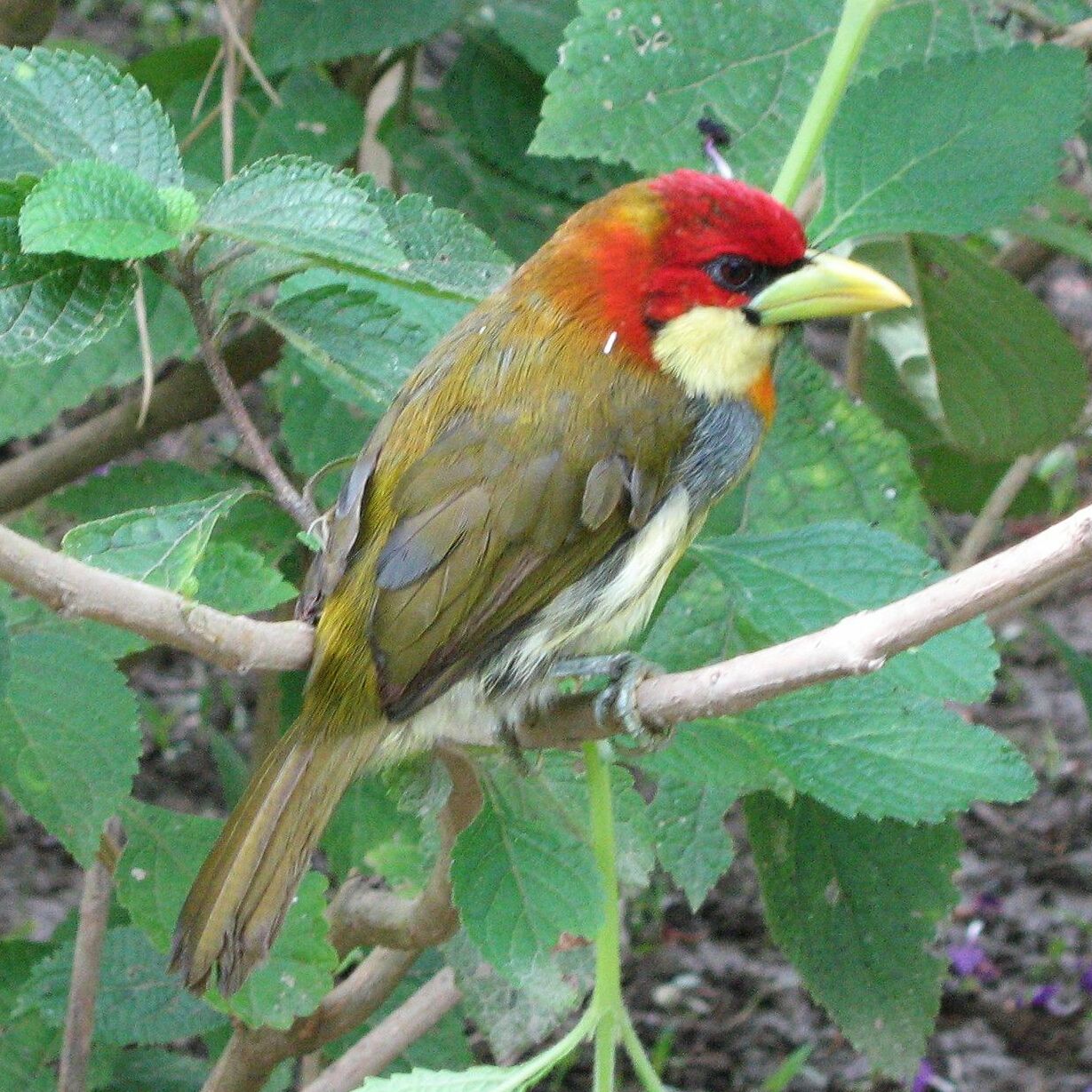
17 cm, stocky, with a thick, yellowish bill. The male has an all-scarlet head and throat with a narrow black edge at the base of the bill, a golden-yellow band across the hindneck, green upperparts, an orange-red breast and a yellow belly with green streaks on the flanks. The female resembles the male but is duller, with less extensive red on the head and a greyish wash on the cheeks and throat. Juveniles are duller and greener.
Confusion species
Lemon-throated Barbet Eubucco richardsoni is smaller; the male has a black face, a red crown and a lemon-yellow throat, and it lives more often in terra firme forest. Gilded Barbet Capito auratus is larger, with black upperparts and an orange to yellow throat.
Habitat
Riverine forest, várzea forest, forest on riverbanks and river islands, forest edges with Cecropia and bamboo in the transition to terra firme forest, in the lowlands up to about 500 m. It forages in the middle and upper canopy, often in mixed flocks, eating fruit and insects taken from dead leaves. It nests in a cavity in dead wood.
Where the bird is most at home, classified by the vegetation units of the Andes and the west coast.


Range and movements
In Peru in the south-eastern lowlands (Madre de Dios, eastern Cusco and Puno, locally Ucayali). In Bolivia in the northern lowlands (Pando, northern La Paz and Beni). Absent from Colombia, Ecuador and the Galápagos. Outside the guide area in western Brazil (Acre and south-western Amazonas).
- Resident
- dark = core range, pale = thinly spread
How and when to look
Search riverine forest and vegetated riverbanks along the Madre de Dios, the Tambopata and the Manu, where the bird moves through the canopy with mixed flocks. The trilling song can be heard all year.
Conservation status
Least Concern. The species has a fairly small range but is not rare in suitable riverine forest; logging and gold mining along rivers are local threats.
Scientific name
Eubucco tucinkae | (Seilern-Aspang, 1913)
Seilern-Aspang described the species in 1913 as Capito tucinkae; because it was later moved to another genus, the author and year stand in brackets. The genus Eubucco was introduced in 1850 by Bonaparte. The genus name combines Greek eu, 'good' or 'true', with the genus name Bucco (Latin bucca, 'cheek'). The species name comes from the Moravian Czech pet name tucinka, used mainly for female domestic animals and sometimes for a young girl; the describer, von Seilern, did not explain the name, but probably honoured his first daughter Ilona (b. 1913). The specimen the first description was based on came from Yahuarmayo, Carabaya, Puno, Peru.