All species › Swifts › Hummingbirds › Black-breasted Puffleg
Black-breasted Puffleg | Eriocnemis nigrivestis
Zwartborstpluimbroekje | Calzadito pechinegro | Calçudo-de-peito-preto
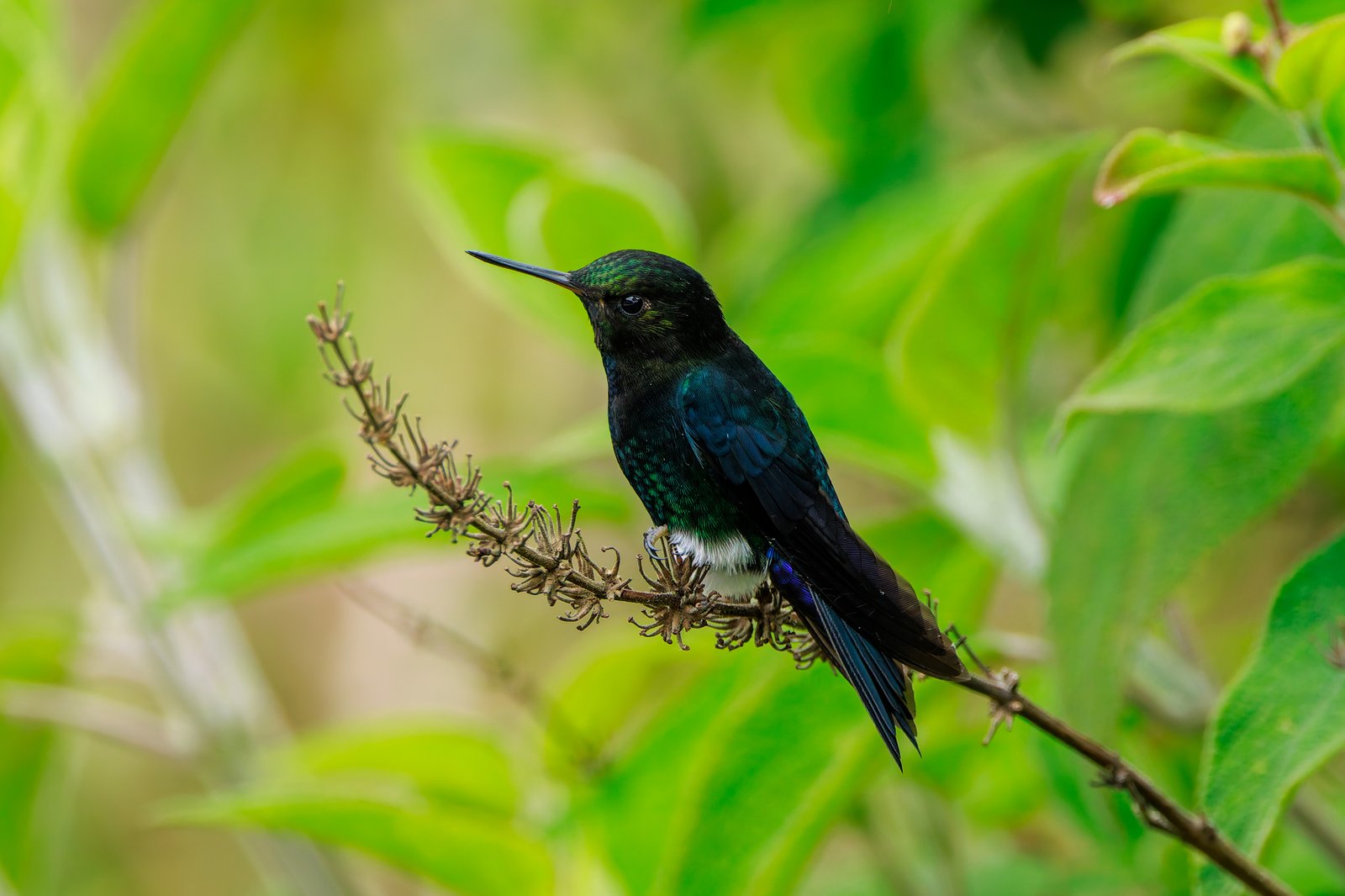
The Black-breasted Puffleg is a small puffleg found only on a few ridges in north-western Ecuador. The male is mostly black, with a violet-blue throat patch and white leg puffs. The species is endangered and since 2005 has been the emblem of the city of Quito.
Voice
A high, sharp tseet and a rapid twitter in chases.
Recording: Mery Juiña — CC BY-NC-SA 4.0 · xeno-canto
Identification
8–9 cm, with a straight black bill and a forked tail. The male is black above and below, with a violet-blue throat patch, violet-blue undertail coverts and dark blue uppertail coverts. The female is bronze-green above, with a blue-green rump, golden-green underparts and a pale blue chin. Both sexes have white, downy leg puffs.
Confusion species
Glowing Puffleg Eriocnemis vestita lives in the same area; the male is glittering green, not black, with a glittering green rump. Sapphire-vented Puffleg Eriocnemis luciani is larger and green, with a longer tail. Black-thighed Puffleg Eriocnemis derbyi is dark green, with black instead of white leg puffs. Metaltails such as Tyrian Metaltail Metallura tyrianthina have a rufous tail and no conspicuous leg puffs.
Habitat
Humid and wet cloud forest, forest edges and low, dense vegetation on the ridges, roughly between 1700 and 3500 m. In the breeding season, from November to February, mainly above 3100 m; from April to September lower, around 2400 to 3000 m. It visits the flowers of ericaceous plants, fuchsias and bromeliads, and especially those of Palicourea fuchsioides; it also catches small insects.
Where the bird is most at home, classified by the vegetation units of the Andes and the west coast.


Range and movements
In Ecuador only in the north-west, on the ridges of Pichincha volcano and in the Cordillera de Toisán in Imbabura and Esmeraldas. Absent from Colombia, Peru, Bolivia and the Galápagos. Does not occur outside the guide area.
- Resident
- dark = core range, pale = thinly spread
How and when to look
The western slope of Pichincha above Quito, where the Yanacocha reserve lies, is the place where the species is most often searched for. Sightings there are scarce and irregular, and the elevational range shifts with the season.
Conservation status
Endangered. The population is estimated at only 100 to 150 birds, in an area of about 100 km². Clearance for farming and cattle, logging, fires and the construction of an oil pipeline have degraded most of its original habitat.
Scientific name
Eriocnemis nigrivestis | (Bourcier & Mulsant, 1852)
Bourcier & Mulsant described the species in 1852 as Trochilus nigrivestis; because it was later moved to another genus, the author and year stand in brackets. The genus Eriocnemis was introduced in 1849 by Reichenbach. The genus name combines Greek erion, 'wool', with knēmis, 'legging', after the downy feather tufts on the legs. The species name combines Latin niger, 'black', with vestis, 'garment': 'black-clad'. The specimen the first description was based on came from Tumbaco, Pichincha, Ecuador.