All species › Swifts › Hummingbirds › Marvelous Spatuletail
Marvelous Spatuletail | Loddigesia mirabilis
Vlagkolibrie | Colibrí cola de espátula | Beija-flor-de-cauda-de-espátula
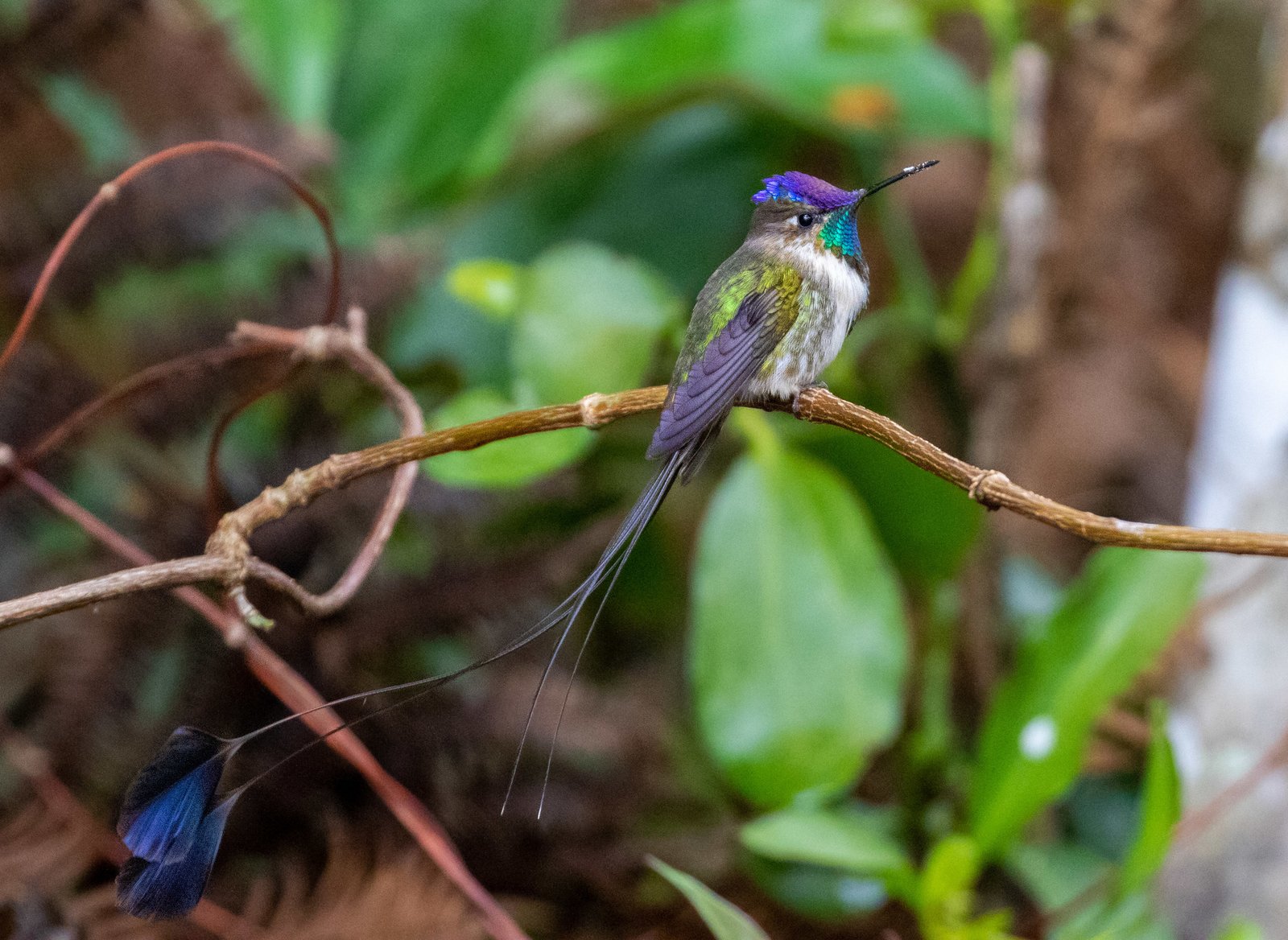
The Marvelous Spatuletail is a small hummingbird found only in northern Peru, mainly in the Utcubamba valley. The male has two elongated outer tail feathers with bare shafts that cross each other and end in large, dark rackets. At fixed display sites, where several males gather, it shows these rackets in a display flight.
Voice
During display a repeated, high, buzzy, metallic note; also a sweet upslurred whistle and a sharper call.
Recording: Jerome Fischer — CC BY-NC-SA 4.0 · xeno-canto
Identification
Male 15–17 cm including the tail, female 9–10 cm; the bill is short, black and slightly decurved. Both sexes have a white spot behind the eye. The male is green above, with a glittering blue crown, a brownish hindneck, a glittering blue-green throat and white underparts with a black central stripe. The two outer tail feathers are greatly elongated, with bare shafts and large, dark rackets at the tips. The female is green above and white below, without throat patch or central stripe, and has shorter outer tail feathers without rackets.
Confusion species
The male is unmistakable. Females resemble female racket-tails, such as Peruvian Racket-tail Ocreatus peruanus, but these have green spots on the underparts and downy leg puffs. Trainbearers such as Green-tailed Trainbearer Lesbia nuna have a long, deeply forked tail without rackets.
Habitat
Forest edges, secondary forest and montane scrub, especially dense thickets of thorny Rubus mixed with alder (Alnus), roughly between 2100 and 2900 m. It feeds along a fixed route of flowering plants and often visits the red flowers of Bomarea formosissima; other hummingbirds often chase it from flowers. The breeding season probably falls mainly from December to February.
Where the bird is most at home, classified by the vegetation units of the Andes and the west coast.


Range and movements
In Peru only in the north, mainly in the Utcubamba valley in the Amazonas region, with a few records further east in San Martín. Absent from Colombia, Ecuador, Bolivia and the Galápagos. Does not occur outside the guide area.
- Resident
- dark = core range, pale = thinly spread
How and when to look
In the Utcubamba valley, especially around Pomacochas, where birds visit feeders and flowering shrubs along forest edges. Males with full tail rackets are seen mainly in the breeding season.
Conservation status
Near Threatened. The species has a very small range and a small population, probably fewer than 1000 mature birds. Deforestation affects its habitat, although it also uses forest edges; males are caught locally for folk medicine. Near Pomacochas habitat is protected and restored with native trees.
Scientific name
Loddigesia mirabilis | (Bourcier, 1847)
Bourcier described the species in 1847 as Trochilus mirabilis; because it was later moved to another genus, the author and year stand in brackets. The genus Loddigesia was introduced in 1850 by Bonaparte. The genus name honours George Loddiges (1786–1846), an English nurseryman who owned a large collection of hummingbirds. The species name is Latin mirabilis, 'wonderful', after the unusual tail with long racket-tipped feathers. The specimen the first description was based on came from Chachapoyas, Amazonas, Peru.