All species › Swifts › Hummingbirds › Hoary Puffleg
Hoary Puffleg | Haplophaedia lugens
Geschubd pluimbroekje | Calzadito canoso | Calçudo-acinzentado
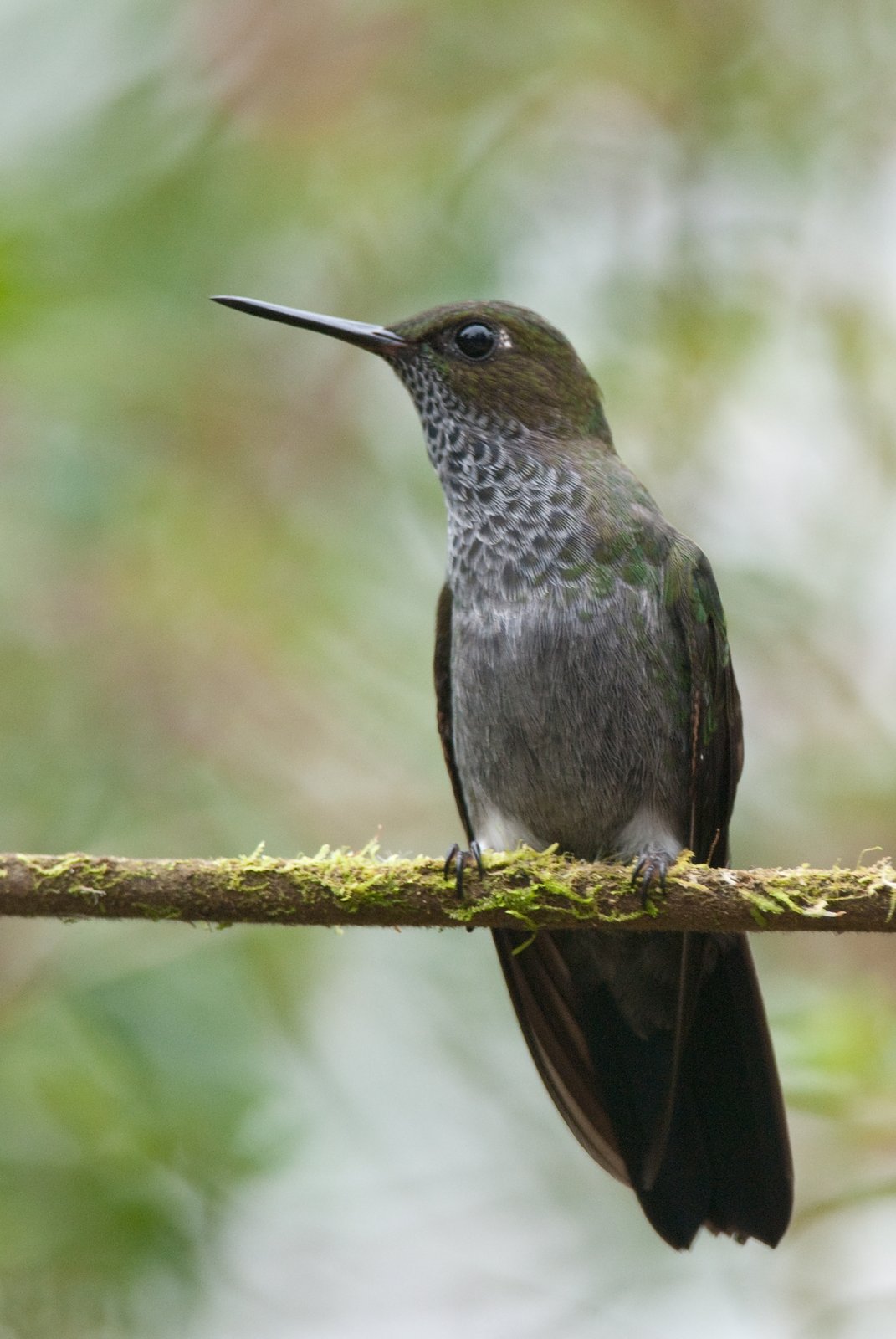
The Hoary Puffleg is a dark puffleg of the Pacific slope of the Andes in south-western Colombia and north-western Ecuador. The species has a small range in a narrow elevational band. It lives low in dense vegetation, often near streams.
Voice
A single, strident tzik or a doubled tsi-tsik, from a perch or in flight.
Recording: Olaf Jahn — CC BY-NC-SA 4.0 · xeno-canto
Identification
9–10 cm, with a straight black bill. The male is bronze-green above, with a coppery crown and rump. The underparts are dark grey, with whitish scaling on the throat and breast. The leg puffs are white on the outside and chestnut on the inside. The tail is blackish and slightly forked. The female is duller, with entirely white leg puffs. Young birds resemble the female.
Confusion species
Greenish Puffleg Haplophaedia aureliae is greener below, with less grey, and in Ecuador lives on the eastern slope. Pufflegs of the genus Eriocnemis, such as Glowing Puffleg Eriocnemis vestita, live higher and are glittering green. Speckled Hummingbird Adelomyia melanogenys also feeds low in the forest, but has spotted underparts, a dark ear patch and no leg puffs.
Habitat
Cloud forest, forest edges and scrub on the Pacific slope, usually in dense, low vegetation and often near streams, roughly between 1200 and 2100 m, in Colombia locally to 2500 m. It feeds mainly low at short-tubed flowers and defends clusters of flowers; it also gleans insects from leaves. The nest hangs under a fern or large leaf.
Where the bird is most at home, classified by the vegetation units of the Andes and the west coast.


Range and movements
In Colombia on the Pacific slope in the south-west, in Nariño. In Ecuador on the western slope of the Andes in the north, south to Pichincha. Absent from Peru, Bolivia and the Galápagos. Does not occur outside the guide area.
- Resident
- dark = core range, pale = thinly spread
How and when to look
Along forest trails and streams in cloud forest on the western slope in north-western Ecuador, low in dense vegetation. Birds often give themselves away by their strident call.
Conservation status
Near Threatened. The range is small, the population is thought to be declining because of deforestation, and the species occurs in only a few protected areas.
Scientific name
Haplophaedia lugens | (Gould, 1852)
Gould described the species in 1852 as Eriopus lugens; because it was later moved to another genus, the author and year stand in brackets. The genus Haplophaedia was introduced in 1918 by Simon. The genus name comes from Greek haploos, 'simple', and phaidros, 'shining, bright'. The species name is Latin lugens, 'mourning', probably referring to the dark, grey-scaled plumage. The specimen the first description was based on came from Quito, Ecuador.