All species › Swifts › Hummingbirds › Buff-thighed Puffleg
Buff-thighed Puffleg | Haplophaedia assimilis
Vaaldijpluimbroekje | Calzadito verdoso sureño | Calçudo-de-coxas-ocráceas
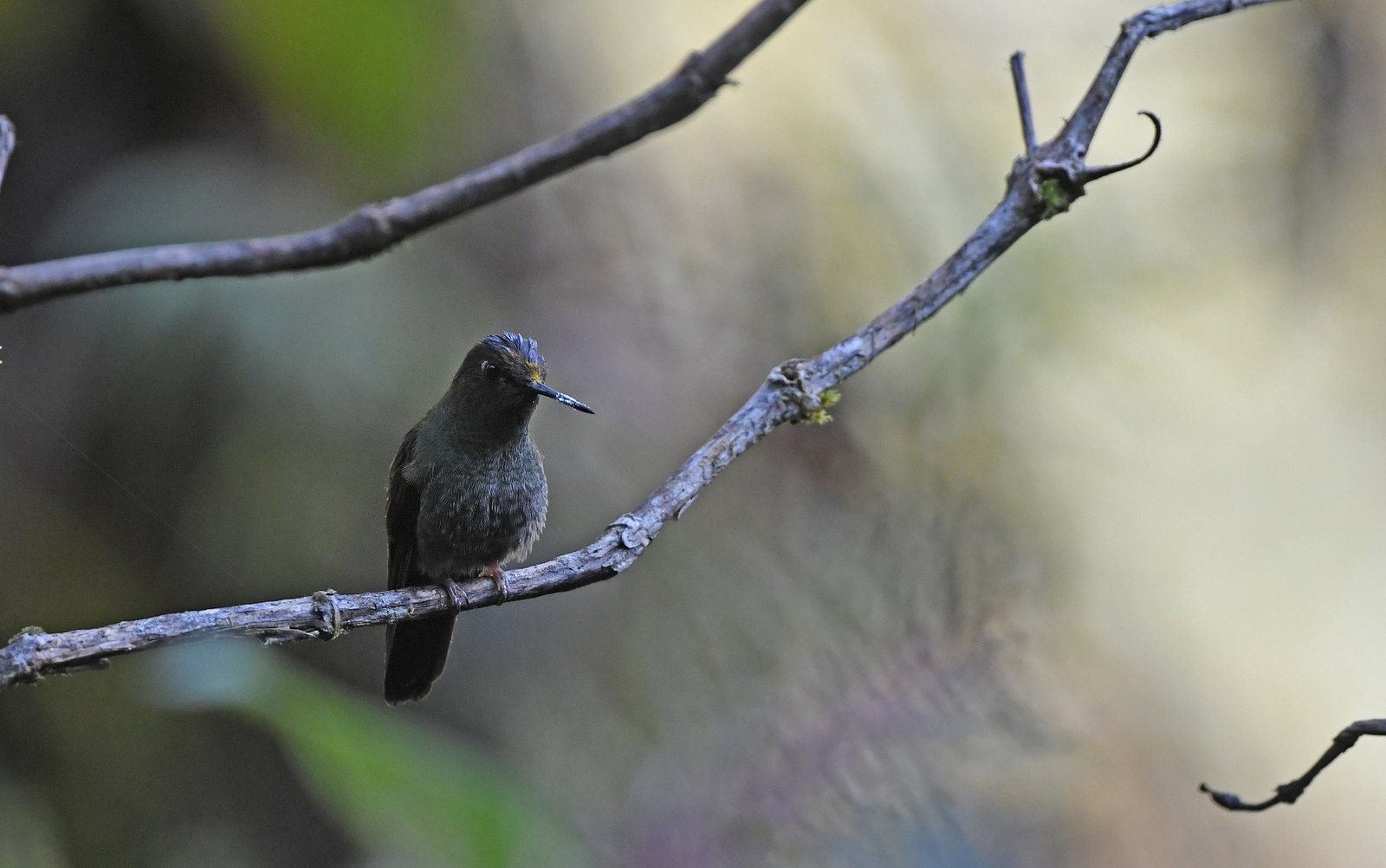
The Buff-thighed Puffleg is a small, dark green puffleg of the undergrowth of humid montane forest on the eastern slope of the Andes in Peru and Bolivia. It was formerly included in Greenish Puffleg. The name refers to the creamy to pale rufous leg puffs.
Voice
The presumed song is a repeated, sharp single note, sometimes alternated with a double call; also a dry rattle and chattering.
Recording: Jacob Wijpkema — CC BY-NC-SA 4.0 · xeno-canto
Identification
9–10 cm, with a straight black bill. Both sexes are mostly dark green, with a slightly forked, blue-black tail. In southern birds the leg puffs are creamy buff to whitish; in birds of northern and central Peru they are pale rufous and the plumage is darker, with a bluer tail. Young birds resemble the adults, with brown fringes to the feathers of the head and neck.
Confusion species
Greenish Puffleg Haplophaedia aureliae lives further north and has whiter leg puffs and more heavily scaled underparts. Pufflegs of the genus Eriocnemis usually live higher, up to the treeline, and are more glittering in colour. Rufous-booted Racket-tail Ocreatus addae also has rufous leg puffs, but the male has long tail rackets and the female is white below with green spots.
Habitat
Undergrowth and edges of humid to wet montane forest on the lower and middle slopes, between about 1500 and 3000 m, but rarely above 2500 m. It feeds low in the forest at flowers and gleans insects from leaves. Outside the breeding season it possibly moves to the lower parts of its elevational range.
Where the bird is most at home, classified by the vegetation units of the Andes and the west coast.


Range and movements
In Peru on the eastern slope of the Andes, from the north to the south. In Bolivia on the eastern slope of the Andes, south to Cochabamba. Absent from Colombia, Ecuador and the Galápagos. Does not occur outside the guide area.
- Resident
- dark = core range, pale = thinly spread
How and when to look
Along trails through montane forest on the eastern slope, for example in the Yungas of Bolivia and the montane forests of central and southern Peru, low at flowering shrubs and epiphytes.
Conservation status
Least Concern. Deforestation on the lower slopes affects its habitat locally.
Scientific name
Haplophaedia assimilis | (Elliot, 1876)
Elliot described the species in 1876 as Eriocnemis assimilis; because it was later moved to another genus, the author and year stand in brackets. The genus Haplophaedia was introduced in 1918 by Simon. The genus name comes from Greek haploos, 'simple', and phaidros, 'shining, bright'. The species name is Latin assimilis, 'similar', probably referring to its likeness to related pufflegs. The specimen the first description was based on came from Apolo and Tilotilo, Bolivia.