All species › Swifts › Hummingbirds › Greenish Puffleg
Greenish Puffleg | Haplophaedia aureliae
Aureliapluimbroekje | Calzadito verdoso | Calçudo-esverdeado
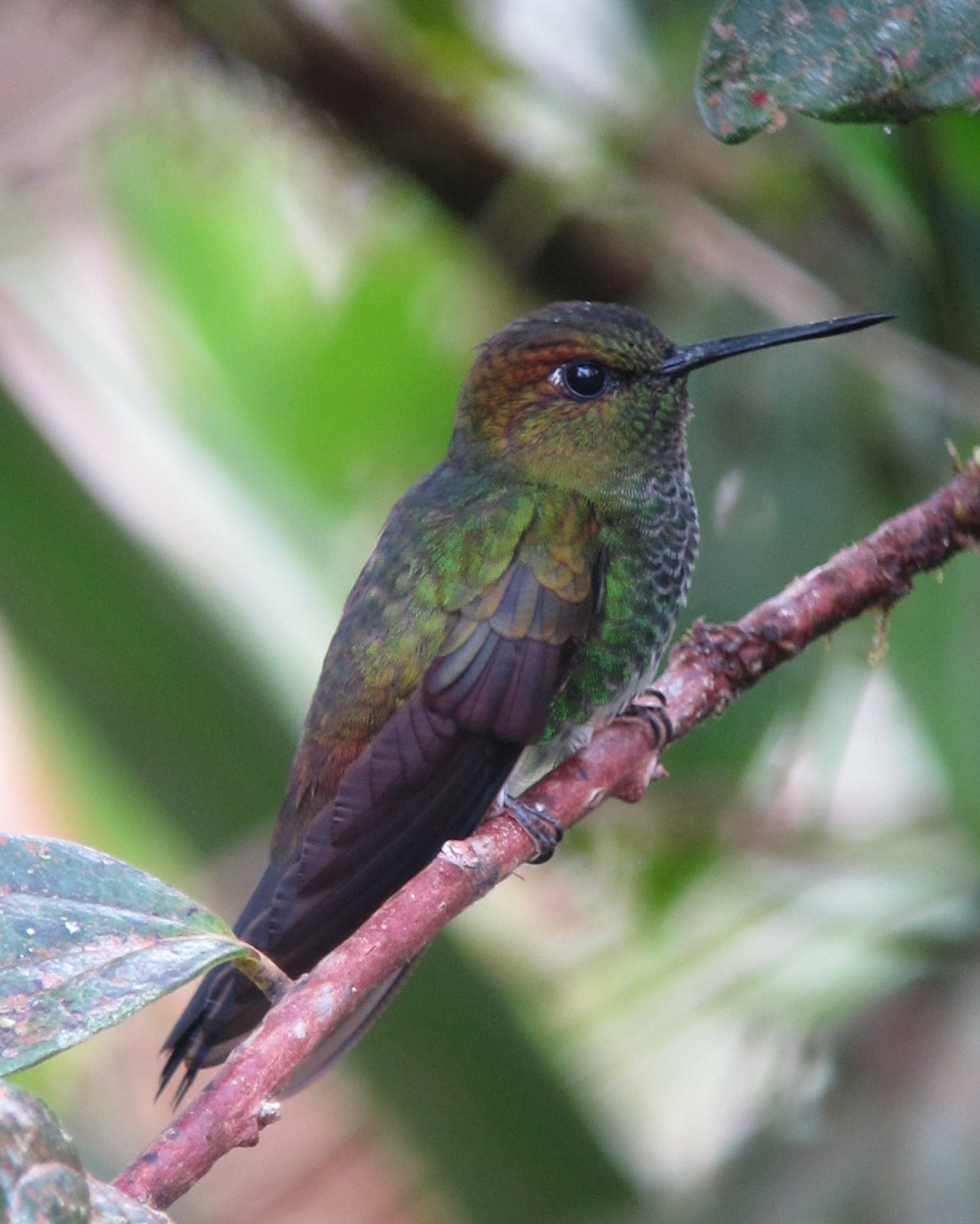
The Greenish Puffleg is a small, green puffleg of the undergrowth of humid montane forest. Unlike the pufflegs of the genus Eriocnemis, it lives mainly low in the forest and has dull, scaly underparts. Like all pufflegs it has downy feather puffs around the legs.
Voice
Groups of males sing from high perches a repeated double note, roughly tur-seet; the call is a sharp tskut.
Recording: John V. Moore — CC BY-NC-SA 4.0 · xeno-canto
Identification
9–11 cm, with a straight black bill. The male is green above, with a coppery head and neck. The underparts are dull green with greyish-white fringes, giving a scaly look. The leg puffs are white on the outside and buff on the inside. The tail is blue-black and slightly forked. The female resembles the male, with more heavily scaled underparts and entirely white leg puffs. Young birds resemble the female.
Confusion species
Buff-thighed Puffleg Haplophaedia assimilis is very similar, but lives further south, in Peru and Bolivia, and has creamy to pale rufous leg puffs. Hoary Puffleg Haplophaedia lugens lives on the Pacific slope and is greyer below, with a more whitish-scaled throat and breast. Pufflegs of the genus Eriocnemis, such as Glowing Puffleg Eriocnemis vestita, usually live higher and are more glittering green or blue.
Habitat
Undergrowth and edges of humid montane forest and cloud forest, also older secondary forest, roughly between 1500 and 3000 m. It feeds mainly low in the forest at clusters of flowers, which it defends, and sometimes visits flowering trees such as Inga in the canopy. It also gleans insects from leaves. The nest is a cup of moss and spider silk, suspended under a large leaf, usually low above the ground.
Where the bird is most at home, classified by the vegetation units of the Andes and the west coast.


Range and movements
In Colombia in all three cordilleras. In Ecuador on the eastern slope of the Andes. In Peru only in the north, on the eastern slope to the Amazonas–San Martín border; according to some classifications the Peruvian birds belong to Buff-thighed Puffleg. Absent from Bolivia and the Galápagos. Outside the guide area in far eastern Panama.
- Resident
- dark = core range, pale = thinly spread
How and when to look
Along forest trails and edges in cloud forest, where birds feed low at flowers. Groups of singing males can be found by listening for the repeated double note.
Conservation status
Least Concern. Deforestation on the mountain slopes affects its habitat locally.
Scientific name
Haplophaedia aureliae | (Bourcier & Mulsant, 1846)
Bourcier & Mulsant described the species in 1846 as Trochilus Aureliae; because it was later moved to another genus, the author and year stand in brackets. The genus Haplophaedia was introduced in 1918 by Simon. The genus name comes from Greek haploos, 'simple', and phaidros, 'shining, bright'. The species name honours Péronne Aurélie Hénon, née Favre (1814–1889), wife of the French botanist and politician Jacques-Louis Hénon. The specimen the first description was based on came from Bogotá, Colombia.