All species › Swifts › Hummingbirds › Green-breasted Mango
Green-breasted Mango | Anthracothorax prevostii
Groenborstmango | Mango pechiverde | Beija-flor-de-peito-verde
The Green-breasted Mango is a large hummingbird of dry, semi-open landscapes around the Caribbean. In the guide area it occurs only in the far north-east of Colombia and on the Colombian islands of San Andrés and Providencia. The birds of western Ecuador and north-western Peru were formerly included in this species, but are now placed with Black-throated Mango.
Voice
Not very vocal. In flight a short, sharp sip or sik, when feeding a harsh chipping, and in disputes a high, shrill twitter. The song is a buzzy, repeated series of notes.
Recording: Paul Driver — CC BY-NC-SA 4.0 · xeno-canto
Identification
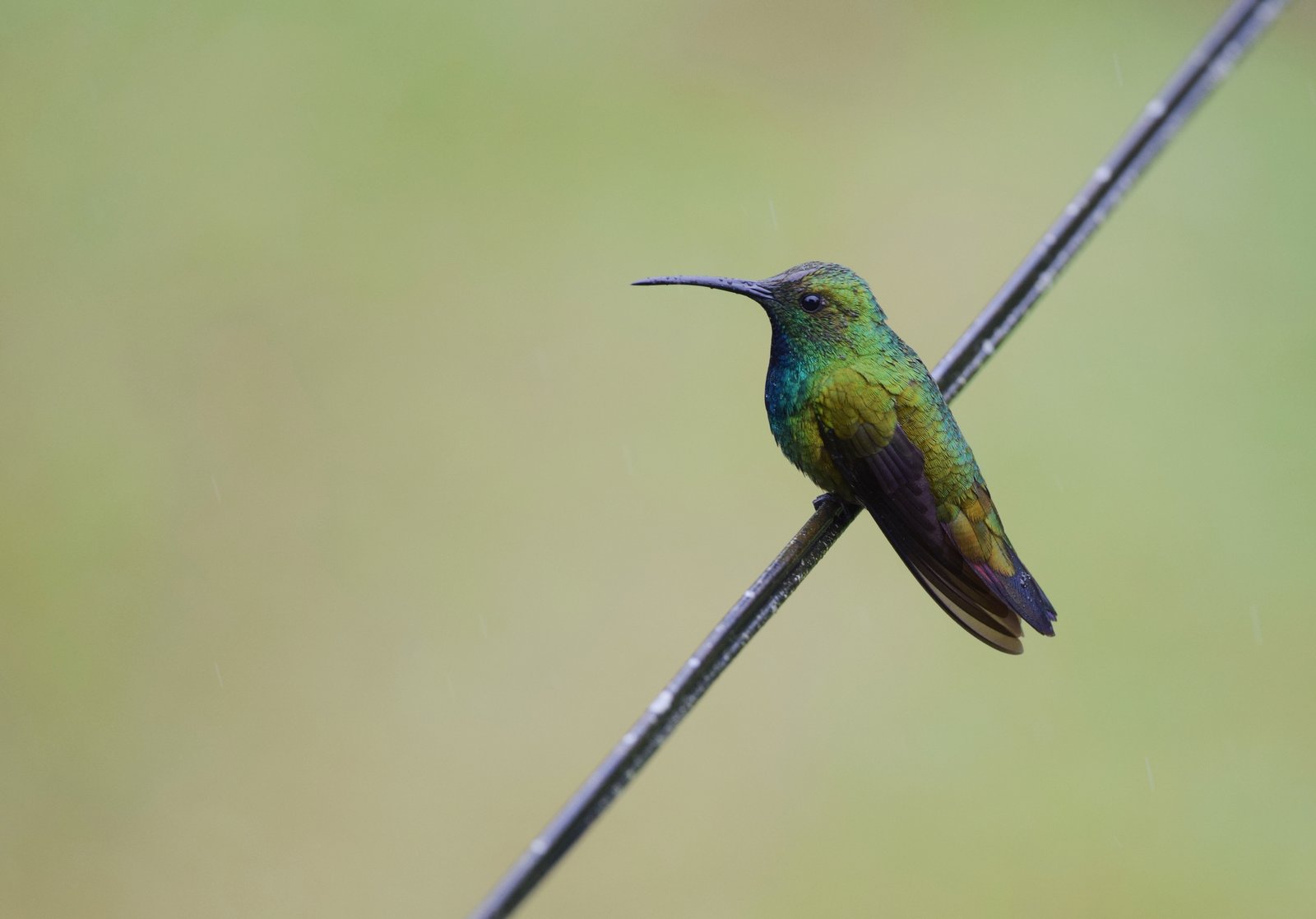
11–12 cm, with a long, slightly decurved black bill. The male is glossy bronze-green to grass-green above, with a velvety black stripe on the chin, throat and breast, bordered by blue-green; towards the belly the stripe becomes bluer. The outer tail feathers are purple, the central ones olive to bronze-green. The female is white below, with a dark central stripe that is blue-green on the breast, and has white tips to the blue-black outer tail feathers. Young birds resemble the female, with some rufous beside the white throat.
Confusion species
Black-throated Mango Anthracothorax nigricollis is very similar; the male has a broader, all-black stripe reaching the belly and reddish-purple outer tail feathers. Both species may occur in north-eastern Colombia; note the colour of the stripe on the belly and the tail. Fiery-tailed Awlbill Avocettula recurvirostris is much smaller, with an upturned bill tip.
Habitat
Dry, semi-open country with shrubs and trees, savanna, gallery forest, mangroves, forest edges, gardens and villages, from sea level to about 500 m. It visits flowering trees and shrubs and catches insects in flight from a high perch.
Where the bird is most at home, classified by the vegetation units of the Andes and the west coast.


Range and movements
In Colombia in the far north-east, on the Guajira Peninsula, and on the islands of San Andrés and Providencia in the Caribbean. Absent from Ecuador, Peru, Bolivia and the Galápagos. Outside the guide area along the coast of Venezuela and from eastern Mexico through Central America to north-western Panama.
- Resident
- dark = core range, pale = thinly spread
How and when to look
On San Andrés at flowering trees in gardens and along roads; on the Guajira Peninsula in dry scrub and at flowering trees in and around villages.
Conservation status
Least Concern. The species lives in a large range and also uses man-made landscapes.
Scientific name
Anthracothorax prevostii | (Lesson, 1832)
Lesson described the species in 1832 as Trochilus prevostii; because it was later moved to another genus, the author and year stand in brackets. The genus Anthracothorax was introduced in 1831 by Boie. The genus name combines Greek anthrax, anthrakos, 'coal', with thōrax, 'breast'. The species name honours Florent Prévost (1794–1863), a French naturalist and bird illustrator at the Paris Muséum. The specimen the first description was based on came from South America (locality unknown).