All species › Swifts › Hummingbirds › Black-throated Mango
Black-throated Mango | Anthracothorax nigricollis
Zwartkeelmango | Mango gorjinegro | Beija-flor-de-veste-preta
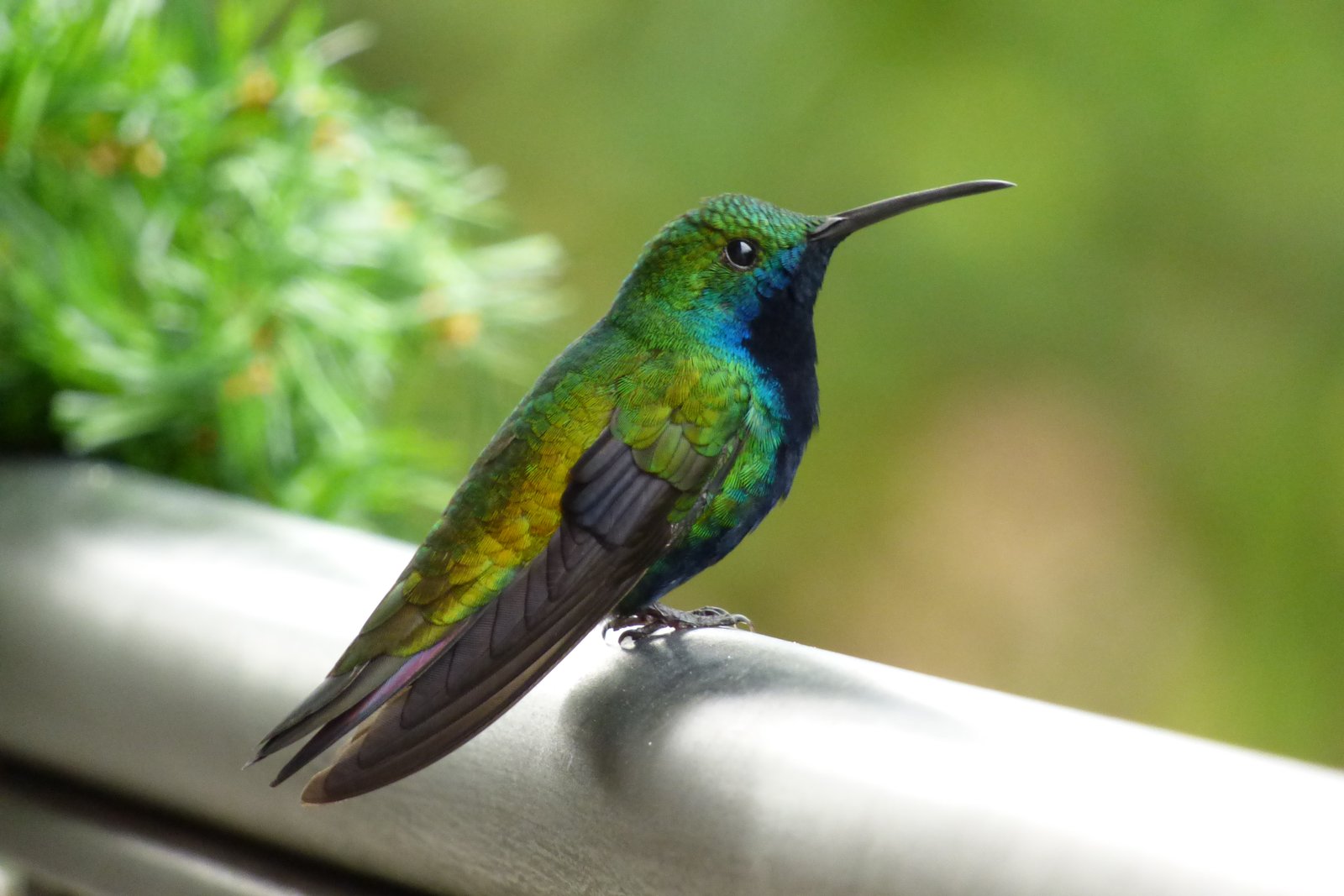
The Black-throated Mango is a large, widespread hummingbird of open and semi-open lowlands, from forest edges and riverbanks to plantations and gardens. The male has a velvety black stripe down the throat and breast and a purplish-red tail. It often feeds high in flowering trees and likes to perch on bare branches in the treetops.
Voice
Not very vocal. The call is a sharp tsik or tchik, and in chases a high twitter. The song is a series of soft, buzzy notes from a treetop.
Recording: Jonas Nilsson — CC BY-NC-SA 4.0 · xeno-canto
Identification
11–12 cm, with a long, slightly decurved black bill. The male is bronze-green above, with a velvety black stripe from chin to belly, bordered on each side by glittering blue-green; the flanks are green. The outer tail feathers are purplish red with a dark edge, the central ones dark bronze-green. The female is green above and white below, with a narrow, ragged black central stripe and white tips to the outer tail feathers. Young birds resemble the female, with rufous fringes on the head and back.
Confusion species
Green-breasted Mango Anthracothorax prevostii is very similar, but in the guide area occurs only in the far north-east of Colombia and on San Andrés and Providencia; in the male the black stripe is narrower and turns bluer towards the belly. Green-throated Mango Anthracothorax viridigula is a vagrant, the male with a green throat. Fiery-tailed Awlbill Avocettula recurvirostris has a similar pattern, but is much smaller, with an upturned bill tip.
Habitat
Semi-open country with scattered trees, forest edges, gallery forest, riverbanks, coffee and cacao plantations, parks and gardens, mainly in the lowlands up to about 1000 m, locally to 1700 m. It visits mainly flowering trees such as Erythrina and Inga, and catches insects in flight from a high lookout. The female builds a small, saddle-shaped cup on an exposed branch.
Where the bird is most at home, classified by the vegetation units of the Andes and the west coast.


Range and movements
In Colombia over most of the lowlands, including the Magdalena and Cauca valleys and the far south-west. In Ecuador in the lowlands east of the Andes and in the west of the country. In Peru in the eastern lowlands and the far north-west. In Bolivia in the north and east. Absent from the Galápagos. Outside the guide area from Panama to Venezuela, the Guianas, most of Brazil, Paraguay and northern Argentina.
- Resident
- dark = core range, pale = thinly spread
How and when to look
At flowering coral trees (Erythrina) and other flowering trees along roads, rivers and village edges. Males often sit still for long periods on a bare branch high in a tree.
Conservation status
Least Concern. The species has a very large range and also uses semi-open, man-made landscapes.
Scientific name
Anthracothorax nigricollis | (Vieillot, 1817)
Vieillot described the species in 1817 as Trochilus nigricollis; because it was later moved to another genus, the author and year stand in brackets. The genus Anthracothorax was introduced in 1831 by Boie. The genus name combines Greek anthrax, anthrakos, 'coal', with thōrax, 'breast'. The species name combines Latin niger, 'black', with collum, 'neck'. The specimen the first description was based on came from Brazil.