All species › Swifts › Hummingbirds › Ruby-topaz Hummingbird
Ruby-topaz Hummingbird | Chrysolampis mosquitus
Muskietkolibrie | Colibrí rubí-topacio | Beija-flor-vermelho
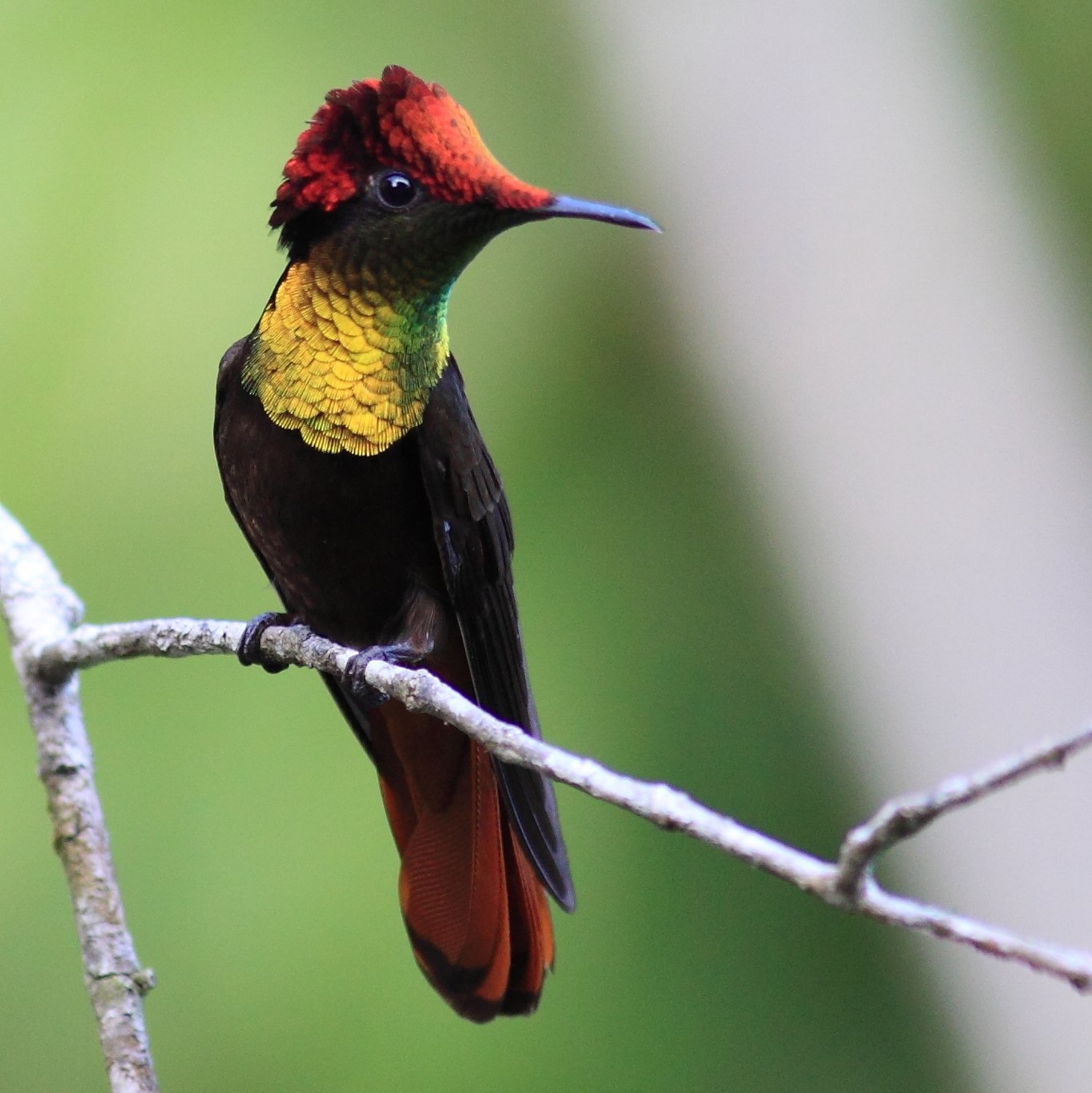
The Ruby-topaz Hummingbird is a small hummingbird of dry, open country in northern and eastern South America. In the male the crown and nape glitter ruby red and the throat and breast golden orange, but in poor light these areas look black. The scientific species name mosquitus, 'little fly', refers to its small size.
Voice
Usually silent. A soft, high tsip and short, dry chirps.
Recording: Jacob Wijpkema — CC BY-NC-SA 4.0 · xeno-canto
Identification
8–9 cm, with a short, straight black bill. The male is dark blackish brown, with a glittering ruby-red crown and nape and a glittering golden-orange to topaz throat and breast; the tail is rufous with a dark terminal band. The female is bronzy green above and pale grey below, sometimes with a narrow dark stripe down the centre of the throat; her tail is rufous with a dark band and white tips to the outer feathers. Immature males have a mottled orange throat.
Confusion species
The male is unmistakable. The female Blue-tailed Emerald Chlorostilbon mellisugus has a blue-black, notched tail without rufous and a dark ear patch. Female mangos, such as Black-throated Mango Anthracothorax nigricollis, are much larger, with a longer, slightly decurved bill and a black central stripe on the underparts.
Habitat
Dry, open country with shrubs and scattered trees, savanna, dry forest and its edges, gardens, parks and farmland, mostly below about 1000 m, locally higher in dry valleys. It takes nectar at low to medium-height flowers and catches small insects. The nest is a small cup of plant down covered with lichen, on a twig or stem.
Where the bird is most at home, classified by the vegetation units of the Andes and the west coast.


Range and movements
In Colombia in the dry Caribbean lowlands, the Magdalena valley, the dry valleys between the cordilleras and the Llanos. In Peru only in the south-east, in Madre de Dios, scarce. In Bolivia only a few records in the north, in Beni and Pando. Absent from Ecuador and the Galápagos. Outside the guide area in Panama, Venezuela, Trinidad and Tobago, the Guianas and large parts of Brazil.
- Resident
- dark = core range, pale = thinly spread
How and when to look
In gardens and scrub in the dry Caribbean lowlands and the Magdalena valley of Colombia, especially at flowering shrubs. The male shows its colours only when the light falls on it directly; wait until it turns.
Conservation status
Least Concern. The species tolerates man-made, semi-open country and gardens.
Scientific name
Chrysolampis mosquitus | (Linnaeus, 1758)
Linnaeus described the species in 1758 as Trochilus Mosquitus; because it was later moved to another genus, the author and year stand in brackets. The genus Chrysolampis was introduced in 1831 by Boie. The genus name comes from Ancient Greek khrusolampis, 'glow-worm' (from khrusos, 'gold', and lampō, 'to shine'). The species name is a Spanish diminutive meaning 'little fly'. The specimen the first description was based on came from Suriname.