All species › Swifts › Hummingbirds › Fiery-tailed Awlbill
Fiery-tailed Awlbill | Avocettula recurvirostris
Vuurstaartkluutkolibrie | Mango picolezna | Beija-flor-de-bico-virado
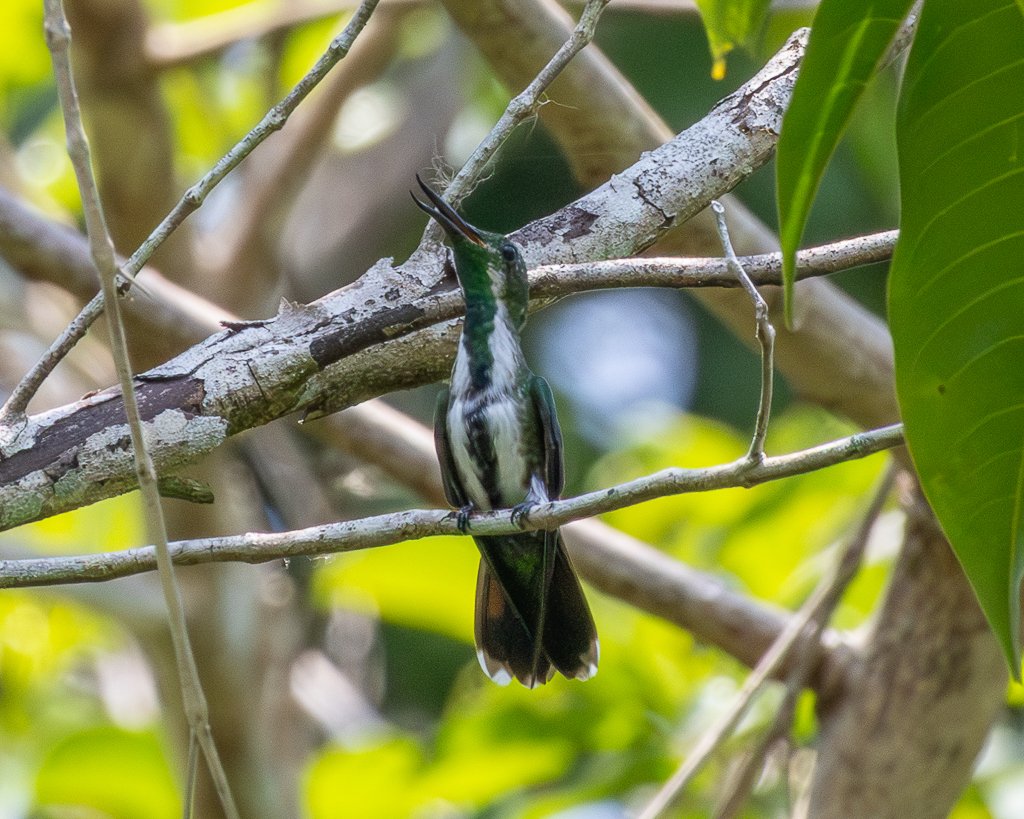
The Fiery-tailed Awlbill is a small hummingbird with a short bill whose tip is sharply upturned, as in an avocet. The male has a glittering green throat, a black stripe down the belly and a coppery-red to purplish-red glittering tail. In the guide area it is known only from a few sites in south-eastern Colombia and eastern Ecuador.
Voice
Poorly known. A thin, high tsip and soft chip notes.
Recording: Jerome Fischer — CC BY-NC-SA 4.0 · xeno-canto
Identification
9 cm, with a short, black bill whose final part is clearly upturned. The male is bronzy green above, with a glittering emerald-green throat and breast and a black stripe down the centre of the breast and belly. The rounded tail glitters coppery red to purplish red. The female is green above and white below, with a black central stripe from throat to belly; her tail is dark purplish red with white tips to the outer feathers.
Confusion species
Black-throated Mango Anthracothorax nigricollis shows the same pattern of a black central stripe and a purplish-red tail, but is much larger, with a longer, slightly decurved bill without an upturned tip; the female has a similar black central stripe. The upturned bill tip is the best feature in a good view.
Habitat
Edges of humid lowland forest, low forest and scrub on sandy soil, and savannas with rock outcrops and granite domes, in the guide area below about 400 m. It visits flowering trees and shrubs, often in the canopy of low forest, and catches small insects. The nest is a cup of plant down on a thin twig.
Where the bird is most at home, classified by the vegetation units of the Andes and the west coast.


Range and movements
In Colombia in the south-east, mainly around Mitú in Vaupés, with a few records in Putumayo. In Ecuador only a few records in the Amazonian lowlands, in Sucumbíos, Orellana and Pastaza. Absent from Peru, Bolivia and the Galápagos. Outside the guide area in southern and eastern Venezuela, the Guianas, and northern and eastern Brazil.
- Resident
- dark = core range, pale = thinly spread
How and when to look
At flowering trees along the edges of low forest and rocky savannas around Mitú in Colombia. Birds often perch motionless for long periods on a bare twig high in a tree.
Conservation status
Least Concern. Scarce and local in the guide area; little is known about its numbers and movements.
Scientific name
Avocettula recurvirostris | (Swainson, 1822)
Swainson described the species in 1822 as Trochilus recurvirostris; because it was later moved to another genus, the author and year stand in brackets. The genus Avocettula was introduced in 1849 by Reichenbach. The genus name is a diminutive of French avocette, 'avocet', referring to the upturned bill tip. The species name combines Latin recurvus, 'bent back', with rostrum, 'bill', referring to the upturned bill tip. The specimen the first description was based on came from Cayenne, French Guiana.