All species › Swifts › Hummingbirds › Green-tailed Goldenthroat
Green-tailed Goldenthroat | Polytmus theresiae
Groenstaartgoudkeelkolibrie | Gorgioro coliverde | Beija-flor-verde
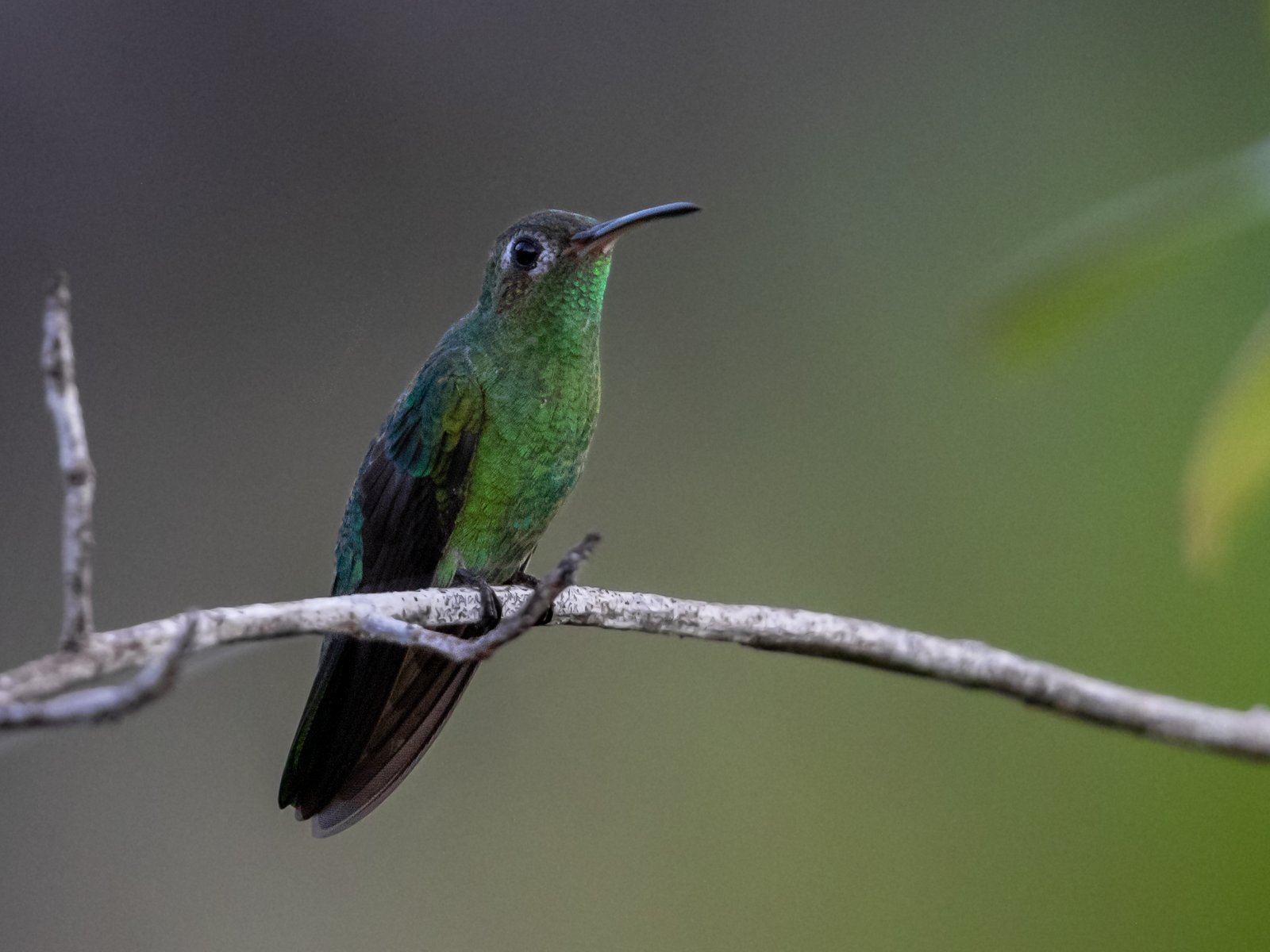
The Green-tailed Goldenthroat is a small, almost entirely glittering green hummingbird with a slightly decurved bill. It lives in open country within Amazonia: white-sand savannas, scrub along rivers and clearings in the forest. In the guide area it is local, with most records in south-eastern Colombia and north-eastern Peru.
Voice
High, dry chip notes and a short, squeaky trill.
Recording: JAYRSON ARAUJO DE OLIVEIRA — CC BY-NC-SA 4.0 · xeno-canto
Identification
9–10 cm, with a slightly decurved black bill with a pink base to the lower mandible. The male is entirely glittering golden green, slightly duller above, with a small white spot behind the eye and white undertail coverts. The rounded tail is green; the outer tail feathers have only a little white at the base. The female is white below, densely marked with green disc-shaped spots on the throat, breast and flanks.
Confusion species
White-tailed Goldenthroat Polytmus guainumbi is larger, with a longer bill, white stripes on the face and a tail with much white. Blue-tailed Emerald Chlorostilbon mellisugus has a shorter, straight bill and a blue-black, notched tail. Glittering-throated Emerald Chionomesa fimbriata has a straight bill and a white stripe down the belly.
Habitat
White-sand savannas with scattered shrubs, open scrub, riverbanks, clearings and forest edges in the lowlands, mostly below about 500 m. It takes nectar low to middle height at flowering shrubs and herbs. The nest is a cup of plant down on a low twig.
Where the bird is most at home, classified by the vegetation units of the Andes and the west coast.


Range and movements
In Colombia in the south-east, east of the Andes, mainly in Vaupés and Guainía. In Peru locally in the north-east, in Loreto, and scattered in Ucayali and Madre de Dios. In Bolivia very locally in the north, in Pando, Beni and La Paz. In Ecuador only a few records. Absent from the Galápagos. Outside the guide area in southern Venezuela, the Guianas and northern Brazil.
- Resident
- dark = core range, pale = thinly spread
How and when to look
In the white-sand savannas around Mitú in Vaupés, Colombia, and in open shrubby country in north-eastern Peru. Check flowering shrubs in open country, where the birds feed low down.
Conservation status
Least Concern. In the guide area local and poorly known; its open habitats lie partly in remote regions.
Scientific name
Polytmus theresiae | (Maia, 1843)
Maia described the species in 1843 as Ornismya theresiae; because it was later moved to another genus, the author and year stand in brackets. The genus Polytmus was introduced in 1760 by Brisson. The genus name comes from Greek polutimos, 'very costly', 'valuable'. The specific name honours Teresa Cristina of Bourbon-Two Sicilies (1822–1889), Empress Consort of Emperor Pedro II of Brazil. The specimen the first description was based on came from Pará, Brazil.