All species › Swifts › Hummingbirds › White-tailed Goldenthroat
White-tailed Goldenthroat | Polytmus guainumbi
Witstaartgoudkeelkolibrie | Colibrí guainumbí | Beija-flor-de-bico-curvo
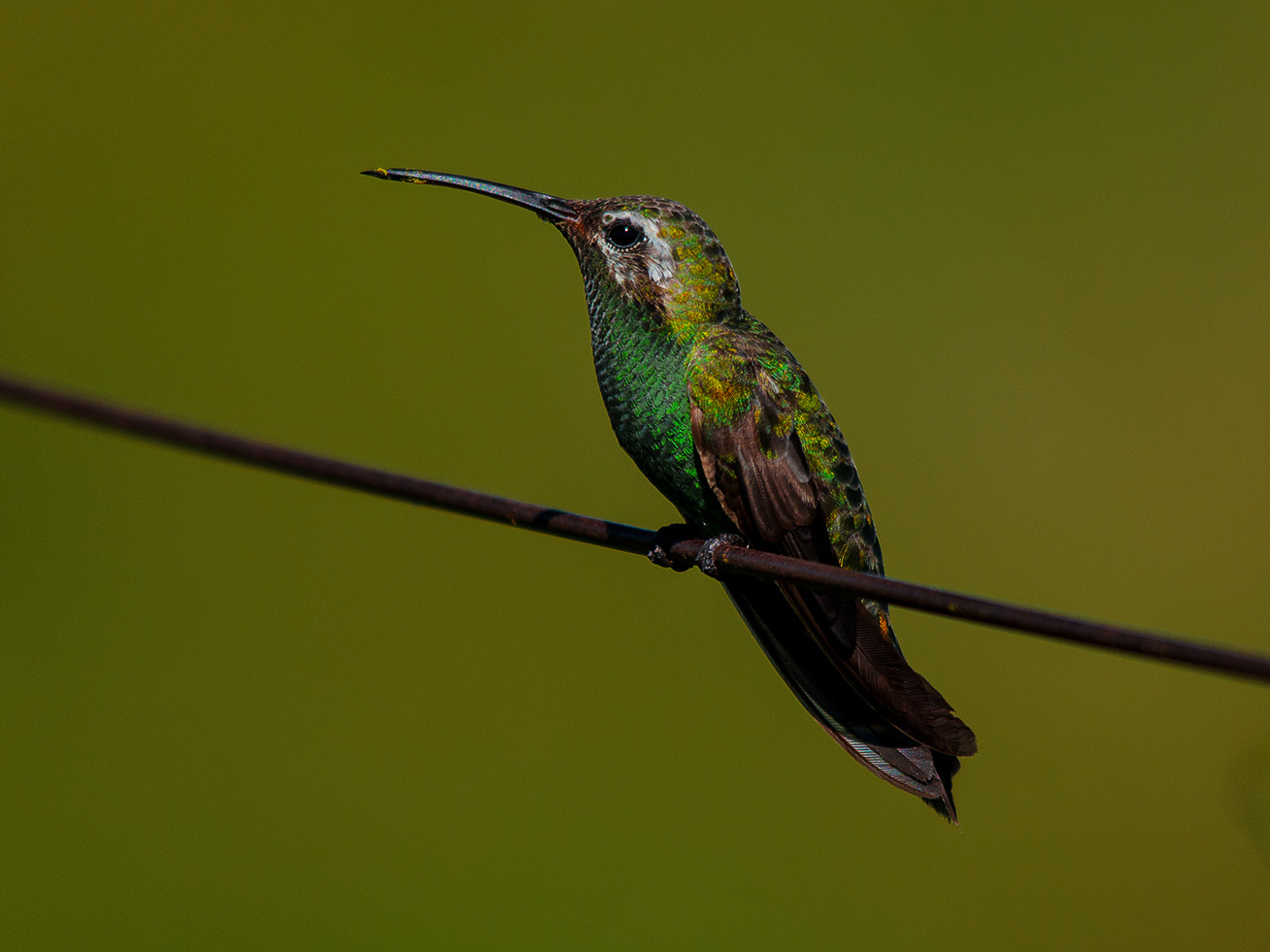
The White-tailed Goldenthroat is a hummingbird of wet savannas and marshy grassland in the lowlands east of the Andes. It has a decurved bill, a striped face and a tail that looks largely white from below. In the guide area it is most numerous in the savannas of Beni in Bolivia and in the Llanos of Colombia.
Voice
High, dry chip notes and a rapid, squeaky twittering, especially during chases.
Recording: Fernando Igor de Godoy — CC BY-NC-SA 4.0 · xeno-canto
Identification
10–11 cm, with a fairly long, slightly decurved black bill; the base of the lower mandible is pink. The male is golden green above and glittering golden green on the throat, breast and belly. A white stripe runs behind the eye and a white malar stripe below it, with a dark cheek patch between. The tail is green, but the outer tail feathers have a broad white base and white tips, so the tail looks mostly white from below. The female is whitish to pale buff below, with green spots on the flanks, and has the same face pattern and tail.
Confusion species
Green-tailed Goldenthroat Polytmus theresiae is smaller, with a shorter bill and a green tail with hardly any white. Glittering-throated Emerald Chionomesa fimbriata has a straight bill, a white stripe down the belly and no white face pattern. The female Ruby-topaz Hummingbird Chrysolampis mosquitus is smaller, with a short, straight bill and a rufous tail.
Habitat
Wet and seasonally flooded savanna, marshy grassland with scattered shrubs, the edges of gallery forest and marshes, and grazed grassland, in the lowlands below about 500 m. It takes nectar low down at flowering herbs and shrubs and defends flowering patches. The nest is a cup of plant down on a low twig or stem, often over water.
Where the bird is most at home, classified by the vegetation units of the Andes and the west coast.


Range and movements
In Colombia in the Llanos east of the Andes. In Peru only in the south-east, in the savannas of Madre de Dios and the adjacent lowlands of Puno. In Bolivia in the savannas of Beni and Santa Cruz and in the lowlands of La Paz. Absent from Ecuador and the Galápagos. Outside the guide area in Venezuela, the Guianas, Brazil, Paraguay and north-eastern Argentina.
- Resident
- dark = core range, pale = thinly spread
How and when to look
In the savannas around Trinidad in Beni and in the Llanos of Colombia, at flowering shrubs along marshes and roadsides. A bird often perches on a low twig near its flowers and flies up at intruders.
Conservation status
Least Concern. The species has a large range and tolerates grazed grassland.
Scientific name
Polytmus guainumbi | (Pallas, 1764)
Pallas described the species in 1764 as Trochilus guainumbi; because it was later moved to another genus, the author and year stand in brackets. The genus Polytmus was introduced in 1760 by Brisson. The genus name comes from Greek polutimos, 'very costly', 'valuable'. The specific name comes from guainumbi, a Tupi name for hummingbirds that entered the literature via Marcgrave. The specimen the first description was based on came from Suriname.