All species › Swifts › Hummingbirds › Black-eared Fairy
Black-eared Fairy | Heliothryx auritus
Zwartoorelfkolibrie | Hada orejinegra | Beija-flor-de-bochecha-azul
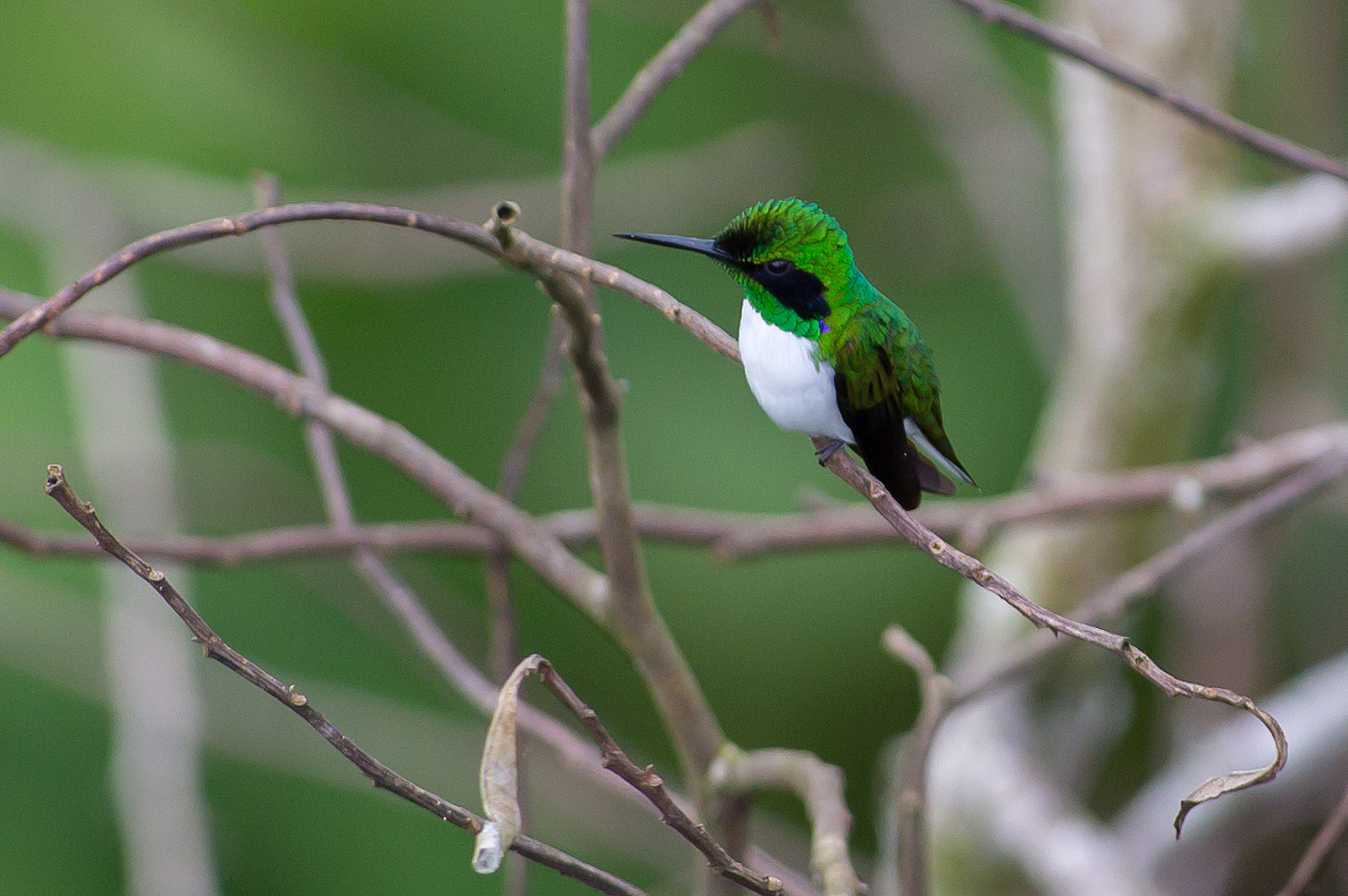
The Black-eared Fairy is the eastern counterpart of the Purple-crowned Fairy: green above, bright white below, with a black ear patch and a long tail with white sides. It lives high in the canopy of Amazonian forest and is therefore mostly observed from a canopy tower or along a forest edge. Like its western relative it often pierces holes in the base of flowers to reach the nectar.
Voice
A sharp, dry tsit or tsik, often in flight; also short series of high, chipping notes.
Recording: Fernando Igor de Godoy — CC BY-NC-SA 4.0 · xeno-canto
Identification
11–13 cm, with a short, straight, sharply pointed black bill; the female has a longer tail. The male is bright green above, including the crown, with a black ear patch behind the eye that ends in a small, glittering blue-violet spot. The underparts are pure white. The central tail feathers are blue-black, the outer ones white. The female resembles the male, but has fine grey spots on the throat and breast and an even longer, strongly graduated tail.
Confusion species
The male Purple-crowned Fairy Heliothryx barroti has a violet crown, and that species lives west of the Andes. Horned Sungem Heliactin bilophus is smaller, the male with a black throat and red head plumes, and lives in open savanna. Other white-bellied hummingbirds in Amazonia, such as White-necked Jacobin Florisuga mellivora, lack the black ear patch.
Habitat
The canopy and edges of humid lowland forest, both terra firme and várzea, and foothill forest, including tall secondary forest edges, mostly below about 1200 m. It forages high, often with the tail spread and bobbing. It takes nectar by piercing the base of the flower and catches small insects in the air. The nest is a cup of plant down on a thin branch, often high in a tree.
Where the bird is most at home, classified by the vegetation units of the Andes and the west coast.


Range and movements
In Colombia east of the Andes, in Amazonia and the foothills. In Ecuador in the Amazonian lowlands and on the lower eastern slope. In Peru in the Amazonian lowlands and the foothills of the eastern slope. In Bolivia in the north and east, in Pando, Beni, La Paz, Cochabamba and Santa Cruz. Absent from the Galápagos. Outside the guide area in southern Venezuela, the Guianas, and Amazonian and Atlantic Forest Brazil.
- Resident
- dark = core range, pale = thinly spread
How and when to look
From canopy towers and high platforms at lodges in the Amazonian lowlands, and along broad riverbanks and forest edges where the canopy is open. Watch for the white flashes of the tail among the high foliage.
Conservation status
Least Concern. The species has a very large range; deforestation affects its habitat locally.
Scientific name
Heliothryx auritus | (Gmelin, 1788)
Gmelin described the species in 1788 as Trochilus auritus; because it was later moved to another genus, the author and year stand in brackets. The genus Heliothryx was introduced in 1831 by Boie. The genus name combines Greek hēlios, 'sun', with thrix, 'hair'. The species name is Latin auritus, 'eared', after the conspicuous ear patch. The specimen the first description was based on came from Cayenne, French Guiana.