All species › Tubenoses › Albatrosses › Black-browed Albatross
Black-browed Albatross | Thalassarche melanophris
Wenkbrauwalbatros | Albatros Ojeroso | Albatroz-de-sobrancelha
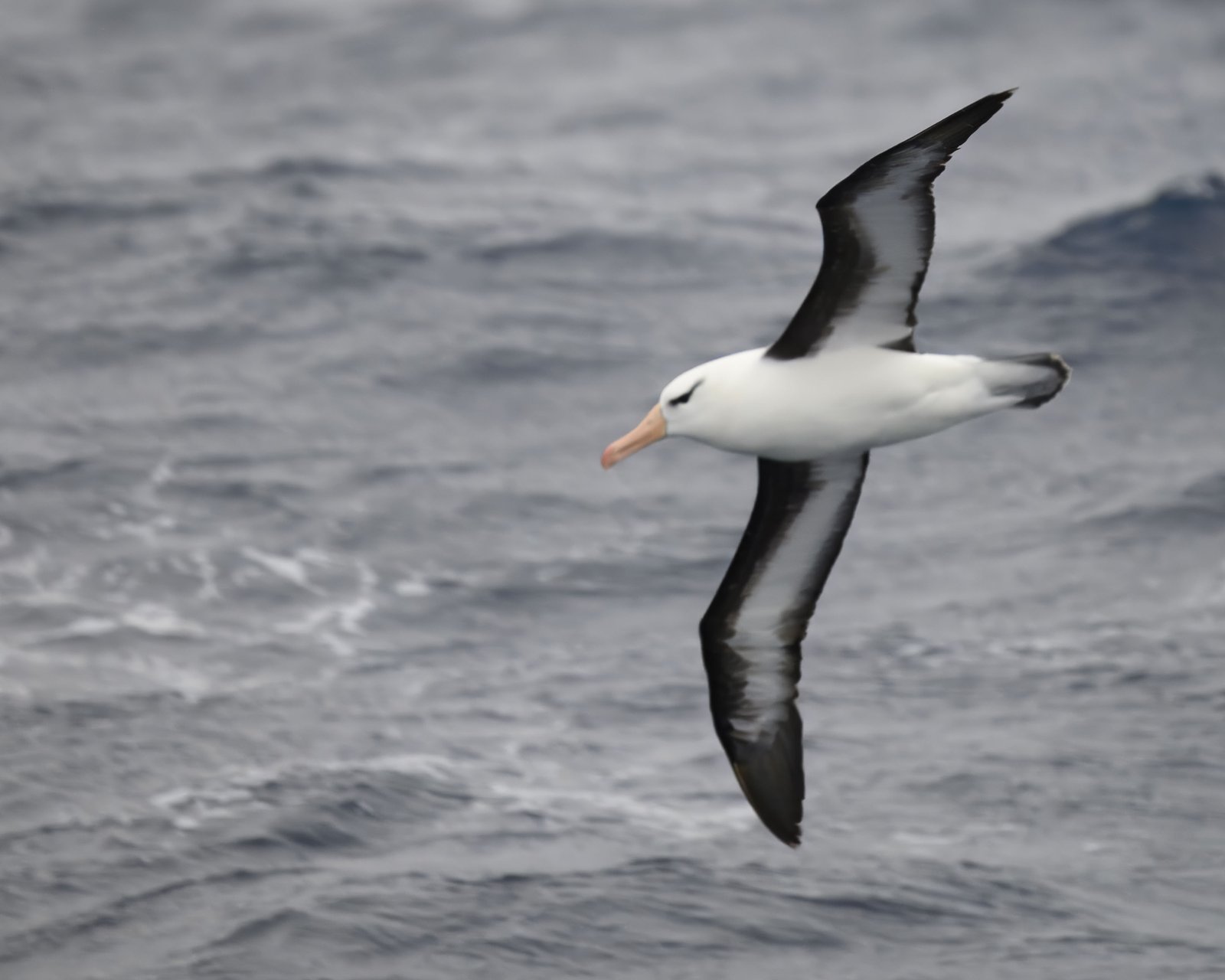
The Black-browed Albatross is the most numerous and widespread albatross of the southern oceans. It is named for the short dark stripe through and above the eye, which gives the white head a frowning expression. It often follows fishing vessels for offal and bait.
Voice
Usually silent at sea; croaking and cackling sounds when competing for food behind ships. At the colony hoarse, grating calls.
Recording: Pepe Rojas — CC BY-NC-SA 4.0 · xeno-canto
Identification
80–95 cm, a medium-sized albatross with a white head and rump and a blackish-grey back, upperwing and tail. A short black stripe runs through and above the eye. The bill of adults is orange-yellow with a reddish tip. The underwing is white with broad black margins, especially on the leading edge, so that the white centre looks narrow. Juveniles have a dark grey bill with a black tip, a grey wash or collar on the hindneck and a largely dark underwing; the bill becomes yellow over several years.
Confusion species
Buller's Albatross Thalassarche bulleri, Salvin's Albatross Thalassarche salvini and Chatham Albatross Thalassarche eremita have a grey head and a white underwing with narrow black margins; Salvin's and Chatham also have a black thumb mark at the base of the leading edge. Waved Albatross Phoebastria irrorata has a brown body. Young Black-browed Albatrosses resemble young dark-billed birds of other Thalassarche species; check then for the broad dark underwing margins.
Habitat
Open ocean, especially over the continental shelf and shelf edge and in cold, productive upwelling waters such as the Humboldt Current. It eats fish, squid and crustaceans, and offal behind ships. Breeds in colonies on steep slopes of remote islands; the nest is a tall cone of mud and plant debris.
Where the bird is most at home, classified by the vegetation units of the Andes and the west coast.


Range and movements
In the guide area a non-breeding visitor at sea off Peru, mainly in the austral winter; usually far offshore, sometimes visible from land. Further north, off Ecuador, rare. Absent from Bolivia and not regular around Galápagos. Outside the guide area it breeds on islands around southern South America, including the Falkland Islands and islands off southern Chile, and on subantarctic islands; it ranges over the southern oceans.
- Resident
- Summer visitor (c. Apr–Sep)
- Passage (Mar–Apr, Oct–Nov)
- dark = core range, pale = thinly spread
How and when to look
Join a pelagic boat trip from a Peruvian port, such as Callao near Lima or Pucusana, in the austral winter. Near fishing boats and offal albatrosses come close to the boat.
Conservation status
Least Concern. The population is large, but declined sharply in parts of the breeding range in the past due to bycatch in longline and trawl fisheries; mitigation measures on board have locally reduced mortality.
Scientific name
Thalassarche melanophris | (Temminck, 1828)
Temminck described the species in 1828 as Diomedea melanophris; because it was later moved to another genus, the author and year stand in brackets. The genus Thalassarche was introduced in 1853 by Reichenbach. The genus name comes from Greek thalassa, 'sea', and arkhē, 'rule', so 'ruler of the sea'. The species name comes from Greek melas, 'black', and ophrus, 'eyebrow', for the dark stripe over the eye. The specimen the first description was based on came from Cape of Good Hope, South Africa.