All species › Tubenoses › Albatrosses › Waved Albatross
Waved Albatross | Phoebastria irrorata
Galápagosalbatros | Albatros de Galápagos | Albatroz-de-galápagos
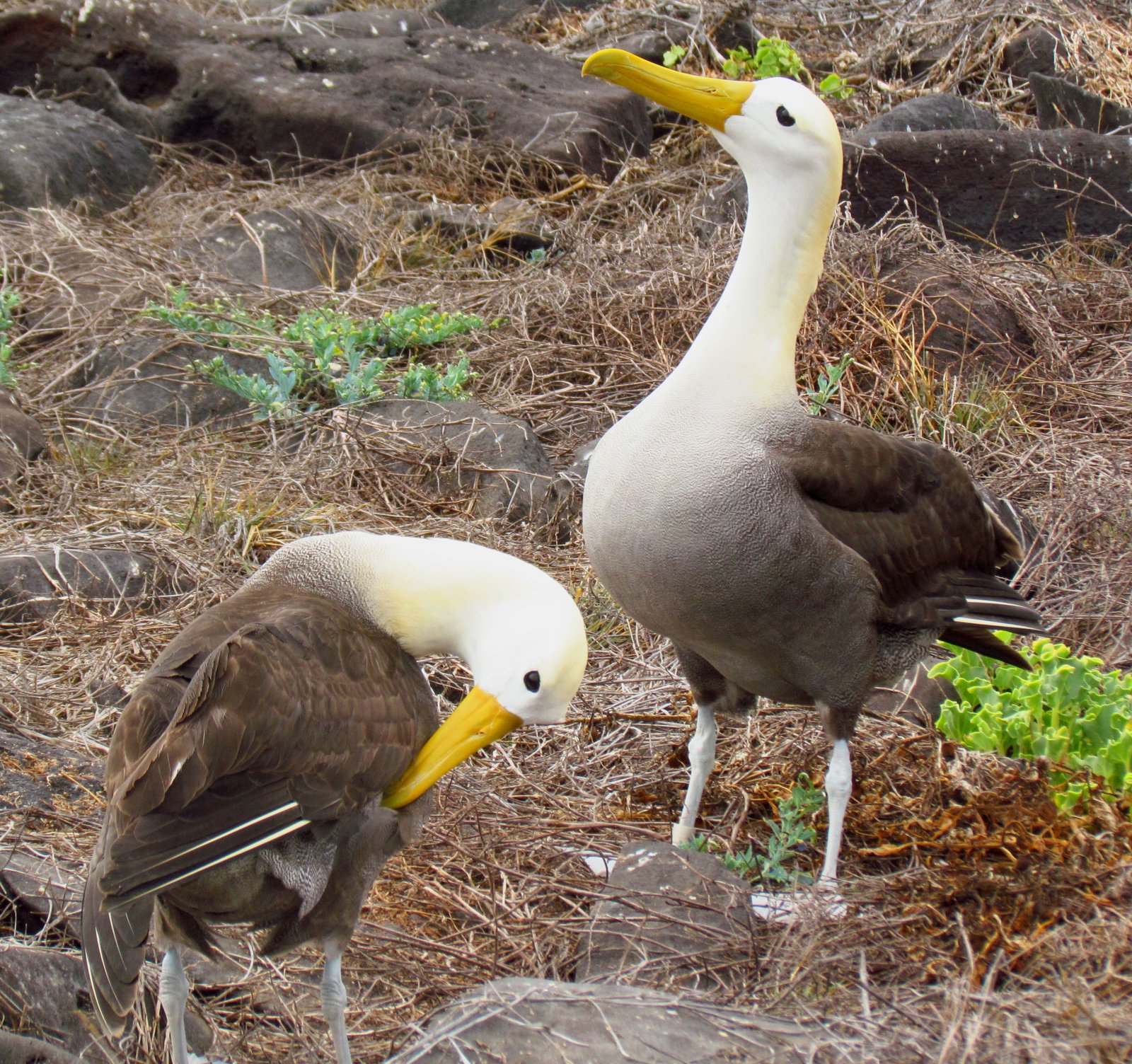
The Waved Albatross is the only albatross that breeds in the tropics. Almost the entire world population nests on the island of Española in Galápagos; outside the breeding season the birds range over the cold, rich waters off Ecuador and Peru. Its courtship dance, with clattering bills and swaying heads, is one of the best-known spectacles of the archipelago.
Voice
During courtship there is bill-clattering, mooing and groaning calls and a high honking sound, as the partners fence with their bills, bow and point their bills skyward. Silent at sea.
Recording: Charlie Vogt — CC BY-NC-SA 4.0 · xeno-canto
Identification
85–93 cm, a medium-sized albatross with long, narrow wings. The head and neck are creamy white with a yellowish wash on the crown and hindneck. The body is greyish brown, finely barred white, which gives a wavy pattern at close range. The upperwing, back and tail are dark brownish grey. The underwing is mostly white with a dark margin. The long, heavy bill is bright yellow and looks too large for the head. The legs are bluish grey and project beyond the tail in flight. Juveniles resemble adults.
Confusion species
At sea off Peru other albatrosses can occur, such as Salvin's Albatross Thalassarche salvini and Black-browed Albatross Thalassarche melanophris, but these have a white rump and white underparts, a dark back and a grey or dark upper surface to the wing; Waved Albatross is the only one with a brown, finely barred body and a white head. Young giant petrels such as Southern Giant Petrel Macronectes giganteus are bulkier, uniformly dark and have a pale bill.
Habitat
Breeds on the dry, open lava plateau of Española, among boulders and low scrub close to the cliffs; the birds walk to the cliff edge to take off into the wind. The egg is laid on bare ground, and the pair sometimes moves it a short distance. It feeds at sea over the continental shelf and shelf edge off Ecuador and Peru, mainly on squid, fish and crustaceans.
Where the bird is most at home, classified by the vegetation units of the Andes and the west coast.


Range and movements
Breeds almost exclusively on Española in Galápagos; a handful of pairs breed on Isla de la Plata off the coast of Ecuador. Outside the breeding season at sea off Ecuador and especially Peru, in the Humboldt Current. Occasionally further north, off Colombia, or further south, off northern Chile. Absent from Bolivia.
- Resident
- Summer visitor (c. Apr–Sep)
- Winter visitor (c. Oct–Mar)
- Passage (Mar–Apr, Oct–Nov)
- dark = core range, pale = thinly spread
How and when to look
Punta Suárez on Española is the classic site, between April and December: albatrosses sit on nests beside the trail and take off from the cliff edge.
Conservation status
Critically Endangered. Birds drown as bycatch in longline and net fisheries off Peru and Ecuador, and some are also caught there for food. Because almost the entire population breeds on a single island, the species is especially vulnerable to disasters, disease and climate change.
Scientific name
Phoebastria irrorata | (Salvin, 1883)
Salvin described the species in 1883 as Diomedea irrorata; because it was later moved to another genus, the author and year stand in brackets. The genus Phoebastria was introduced in 1853 by Reichenbach. The genus name comes from Greek phoibastria, 'prophetess', from phoibos, 'prophet'. The species name comes from Latin irroratus, 'bedewed, sprinkled', for the fine wavy barring on the plumage. The specimen the first description was based on came from Callao Bay, Peru.