All species › Penguins › Penguins › Magellanic Penguin
Magellanic Penguin | Spheniscus magellanicus
Magelhaenpinguïn | Pingüino Magallánico | Pinguim-de-magalhães
The Magellanic Penguin is a penguin of the cool coasts of southern South America. After the breeding season many birds move north: on the Atlantic side as far as Brazil, on the Pacific side along the coast of Chile. In the guide area it is a rare visitor to the coast of Peru, where it resembles the much commoner Humboldt Penguin.
Voice
At the colony a loud, braying call reminiscent of a donkey, given with the bill pointed upward. At sea short calls between birds in a group.
Recording: Ryan Irvine — CC BY-NC-SA 4.0 · xeno-canto
Identification
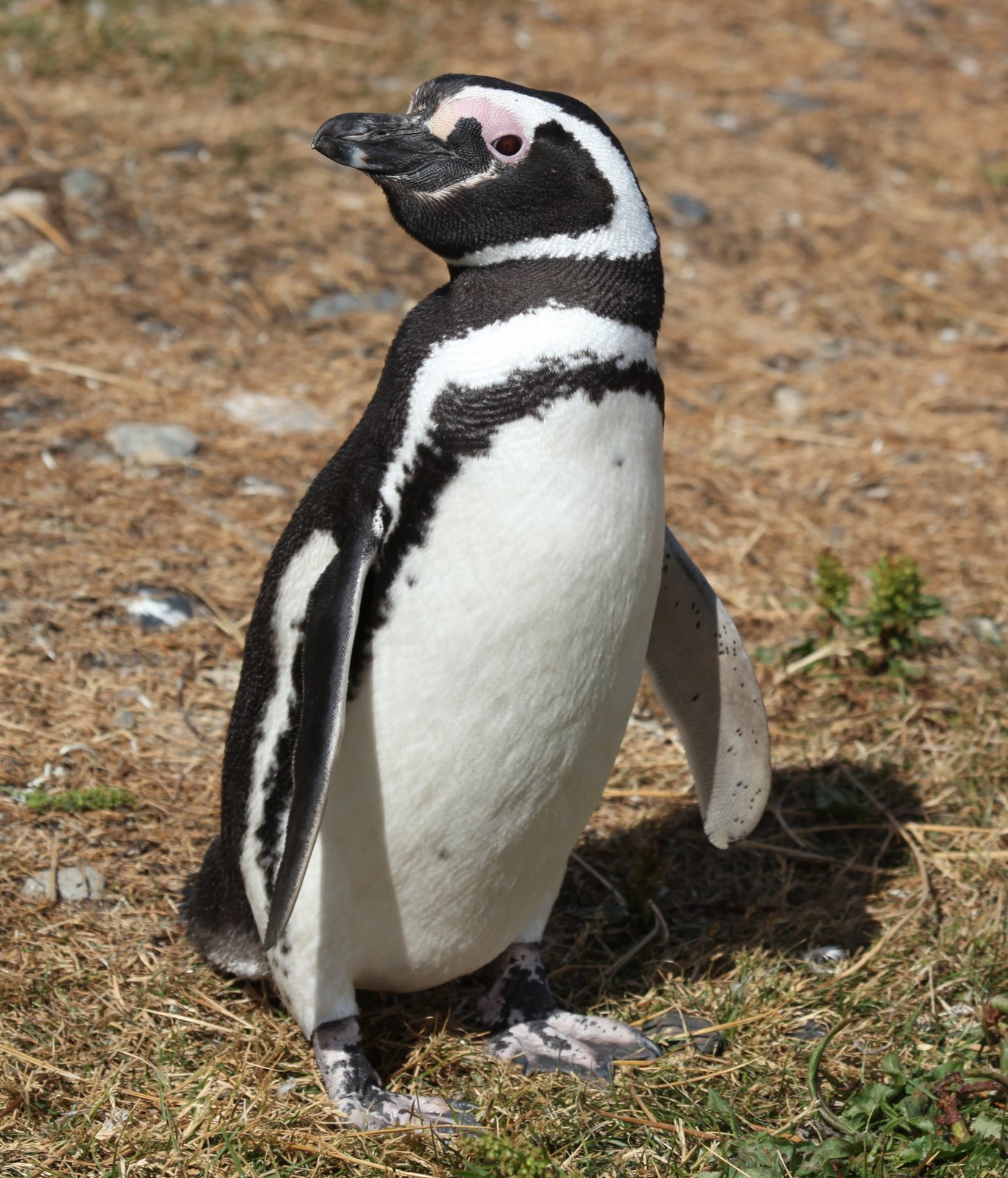
65–75 cm, a medium-sized penguin with a black back and white underparts. A white band runs from above the eye around the cheek to the throat. Two black bands cross the throat and breast: a broad band below the chin and, separated from it by white, a narrower horseshoe-shaped band that continues along the flanks. A narrow strip of pink bare skin surrounds the base of the bill. The bill is black with a pale crossband. The sexes are alike. Juveniles are greyer, with grey cheeks and no distinct breast bands.
Confusion species
Humboldt Penguin Spheniscus humboldti is the regular penguin along the coast of Peru; it has a single black breast band and a larger patch of pink skin around the base of the bill. Galapagos Penguin Spheniscus mendiculus is much smaller and occurs only on Galápagos. Juveniles closely resemble young Humboldt Penguins; check the extent of pink skin around the bill and the head pattern.
Habitat
Cool inshore waters and open sea over the continental shelf. Breeds in colonies, in burrows in the ground or under bushes, on islands and along the coast. It dives for schooling fish such as anchovies and sardines, and for squid and crustaceans. After the breeding season it swims long distances northward.
Where the bird is most at home, classified by the vegetation units of the Andes and the west coast.


Range and movements
In the guide area only in Peru, as a rare visitor along the coast, mainly in the south and in the austral winter; sometimes among Humboldt Penguins. Absent from Colombia, Ecuador, Bolivia and Galápagos. Outside the guide area it breeds in southern Chile and Argentina and on the Falkland Islands; in winter it moves north to central Chile and, on the Atlantic side, to southern and southeastern Brazil.
- Summer visitor (c. Apr–Sep)
- dark = core range, pale = thinly spread
How and when to look
Check the breast bands of penguins on rocky coasts and islands in southern Peru, for example around Paracas: a bird with two black bands is a Magellanic Penguin.
Conservation status
Least Concern, but the population is declining in parts of its range. Threats include oil pollution, bycatch in fishing nets, overfishing of prey fish and climate change.
Scientific name
Spheniscus magellanicus | (Forster, 1781)
Forster described the species in 1781 as Aptenodytes magellanicus; because it was later moved to another genus, the author and year stand in brackets. The genus Spheniscus was introduced in 1760 by Brisson. The genus name comes from Greek sphēniskos, 'small wedge', a diminutive of sphēn, 'wedge', for the shape of the flippers. The species name refers to the Strait of Magellan, named after Ferdinand Magellan (c. 1480–1521). The specimen the first description was based on came from Strait of Magellan.