All species › Penguins › Penguins › Galapagos Penguin
Galapagos Penguin | Spheniscus mendiculus
Galápagospinguïn | Pingüino de Galápagos | Pinguim-de-galápagos
The Galapagos Penguin is the northernmost penguin in the world and the only one that naturally occurs north of the equator, at the northern tip of Isabela. It lives along the cool western coast of the archipelago, where upwelling cold water provides food. With only a few thousand birds it is also one of the rarest penguins.
Voice
A hoarse, donkey-like braying, mainly at the nest and between partners, softer than in Humboldt Penguin. Usually silent at sea.
Recording: Jesse Fagan — CC BY-NC-SA 4.0 · xeno-canto
Identification
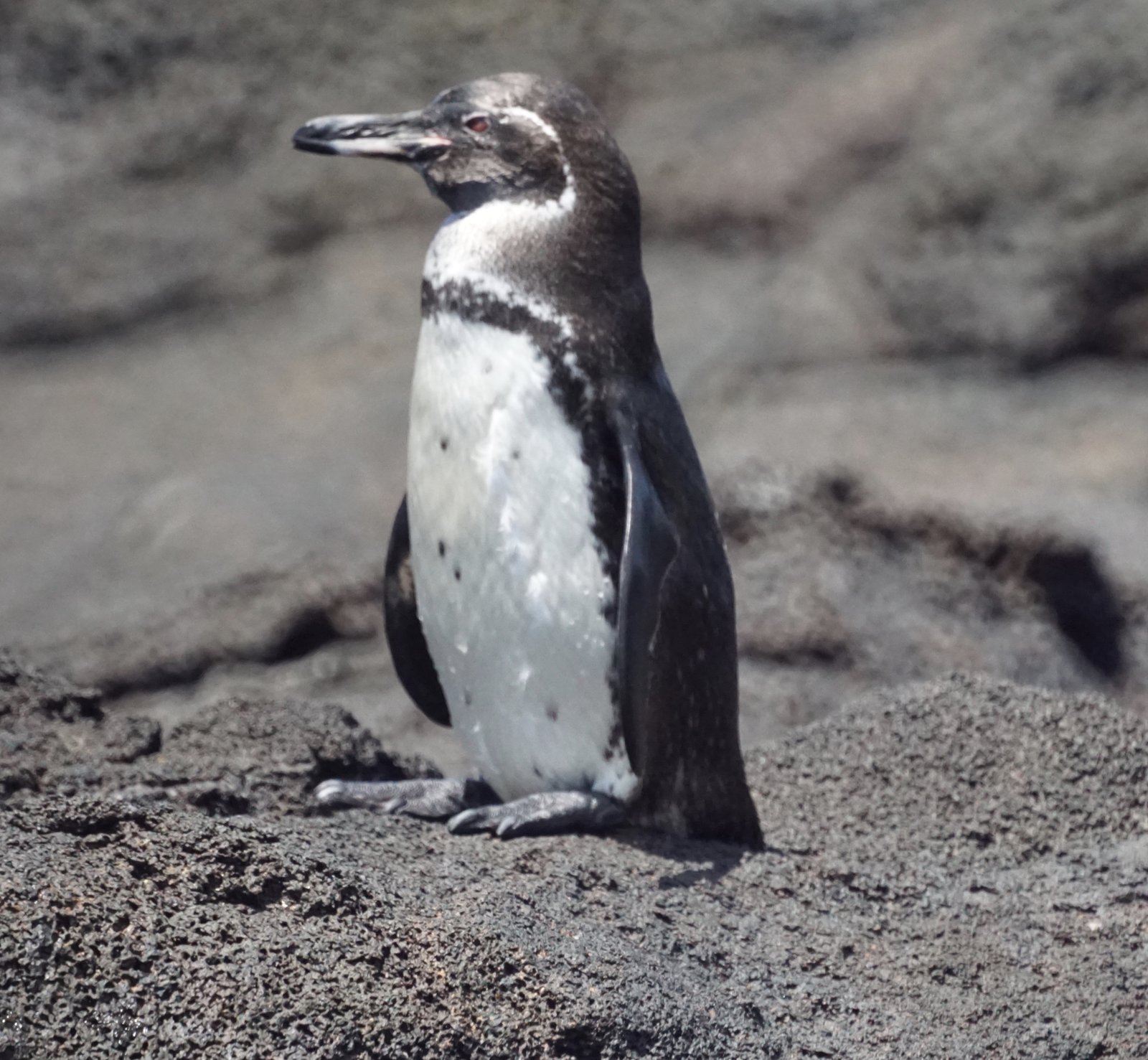
48–53 cm, a small, slender penguin. The upperparts are blackish grey, the underparts white, with a narrow black band across the breast continuing down the flanks, and above it a further black band across the upper breast. The head is black, with a thin white line running from above the eye behind the ear coverts down to the throat. The bill is slender and black, with some pale, pink to yellowish bare skin at the base of the lower mandible and around the eye. Juveniles have a greyish head, without a clear white line and without breast bands.
Confusion species
No other penguin occurs on Galápagos. Humboldt Penguin Spheniscus humboldti along the coast of Peru is much larger, with a broader white head band and a single broad breast band. A swimming Flightless Cormorant Nannopterum harrisi can cause confusion at a distance, but it is much larger, uniformly dark and has a long neck and a long, hooked bill.
Habitat
Rocky lava coasts with cool, food-rich water. It nests in cavities, crevices and small caves in the lava close to the waterline, where eggs and young are sheltered from the sun. It feeds by day close inshore on shoals of small fish such as sardines and anchovies, often in small groups. It rests on rocks along the water.
Where the bird is most at home, classified by the vegetation units of the Andes and the west coast.

Range and movements
Only on Galápagos. The great majority live along the west coast of Isabela and the coast of Fernandina; small numbers elsewhere, including around Bartolomé, Santiago and Floreana. Absent from mainland Ecuador, Colombia, Peru and Bolivia.
- Resident
How and when to look
At Pinnacle Rock on Bartolomé a few birds often sit on the rocks, visible from a dinghy or while snorkelling. Along the west coast of Isabela, for example in the bays at Punta Moreno and Elizabeth Bay, they are more numerous.
Conservation status
Endangered. The population is small and fluctuates strongly: in strong El Niño years, when the cold upwelling fails, many birds starve. Introduced cats and dogs, fishing nets, disturbance and disease are further threats. The breeding sites lie within Galápagos National Park.
Scientific name
Spheniscus mendiculus | Sundevall, 1871
Sundevall described the species in 1871 and placed it straight away in the genus where it still stands. The genus Spheniscus was introduced in 1760 by Brisson. The genus name comes from Greek sphēniskos, 'small wedge', a diminutive of sphēn, 'wedge', for the shape of the flippers. The species name is Latin mendiculus, 'little beggar', a diminutive of mendicus, 'beggar'. The specimen the first description was based on came from Galápagos Islands, Ecuador.