All species › Penguins › Penguins › Humboldt Penguin
Humboldt Penguin | Spheniscus humboldti
Humboldtpinguïn | Pingüino de Humboldt | Pinguim-de-humboldt
The Humboldt Penguin is the penguin of the cold Humboldt Current along the coasts of Peru and Chile. It breeds on bare islands and rocky shores at the edge of the desert, where it digs its nest in guano or tucks itself into caves and crevices. The fate of the species is closely tied to the anchovy and to guano harvesting.
Voice
In the colony a loud, hoarse, donkey-like braying, often with the head raised and flippers flapping; also short, hoarse calls between partners. Usually silent at sea.
Recording: Cristian Pinto — CC BY-NC-SA 4.0 · xeno-canto
Identification
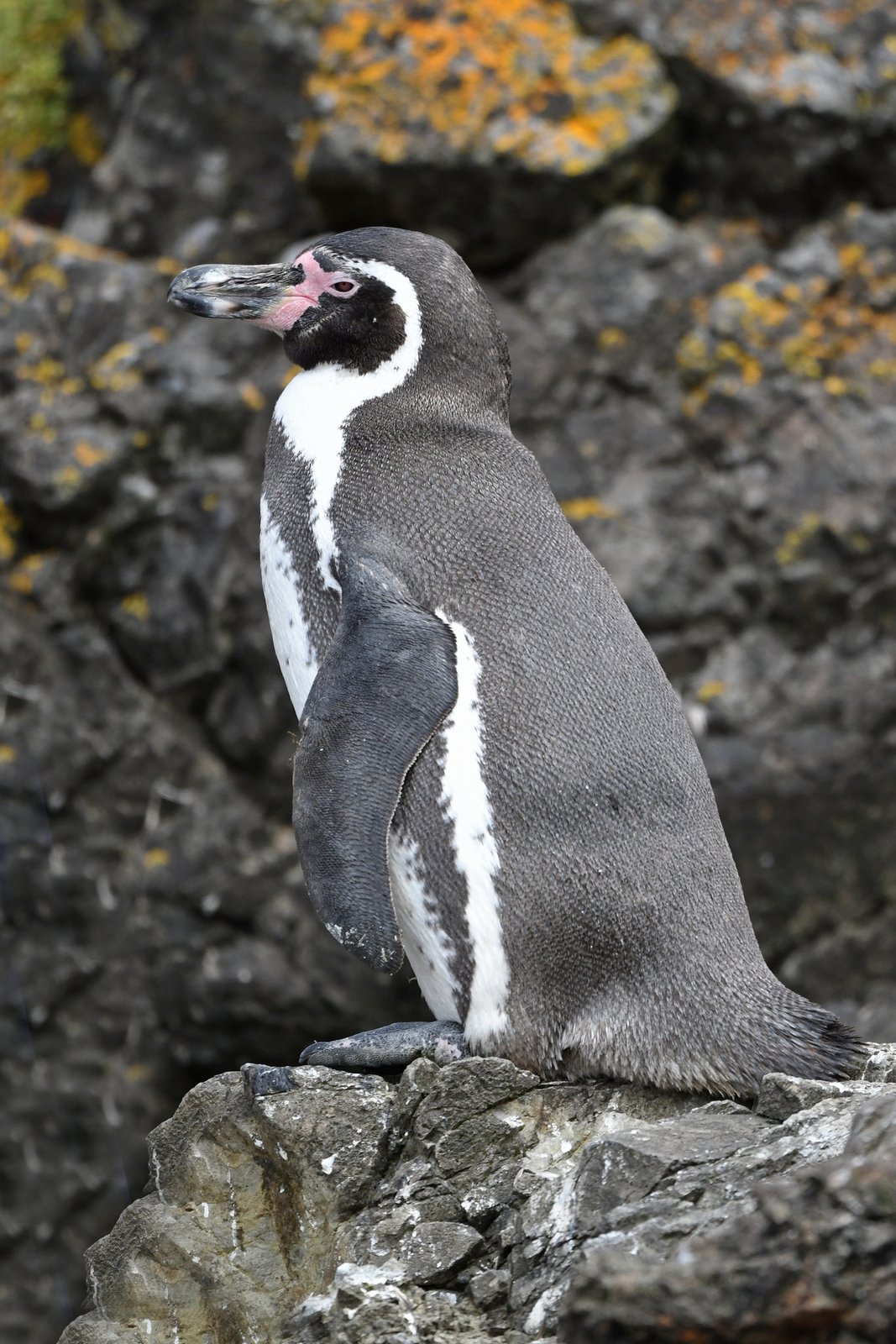
65–70 cm, a medium-sized, stocky penguin. The upperparts are blackish grey, the underparts white with a single broad black band in the shape of an inverted U across the breast and flanks, and scattered black spots on the belly. The head is black, with a narrow white band that starts above the eye, runs behind the ear coverts and meets under the throat. The bill is heavy and black, with a pale crossband; there is a large area of bare pink skin at the base of the bill and around the eye. Juveniles are greyish brown above, without the white head band or breast band, and with a dingy white cheek.
Confusion species
Magellanic Penguin Spheniscus magellanicus, a rare vagrant from the south, has two black breast bands instead of one, a broader white head band and less bare pink skin at the bill base. Galapagos Penguin Spheniscus mendiculus is much smaller, with a narrower white head band, and occurs only on Galápagos.
Habitat
Rocky islands, headlands and cliffs along the cold coast, especially guano islands; it nests in self-dug burrows in the guano or in caves, crevices and under boulders. It feeds in the cool inshore waters on shoals of small fish, mainly anchovies and sardines, usually within a few kilometres of the colony. It rests on rocks and sometimes on beaches.
Where the bird is most at home, classified by the vegetation units of the Andes and the west coast.


Range and movements
In Peru along almost the entire coast, from the north south to the Chilean border, with the largest colonies on islands and peninsulas in the centre and south. North of Peru only as a rare vagrant. Absent from Colombia, Bolivia and Galápagos. Outside the guide area along the coast of Chile south to about the island of Chiloé.
- Resident
- dark = core range, pale = thinly spread
How and when to look
A boat trip from Paracas to the Islas Ballestas almost always produces Humboldt Penguins, on the rocks among cormorants, boobies and sea lions. The protected colonies may not be visited on land.
Conservation status
Vulnerable. Guano harvesting destroyed many nesting sites in the past. Today drowning in fishing nets, overfishing of anchovy, disturbance and food shortages in El Niño years are the main threats; strong El Niño events have repeatedly caused steep declines.
Scientific name
Spheniscus humboldti | Meyen, 1834
Meyen described the species in 1834 and placed it straight away in the genus where it still stands. The genus Spheniscus was introduced in 1760 by Brisson. The genus name comes from Greek sphēniskos, 'small wedge', a diminutive of sphēn, 'wedge', for the shape of the flippers. The species name honours Alexander von Humboldt (1769–1859), a Prussian naturalist and explorer of South America; the Humboldt Current along the coast is also named after him. The specimen the first description was based on came from Peru.