All species › Tropicbirds › Tropicbirds › Red-billed Tropicbird
Red-billed Tropicbird | Phaethon aethereus
Roodsnavelkeerkringvogel | Rabijunco etéreo | Rabo-de-palha-de-bico-vermelho
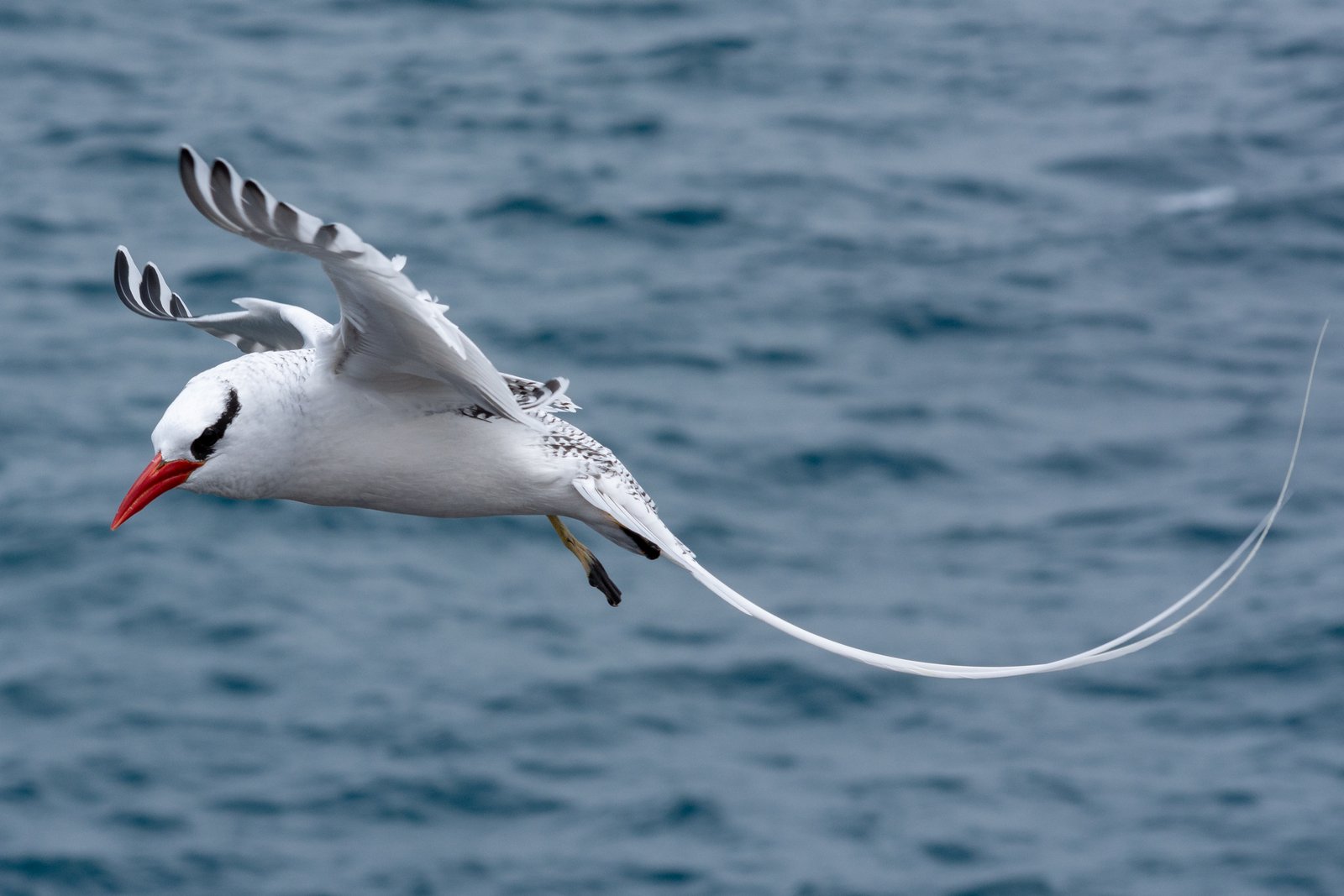
The Red-billed Tropicbird is a slender white seabird with two very long white central tail feathers. It flies with fast, pigeon-like wingbeats high over the open sea and plunges from a height onto fish and squid. In the guide area it breeds on Galápagos and on a few islands off the coasts of Ecuador and Peru.
Voice
A shrill, piercing scream and rattling series, kreeee-krr-krr-krr, mainly around the breeding cliffs and during group flights. Usually silent at sea.
Recording: Dan Lane — CC BY-NC-SA 4.0 · xeno-canto
Identification
90–105 cm including the tail streamers; the body alone measures 46–50 cm. The plumage is white, with a black eye-stripe that extends onto the hindneck. The back, scapulars and upperwing coverts are finely barred black, giving a grey tone at a distance. The outer primaries form a black wedge at the wingtip. The bill is red, the legs yellowish with black webs. The sexes are alike. Juveniles lack the tail streamers and have a yellowish bill with a dark tip and a black band across the hindneck.
Confusion species
Other tropicbirds are very rare in the guide area: White-tailed Tropicbird Phaethon lepturus is smaller, with a plain white back, a black diagonal bar across the upperwing and a yellow bill; Red-tailed Tropicbird Phaethon rubricauda has red tail streamers and almost no black on the wing. Terns, such as Royal Tern Thalasseus maximus, have a different flight, a black cap and a forked tail without streamers.
Habitat
Open, warm sea, often far from shore. Breeds in crevices and cavities in cliffs and among boulders on islands. It catches flying fish, other small fish and squid by plunging into the water from 10 to 20 m. The single egg is laid on the bare floor of the cavity. On Galápagos it breeds throughout the year.
Where the bird is most at home, classified by the vegetation units of the Andes and the west coast.


Range and movements
On Galápagos it breeds on many islands, including Daphne, Plaza Sur, Genovesa and Española. In Ecuador also on Isla de la Plata. In Peru on a few islands off the north coast and at sea off the north of the country; scarce further south. In Colombia at sea off the Pacific coast and in the Caribbean Sea. Absent from Bolivia. Outside the guide area in the tropical parts of the eastern Pacific and the Atlantic, and in the northwestern Indian Ocean.
- Resident
- dark = core range, pale = thinly spread
How and when to look
On Galápagos they fly along the cliffs of Plaza Sur, Genovesa and Española, among others, often in small calling groups; from the trail you can sometimes look into the nest crevices. On Isla de la Plata they can be seen from the cliffs along the trail.
Conservation status
Least Concern. The world population is relatively small and spread over many islands. Introduced rats and cats can kill eggs and chicks in the nest cavities.
Scientific name
Phaethon aethereus | Linnaeus, 1758
Linnaeus described the species in 1758 and placed it straight away in the genus where it still stands. He introduced the genus Phaethon in that same work. The genus name comes from Greek phaethōn, 'sun' or 'shining'. The species name comes from Latin aetherius, 'heavenly' or 'of the upper air'. The specimen the first description was based on came from Ascension Island.