All species › Sunbittern and Kagu › Sunbittern › Sunbittern
Sunbittern | Eurypyga helias
Zonneral | Garza del sol | Pavãozinho-do-pará
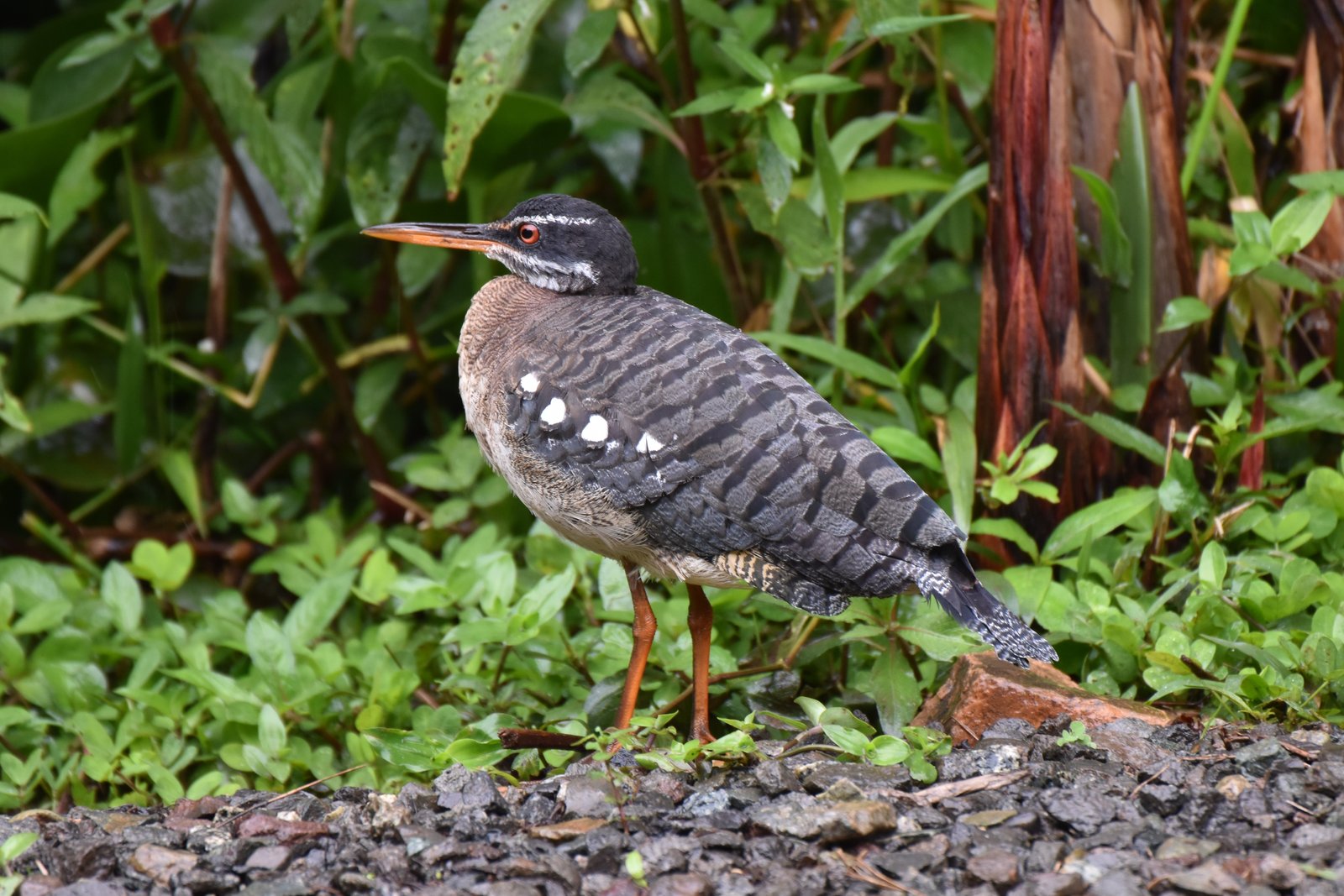
The Sunbittern is the only member of its family: a slender, long-necked bird of forested banks in the tropical lowlands. At rest it is camouflaged in finely barred grey and brown, but in threat or courtship it spreads its wings and tail, revealing on each wing a large eyespot in chestnut, yellow and black. Its closest relative is the Kagu of New Caledonia.
Voice
A long, high, plaintive whistle that slowly swells or rises slightly, wheeeee, often given from cover. Also rattling and hissing sounds when threatened.
Recording: JAYRSON ARAUJO DE OLIVEIRA — CC BY-NC-SA 4.0 · xeno-canto
Identification
43–48 cm, with a long, thin neck, a small head, a straight, pointed bill and rather short orange legs. The head is black with one white stripe above and one below the eye. The neck and upperparts are finely barred and spotted in grey, brown and black; the long tail has grey and black bands. When the wings are spread, a large chestnut, yellow and black eyespot appears on each wing. The upper mandible is black, the lower orange. The sexes are alike; juveniles are duller, with less distinct head stripes.
Confusion species
Sungrebe Heliornis fulica lives along the same quiet banks, but swims low in the water and has a short red bill and a black-and-white striped neck. Young tiger herons, such as Rufescent Tiger Heron Tigrisoma lineatum and Fasciated Tiger Heron Tigrisoma fasciatum, are also finely barred, but larger and heavier, with a thicker neck and without the white head stripes. In flight the wing eyespots separate the Sunbittern from all other species.
Habitat
Banks of forested streams, rivers and lakes, often in shade, in the lowlands and Andean foothills up to about 1200 m, locally higher. It walks slowly and cautiously along the water and over mud and stones, and catches insects, crustaceans, frogs and small fish with a quick thrust of the bill. The nest is a cup of mud and plant material on a branch or in a fork, above or close to water.
Where the bird is most at home, classified by the vegetation units of the Andes and the west coast.


Range and movements
In Colombia in the lowlands on both sides of the Andes, from the Pacific coast to Amazonia. In Ecuador mainly in the eastern lowlands and foothills, scarce in the northwest. In Peru and Bolivia in the Amazonian lowlands and the foothills of the east slope of the Andes. Absent from Galápagos. Outside the guide area from southern Mexico to Amazonian Brazil.
- Resident
- dark = core range, pale = thinly spread
How and when to look
Search along quiet, shaded forest streams and oxbow lakes, for example from a canoe or along trails that follow a stream. It often walks calmly along the waterline and, when disturbed, flies off low over the water, showing the wing patches.
Conservation status
Least Concern. Large range and a stable population; locally sensitive to deforestation along rivers and pollution of streams.
Scientific name
Eurypyga helias | (Pallas, 1781)
Pallas described the species in 1781 as Ardea helias; because it was later moved to another genus, the author and year stand in brackets. The genus Eurypyga was introduced in 1811 by Illiger. The genus name comes from Greek eurus, 'broad', and pugē, 'rump'. The species name comes from Greek hēlias, 'of the sun', after the sun-like patches on the spread wings. The specimen the first description was based on came from Suriname.