All species › Waders, gulls and terns › Painted-snipes › South American Painted-Snipe
South American Painted-Snipe | Nycticryphes semicollaris
Pampasnip | Aguatero americano | Narceja-de-bico-torto
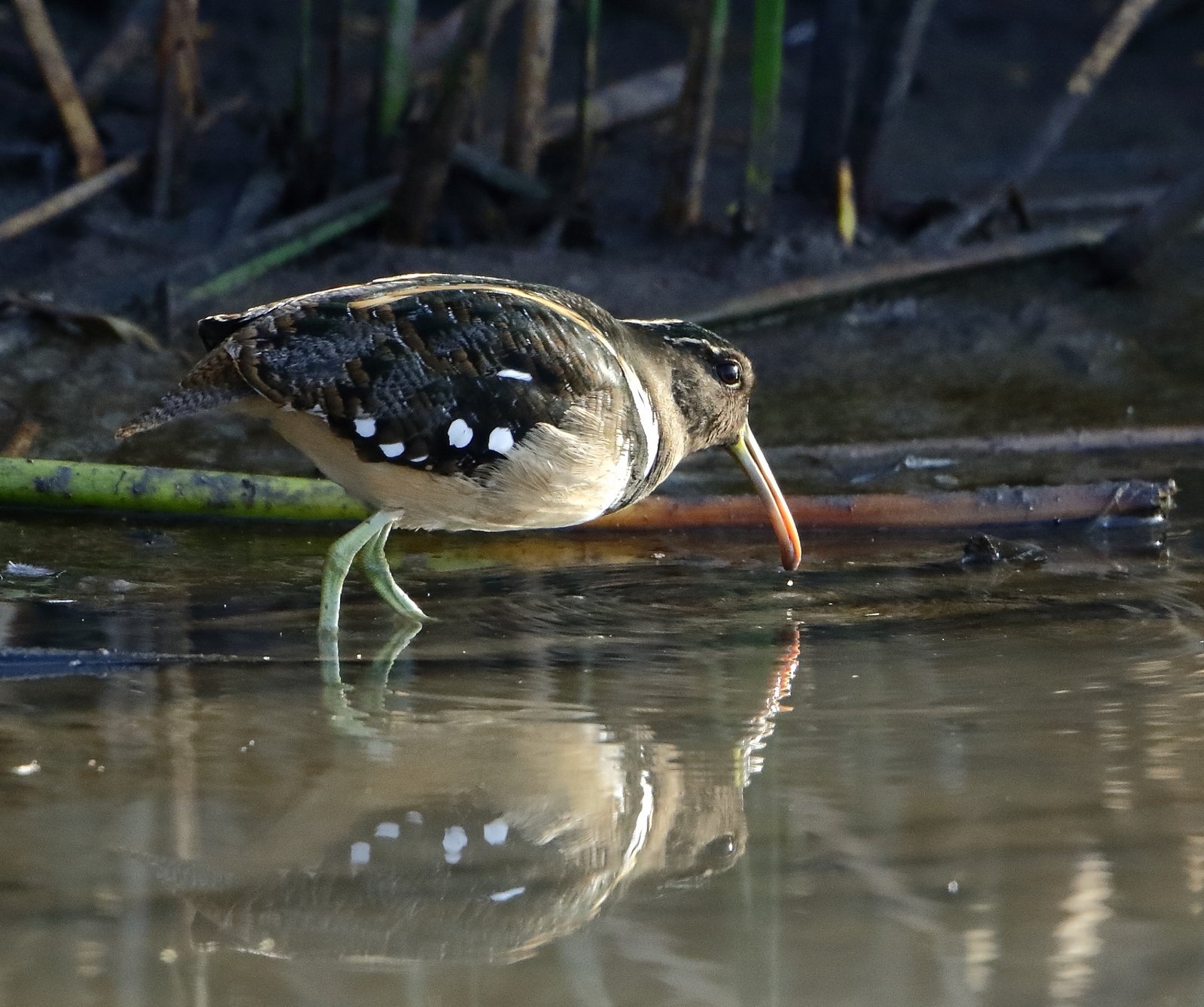
The South American Painted-Snipe is a stocky, snipe-like bird of marshes in southern South America and the only painted-snipe of the New World. It is active mainly at dusk and hides by day in dense waterside vegetation. In the guide area it has been recorded only as a very rare vagrant.
Voice
Mostly silent; its calls are poorly described.
Recording: Pablo Fernández — CC BY-NC-SA 4.0 · xeno-canto
Identification
19–23 cm, with a long bill whose tip curves slightly downwards, a round head and fairly short, greenish legs. The head and neck are dark rufous-brown to blackish, with a pale crown stripe and a pale stripe behind the eye. The upperparts are dark olive-brown with pale, V-shaped stripes on the back and round white spots on the wing coverts. A white band runs from the side of the breast up to the shoulder; the belly is white. In flight broad, rounded wings. The sexes are similar.
Confusion species
Pantanal Snipe Gallinago paraguaiae has a straight, longer bill, a striped head and no white spots on the wings or white breast band; it flushes in fast zigzags. Puna Snipe Gallinago andina and Jameson's Snipe Gallinago jamesoni live high in the Andes and also have a straight bill and streaked plumage.
Habitat
Freshwater marshes, wet grassland, rice fields and the vegetated banks of lakes and ditches in the lowlands. It probes the mud for invertebrates and seeds, mainly at dusk and at night. It does not breed in the guide area.
Where the bird is most at home, classified by the vegetation units of the Andes and the west coast.


Range and movements
In the guide area only as a very rare vagrant, with only a few records in the south. Absent from the Galápagos. It breeds in central Chile, Argentina, Uruguay, Paraguay and southern Brazil.
How and when to look
A vagrant may turn up in wet grasslands and marshes in south-eastern Bolivia. The bird crouches against the ground when disturbed and flushes with dangling legs, more slowly than a snipe.
Conservation status
Least Concern. Drainage of marshes degrades its habitat locally, but the species has a large range.
Scientific name
Nycticryphes semicollaris | (Vieillot, 1816)
Vieillot described the species in 1816 as Totanus semi-collaris; because it was later moved to another genus, the author and year stand in brackets. The genus Nycticryphes was introduced in 1923 by Wetmore & Peters. The genus name comes from Greek nukti-, 'night-, nocturnal' (from nux, nuktos, 'night'), and kruphē, 'concealment, secrecy'. The specific name comes from Latin semi, 'half', and collaris, 'of the neck', so 'half-collared'. The specimen the first description was based on came from Paraguay.