All species › Waders, gulls and terns › Skimmers, noddies, terns and gulls › California Gull
California Gull | Larus californicus
Californische meeuw | Gaviota californiana | Gaivota-da-califórnia
The California Gull breeds on inland lakes in western North America and winters along the Pacific coast, mainly from British Columbia to Mexico. It is seldom seen south of Mexico. In the guide area it is known only as a very rare vagrant; there are only a few records, some of them uncertain.
Voice
A hoarse, laughing kyaa-kyaa, higher than in the herring gulls. Vagrants are rarely heard.
Recording: Paul Marvin — CC BY-NC-SA 4.0 · xeno-canto
Identification
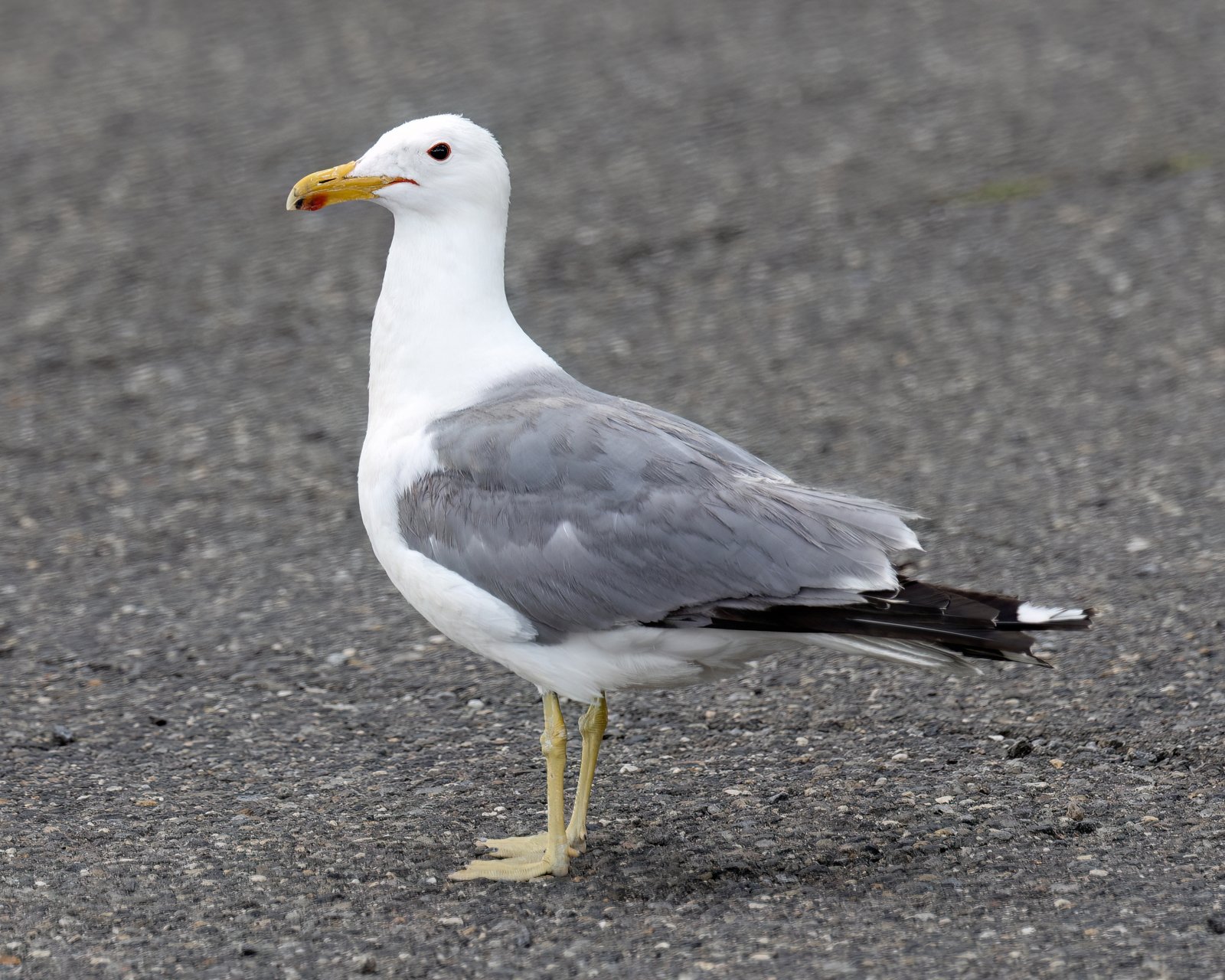
51–58 cm, a medium-sized gull, between Ring-billed Gull and the herring gulls, with a rather long, slender bill. Adults have a mid-grey mantle, slightly darker than in the herring gulls, a black wingtip with white spots, a dark iris, greenish-yellow legs and a yellow bill with a red and a black spot; in winter the hindneck is streaked brown. Immatures are mottled brown, with a pink bill with a sharply defined black tip and greyish-pink legs. Adult plumage is reached after about four years. The sexes are alike.
Confusion species
Ring-billed Gull Larus delawarensis is smaller, with a paler mantle, a pale iris and a shorter bill with a black ring. American Herring Gull Larus smithsonianus is larger, with a paler mantle, a pale iris and pink legs. Lesser Black-backed Gull Larus fuscus has a much darker mantle and a pale iris. Belcher's Gull Larus belcheri has a blackish-brown mantle and a black tail band.
Habitat
Coasts, estuaries, harbours and rubbish dumps; on the breeding grounds inland lakes and farmland. It eats fish, insects, invertebrates and refuse. It does not breed in the guide area.
Where the bird is most at home, classified by the vegetation units of the Andes and the west coast.


Range and movements
In the guide area only as a very rare vagrant, with at most a few records on the Pacific coast; its status is uncertain. Breeds inland in western Canada and the western United States; winters along the Pacific coast of North America, south to Mexico.
How and when to look
A vagrant can only be found among flocks of gulls in harbours and estuaries on the Pacific coast. Note the medium size, dark iris and greenish-yellow legs; a good photograph is needed to document the record.
Conservation status
Least Concern. The population is large; locally breeding colonies suffer from falling water levels in inland lakes.
Scientific name
Larus californicus | Lawrence, 1854
Lawrence described the species in 1854 and placed it straight away in the genus where it still stands. The genus Larus was introduced in 1758 by Linnaeus. The genus name comes from Greek laros or Latin larus, a word for a gull or another large seabird. The species name refers to California, not necessarily the type locality. The specimen the first description was based on came from Stockton, California, United States.