All species › Passerines › Antbirds › Black Bushbird
Black Bushbird | Neoctantes niger
Zwarte dikbekmiervogel | Arbustero negro | Choca-preta
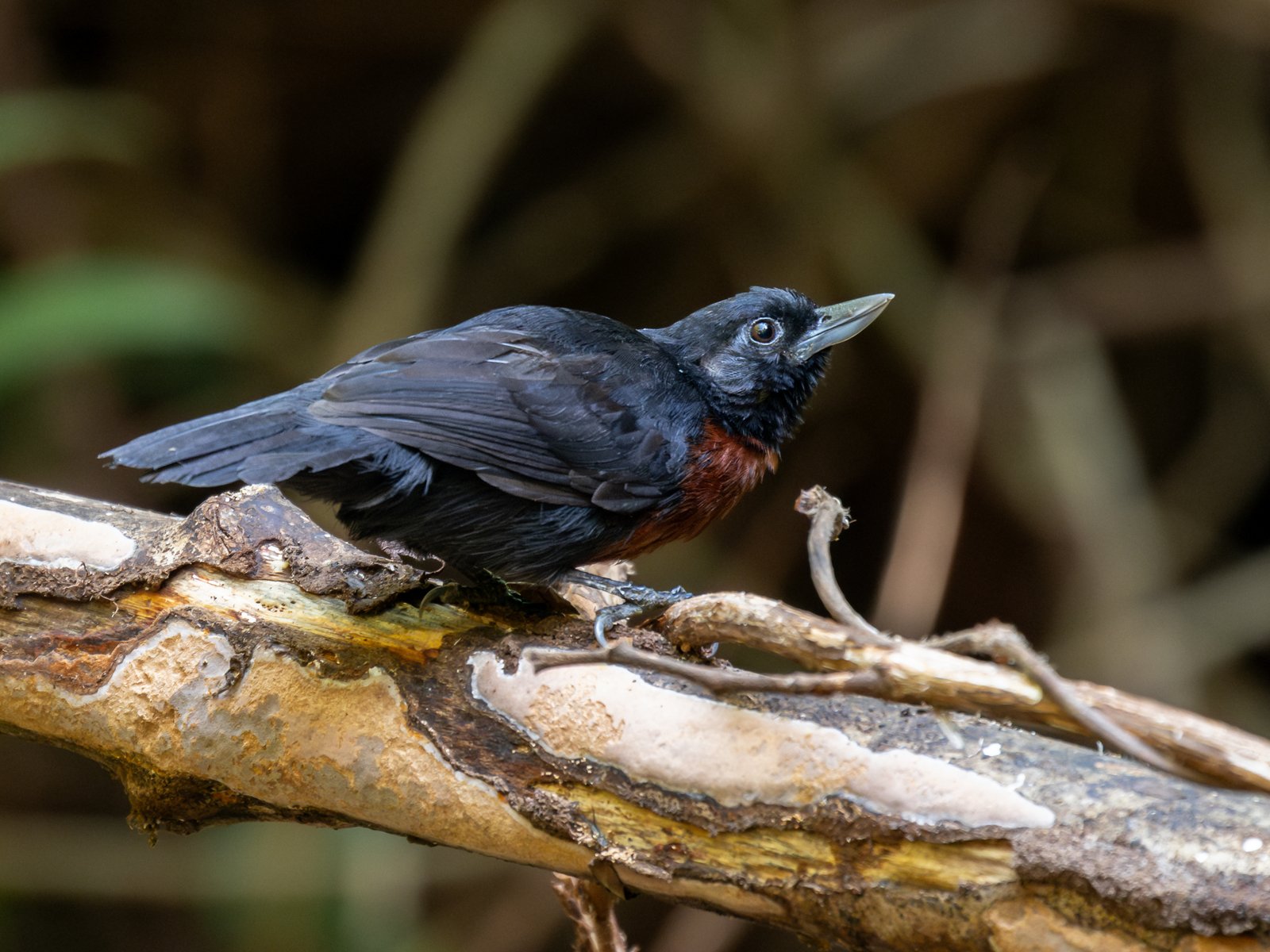
The Black Bushbird is a stocky black antbird with a short, thick bill with an upturned lower mandible, which it uses to pry open bark and rotten wood. It lives in dense undergrowth in the Amazonian lowlands, mainly in várzea. Pairs are widely spaced and do not vocalize often.
Voice
The song is a long series of semi-musical werk notes, about one per second, that can continue for a minute or more. The call is a nasal, squealing two-part kyoo, the second part lower.
Recording: GABRIEL LEITE — CC BY-NC-SA 4.0 · xeno-canto
Identification
15–16 cm, stocky, with a short tail and a short, thick bill with an upturned lower mandible. The male is entirely black, with a small, usually concealed white interscapular patch. The female is sooty black with a rufous breast and upper belly.
Confusion species
Blackish Antbird Cercomacroides nigrescens is slimmer, with a thin, straight bill and a longer tail; the female is rufous below with an olive-brown back. Recurve-billed Bushbird Clytoctantes alixii has an even larger, laterally compressed bill and a grey male; it lives in northern Colombia and does not overlap with this species.
Habitat
Dense undergrowth in várzea and terra firme forest of the Amazonian lowlands, mainly in várzea, along forest edges, in treefall gaps and along swampy streams. It forages alone or in pairs from the ground up to about 10 m, picking, hammering and digging into branches, woody vines and rotten wood for insects and other arthropods. It sometimes briefly joins mixed flocks passing through its territory. The only described nest was a bulky cup of plant material with one egg.
Where the bird is most at home, classified by the vegetation units of the Andes and the west coast.


Range and movements
In Colombia in the south and south-east, east of the Andes. In Ecuador in the eastern lowlands. In Peru in the north-east and south-east of the Amazonian lowlands. In Bolivia at most in the far north, with few documented records. Absent from the Galápagos. Outside the guide area in western Amazonian Brazil and isolated in central Amazonia.
- Resident
- dark = core range, pale = thinly spread
How and when to look
In várzea forest along tributaries of the Amazon, for example around Iquitos, listen for the long, regular werk series and search close to the ground in the undergrowth.
Conservation status
Least Concern. The species is widespread but occurs everywhere at low densities.
Scientific name
Neoctantes niger | (Pelzeln, 1859)
Pelzeln described the species in 1859 as Xenops niger; because it was later moved to another genus, the author and year stand in brackets. The genus Neoctantes was introduced in 1869 by Sclater. The genus name comes from Greek neos, 'new, strange', and ktantēs, 'murderer', an allusion to the antshrikes. Sclater erected the genus in 1869. The species name comes from Latin niger, 'black'. The specimen the first description was based on came from Marabitanas, Rio Negro, Brazil.