All species › Passerines › Antbirds › Sooty Antbird
Sooty Antbird | Hafferia fortis
Roetmiervogel | Hormiguero tiznado | Formigueiro-de-taoca
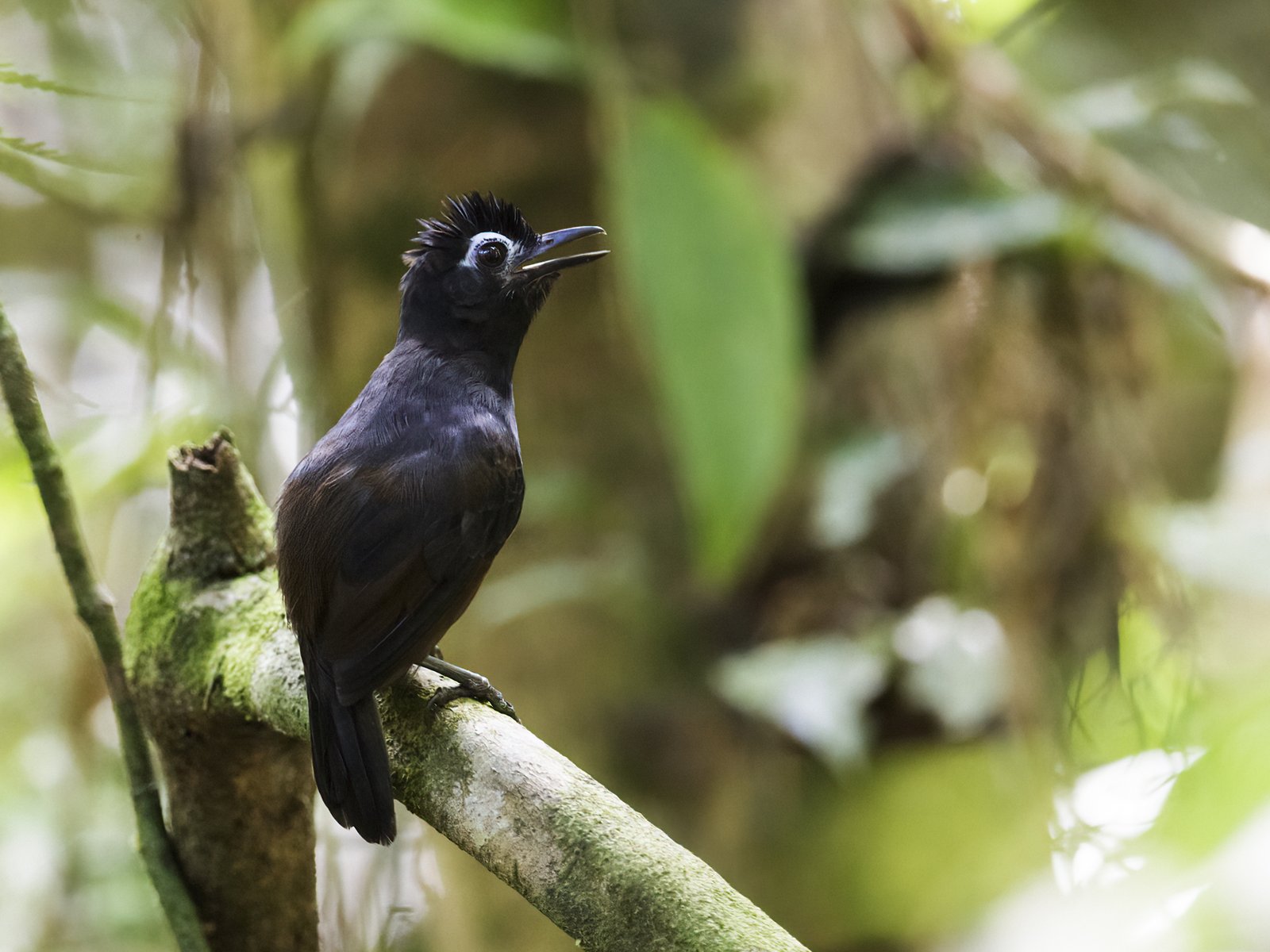
The Sooty Antbird is a large, dark antbird of the forest floor in the western Amazon basin. Both sexes have bare, pale blue skin around the eye. It regularly follows army ant swarms and dominates smaller ant-followers there.
Voice
The song is an even series of ringing, whistled notes that gradually descend. Calls: a loud, musical rattle, a descending mewing note and a hollow chatter.
No recording with a suitable Creative Commons licence is available for this species yet.
Identification
18 cm. Bare, pale blue skin around the eye; the iris is red. The male is uniform very dark grey, almost black, with a brownish tinge to the wings. The female has a rufous-chestnut crown with a black border, greyish olive-brown upperparts, rufous wings and grey underparts with tawny flanks. Young males resemble the female but are darker and greyer.
Confusion species
Plumbeous Antbird Myrmelastes hyperythrus also has blue skin around the eye, but the male is paler, lead-grey, with white spots on the wing coverts, and the female has rufous underparts; it lives mainly in várzea. White-shouldered Antbird Akletos melanoceps is black with a white shoulder patch and no blue eye-ring, and the female has a rufous body. Dusky Antbird Cercomacroides tyrannina and related species are smaller and slimmer.
Habitat
Floor and understorey of terra firme forest, less often in transitional forest and occasionally in várzea; prefers dense undergrowth near streams and treefall openings. In Colombia up to about 300 m, in Ecuador to 600 m and in Peru to 1300 m. It forages alone, in pairs or family groups on or just above the ground, pumping its tail. The nest is a domed ball of dry leaves, twigs and bark on the ground, with a side entrance.
Where the bird is most at home, classified by the vegetation units of the Andes and the west coast.


Range and movements
Colombia: the Amazon region in the south. Ecuador: the eastern lowlands and foothills. Peru: the eastern lowlands south to northern Puno. Bolivia: the north-west (Pando, La Paz). Absent from the Galápagos. Beyond the guide area in western Brazil south of the Amazon to the Madeira.
- Resident
- dark = core range, pale = thinly spread
How and when to look
Wait at an army ant swarm in terra firme forest in eastern Ecuador or eastern Peru; the Sooty Antbird often joins. Also listen for the ringing, descending song near streams in dense undergrowth.
Conservation status
Least Concern. Large range, probably stable population, fairly common in Colombia and uncommon to fairly common in Peru; it occurs in several large protected areas.
Scientific name
Hafferia fortis | (Sclater & Salvin, 1868) (GBIF: Myrmeciza fortis)
Sclater & Salvin described the species in 1868 as Percnostola fortis; because it was later moved to another genus, the author and year stand in brackets. The genus Hafferia was introduced in 2013 by Isler, Bravo & Brumfield. The genus name honours the German geologist and ornithologist Jürgen Haffer (1932–2010), who made groundbreaking contributions to Neotropical ornithology. The species name comes from Latin fortis, 'strong, sturdy', for the robust build. The specimen the first description was based on came from Loreto, Peru.