All species › Passerines › Antbirds › Zeledon's Antbird
Zeledon's Antbird | Hafferia zeledoni
Zeledons miervogel | Hormiguero de Zeledón | Formigueiro-de-zeledón
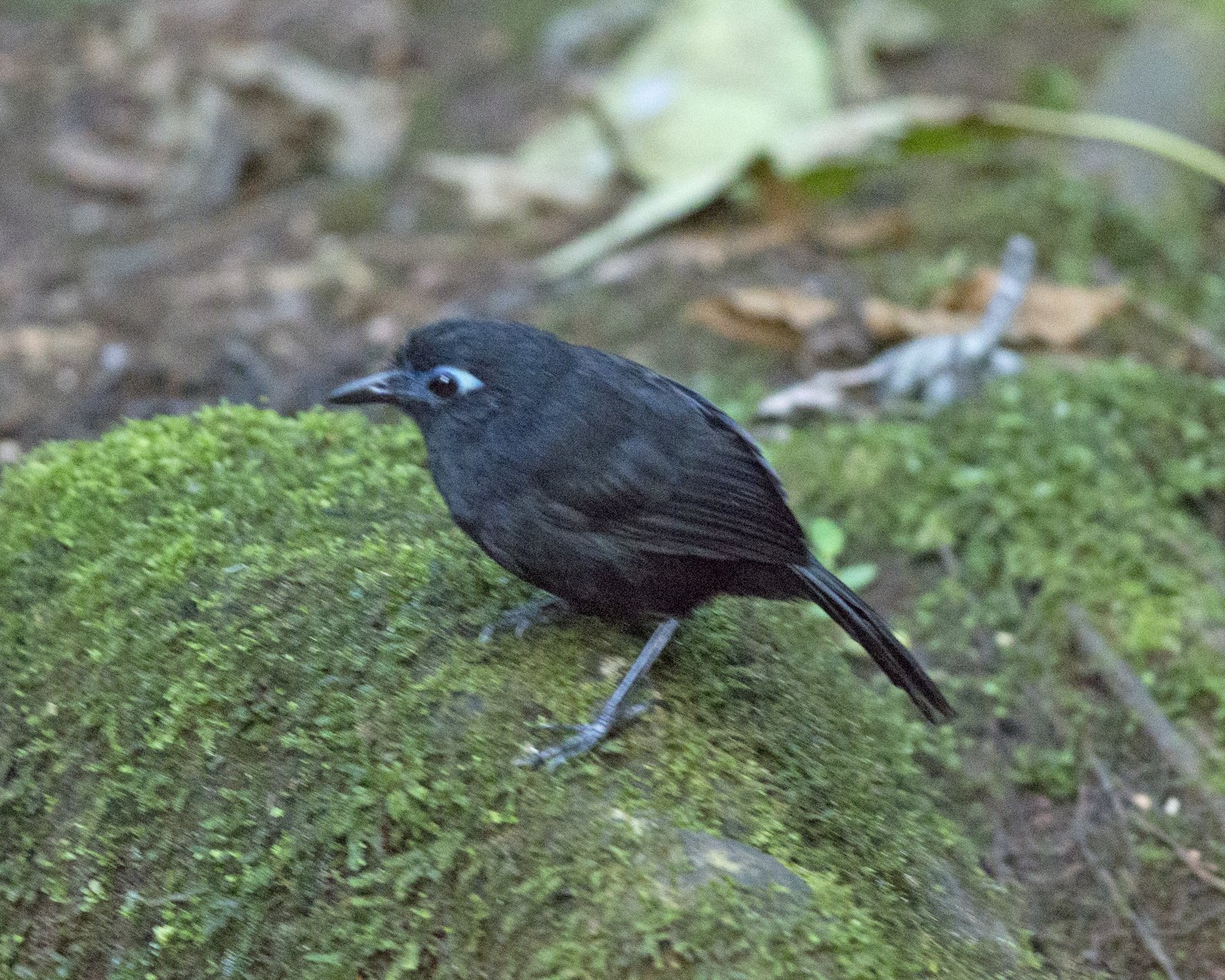
Zeledon's Antbird is a large, long-tailed antbird of humid forest in Central America and on the Pacific side of Colombia and Ecuador. It is named after the Costa Rican ornithologist José Castulo Zeledón. Together with the Blue-lored Antbird of the Colombian Andes it was formerly treated as one species.
Voice
The male sings a loud, ringing series of clear whistled notes that descends slightly and slows towards the end. Both sexes give a sharp cheek! and a fast scolding rattle.
No recording with a suitable Creative Commons licence is available for this species yet.
Identification
18–19 cm, with a long tail. Both sexes have a broad, bare, pale blue eye-ring and a deep red iris. The male is black with a usually concealed white patch at the bend of the wing. The female is dark brown, paler below, with black lores and face; in the guide area (subspecies berlepschi) the female is paler and brighter brown and the male shows more white on the wing. Young males resemble the female.
Confusion species
Blue-lored Antbird Hafferia immaculata lives in the Andes of Colombia and is almost identical; the female is darker brown. Esmeraldas Antbird Sipia nigricauda and Stub-tailed Antbird Sipia berlepschi are much smaller, with a short tail and no blue eye-ring. Dusky Antbird Cercomacroides tyrannina is smaller and greyer.
Habitat
Understorey and edges of humid evergreen forest and mature secondary forest in the lowlands and foothills, especially on regenerating landslides, at treefalls and in steep ravines. In Colombia from 100 to 1600 m, in Ecuador mostly below 1400 m and locally up to 2000 m. It searches for insects on or just above the ground and sometimes follows army ants.
Where the bird is most at home, classified by the vegetation units of the Andes and the west coast.


Range and movements
Colombia: the Pacific lowlands and the western slope of the West Andes, from the Panama border southwards. Ecuador: the west, south to western Loja. Absent from Peru, Bolivia and the Galápagos. Beyond the guide area from Nicaragua to Panama.
- Resident
- dark = core range, pale = thinly spread
How and when to look
In north-western Ecuador, for example around Mindo and Milpe, the species can be found in the understorey of forest in ravines; listen for the ringing series of whistles and look for the blue eye-ring in the half-light.
Conservation status
Least Concern. Large range with at least 50,000 mature individuals; the population is probably declining through forest loss, but no immediate threats are known. Common in Colombia.
Scientific name
Hafferia zeledoni | (Ridgway, 1909)
Ridgway described the species in 1909 as Myrmeciza zeledoni; because it was later moved to another genus, the author and year stand in brackets. The genus Hafferia was introduced in 2013 by Isler, Bravo & Brumfield. The genus name honours the German geologist and ornithologist Jürgen Haffer (1932–2010), who made groundbreaking contributions to Neotropical ornithology. The species name honours the Costa Rican ornithologist José Castulo Zeledón (1846–1923), who collected birds in Costa Rica and donated his collection to the National Museum of Costa Rica. The specimen the first description was based on came from Guayabo, Costa Rica.