All species › Passerines › Antbirds › Blue-lored Antbird
Blue-lored Antbird | Hafferia immaculata
Blauwmaskermiervogel | Hormiguero inmaculado | Formigueiro-de-loro-azul
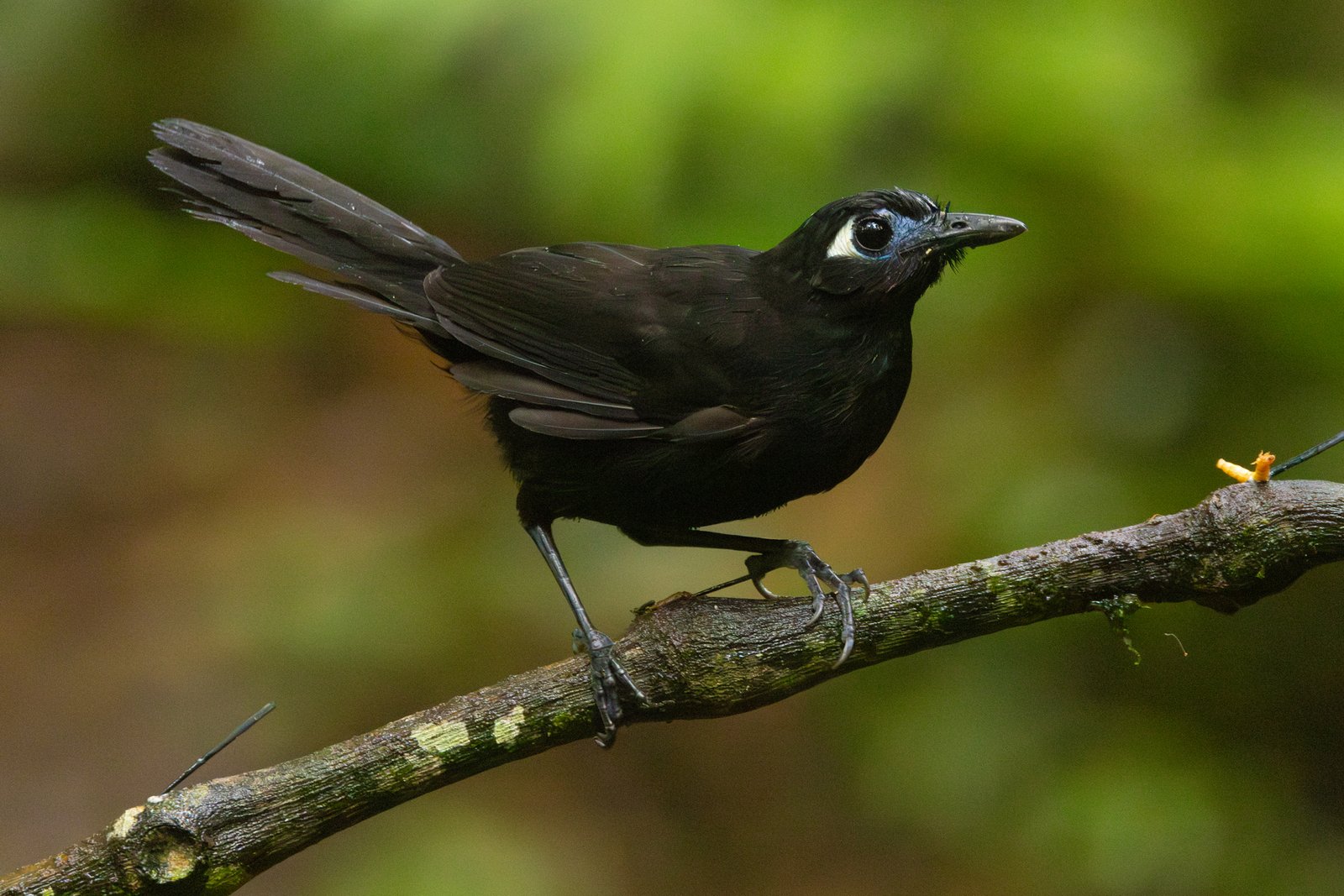
The Blue-lored Antbird is the Andean counterpart of Zeledon's Antbird; the two were treated as one species until recently. It lives patchily in humid forest in the Andes of Colombia and adjacent western Venezuela. The name refers to the bare, pale blue skin around and in front of the eye.
Voice
The song closely resembles that of Zeledon's Antbird: a loud, ringing series of whistled notes. According to the available literature only one of the vocalizations differs; details are insufficiently known.
No recording with a suitable Creative Commons licence is available for this species yet.
Identification
18–19 cm, with a long tail. Bare, pale blue skin around the eye and on the lores, which can look almost white from behind. The male is black with a small, usually concealed white patch at the bend of the wing. The female is dark brown, with a blackish face and a darker tail.
Confusion species
Zeledon's Antbird Hafferia zeledoni on the Pacific side is almost identical; its female is paler and brighter brown. Range and elevation are the best features. Parker's Antbird Cercomacroides parkeri in the Colombian Andes is much smaller and grey, without blue skin around the eye.
Habitat
Understorey of humid foothill and montane forest and mature secondary forest, especially in ravines and dense undergrowth. Mostly below about 1400 m, locally higher. It searches for insects on the dark forest floor and sometimes follows army ant swarms.
Where the bird is most at home, classified by the vegetation units of the Andes and the west coast.


Range and movements
Colombia: patchily in the Andes, mainly in the Central and East Andes and the Sierra de Perijá. Absent from Ecuador, Peru, Bolivia and the Galápagos. Beyond the guide area only in western Venezuela (Perijá and the Andes).
- Resident
- dark = core range, pale = thinly spread
How and when to look
Search forest remnants with ravines on the slopes of the Magdalena Valley, for example in Caldas and Cundinamarca. The birds stay low in the undergrowth; listen for the song and look for the pale patch around the eye.
Conservation status
Least Concern. The species occurs patchily; much of the forest in the Colombian Andes at these elevations has been converted to farmland, so the population locally lives in small forest remnants.
Scientific name
Hafferia immaculata | (de Lafresnaye, 1845)
De Lafresnaye described the species in 1845 as Thamnophilus immaculatus; because it was later moved to another genus, the author and year stand in brackets. The genus Hafferia was introduced in 2013 by Isler, Bravo & Brumfield. The genus name honours the German geologist and ornithologist Jürgen Haffer (1932–2010), who made groundbreaking contributions to Neotropical ornithology. The species name comes from Latin immaculatus, 'spotless', for the plain plumage. The specimen the first description was based on came from Bogotá, Colombia.