All species › Passerines › Antbirds › Black-throated Antbird
Black-throated Antbird | Myrmophylax atrothorax
Zwartkeelmiervogel | Hormiguero golinegro | Formigueiro-de-peito-preto
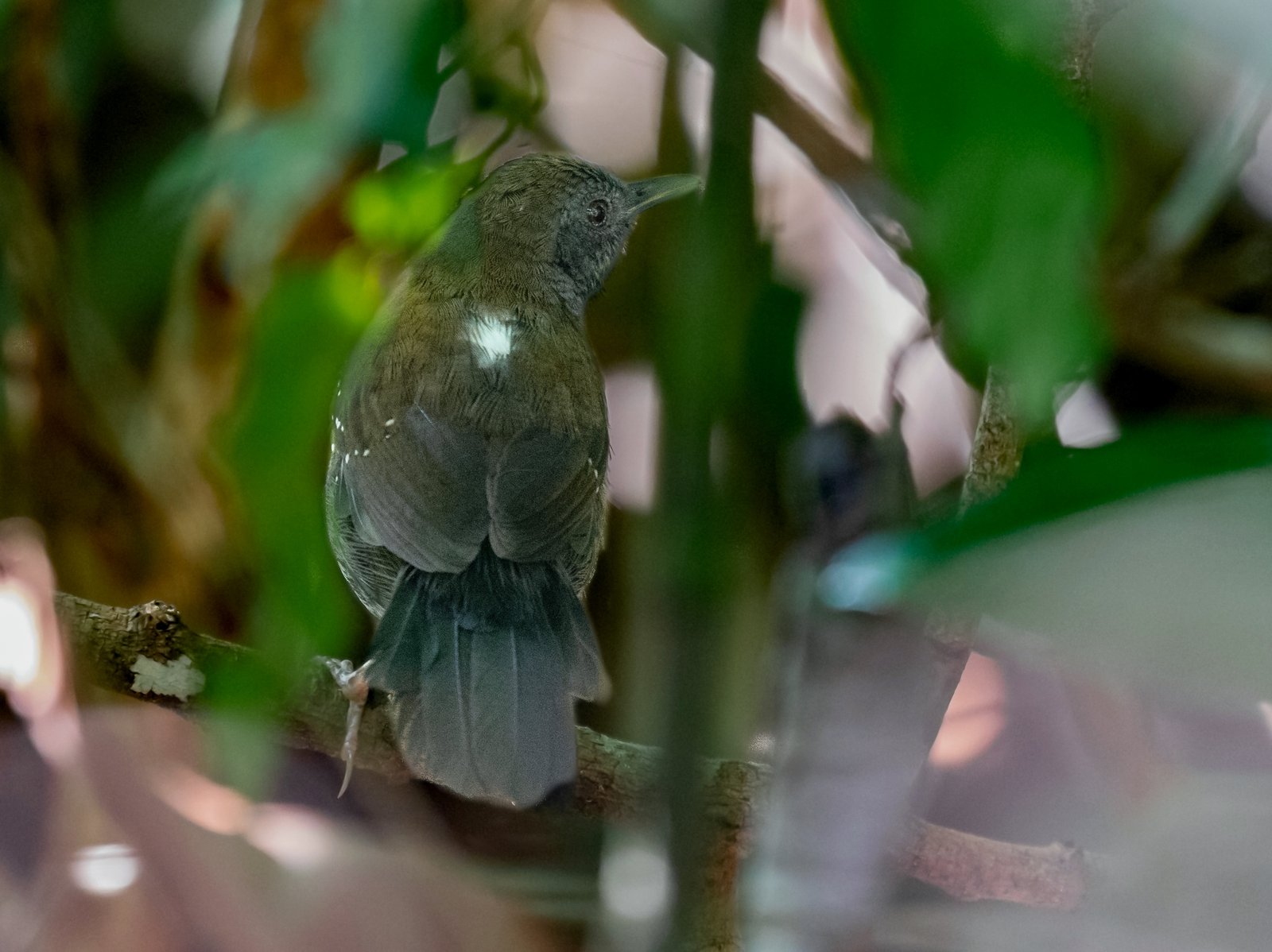
The Black-throated Antbird is a dark antbird of dense thickets, forest edges and riverine forest in the Amazon basin. It keeps low in tangled vegetation and usually first gives itself away by its song. The male is recognized by its black throat and breast combined with white-dotted wing coverts.
Voice
The song is a rising series of sharp, whistled notes that follow each other faster and faster. Calls are short, sharp notes and a dry rattle.
Recording: João Capurucho — CC BY-NC-SA 4.0 · xeno-canto
Identification
13–14 cm, with a fairly long tail. The male is dark olive-brown above, with blackish wing coverts with small white dots; the throat and breast are black, the belly dark grey and the flanks brown. The female is similar above, but has a pale throat and a warm rufous breast and belly. In both sexes the tail lacks white tips.
Confusion species
The male Black-faced Antbird Myrmoborus myotherinus has a grey back, a black mask, a narrow white supercilium and a grey breast. Grey-bellied Antbird Ammonastes pelzelni has a shorter tail, a rufous back and large buff wing spots, and lives on white sand. Southern Chestnut-tailed Antbird Sciaphylax hemimelaena has a rufous tail and lives in the forest interior.
Habitat
Dense thickets along forest edges and clearings, secondary forest, riverine forest and river islands, bamboo and dense scrub along streams in the Amazonian lowlands and foothills, up to about 1000 m, locally higher. It forages low, in pairs, on and just above the ground for insects and other arthropods, and sometimes follows army ants. The nest is a cup low in dense vegetation.
Where the bird is most at home, classified by the vegetation units of the Andes and the west coast.


Range and movements
In Colombia east of the Andes, in the east and south of the country. In Ecuador in the eastern lowlands and foothills. In Peru in the Amazonian lowlands east of the Andes. In Bolivia in the northern and eastern lowlands. Absent from the Galápagos. Outside the guide area in southern Venezuela, the Guianas and Amazonian Brazil.
- Resident
- dark = core range, pale = thinly spread
How and when to look
Listen along thickets and second growth near Amazonian lodges, for example in Madre de Dios or around Leticia. Follow the song to a low spot in the thicket and wait for the bird to show itself.
Conservation status
Least Concern. It tolerates disturbance and is locally common in second growth.
Scientific name
Myrmophylax atrothorax | (Boddaert, 1783) (GBIF: Myrmeciza atrothorax)
Boddaert described the species in 1783 as Formicarius attothorax; because it was later moved to another genus, the author and year stand in brackets. The genus Myrmophylax was introduced in 1927 by Todd. The genus name comes from Greek murmos, 'ant', and phulax, 'watcher, observer'. The species name comes from Latin ater, 'black', and thorax, 'breast'. The specimen the first description was based on came from Cayenne, French Guiana.