All species › Passerines › Antbirds › Striated Antbird
Striated Antbird | Drymophila devillei
Streepkopmiervogel | Tiluchí estriado occidental | Trovoada-listrada
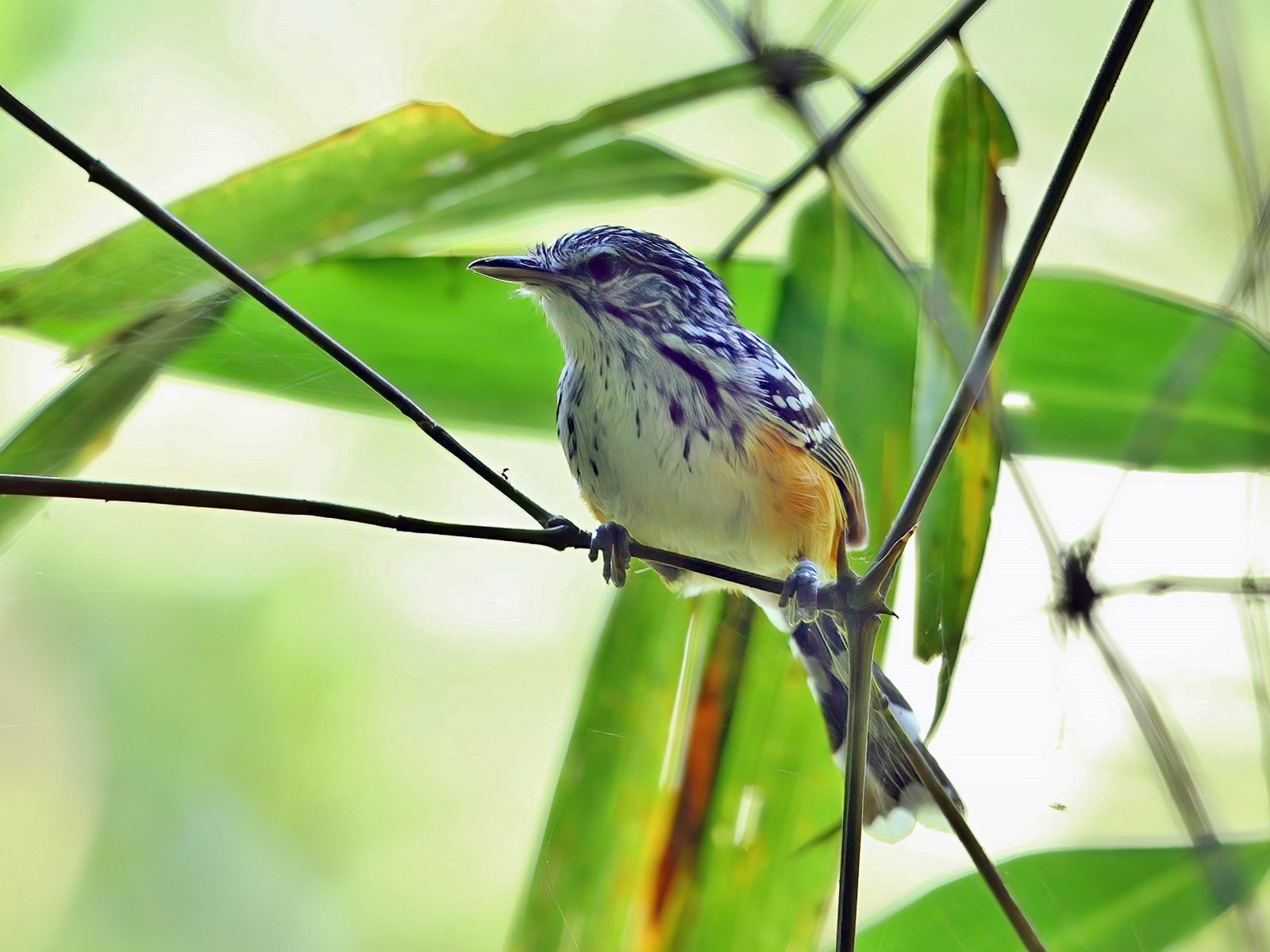
The Striated Antbird is a long-tailed, heavily streaked antbird that in the guide area lives almost exclusively in bamboo. Pairs and family groups move through dense Guadua stands and often sing in duet. It is the only member of the genus Drymophila in the Amazonian lowlands of the guide area.
Voice
The male sings a short series: one or two clear introductory notes followed by a series of hoarse, buzzy notes; the female answers with a shorter series of her own. The call is a dry chip.
Recording: Juan Freile — CC BY-NC-SA 4.0 · xeno-canto
Identification
13–14 cm, with a long, graduated tail. The male has a black crown with white streaks, a white supercilium and a mantle streaked black and white with a rufous rump. The wings are black with white wingbars. The throat and breast are white with black streaks, the flanks and undertail coverts rufous. The tail is blackish with white tips. The female has buff streaks on the crown and is less heavily streaked and more buff on the breast.
Confusion species
The warbling antbirds of the genus Hypocnemis, such as Peruvian Warbling Antbird Hypocnemis peruviana, have a much shorter tail without white tips. Dot-winged Antwren Microrhopias quixensis also often lives in bamboo and has white tail tips, but the male is plain black and the female rufous below. Streak-headed Antbird Drymophila striaticeps lives higher in the Andes, in Chusquea bamboo, and is larger.
Habitat
Dense stands of Guadua bamboo in the lowlands and foothills, also bamboo at forest edges and along rivers, from about 200 to 1200 m. It searches for insects and spiders among bamboo leaves and stems, usually 1 to 8 m above the ground, sometimes in mixed flocks. The nest is a cup in dense bamboo or rank growth.
Where the bird is most at home, classified by the vegetation units of the Andes and the west coast.


Range and movements
Colombia: in the south-east, locally in Putumayo and Amazonas. Ecuador: locally in the eastern lowlands where bamboo grows. Peru: in the east, mainly in the centre and south-east (Ucayali, Cusco, Madre de Dios, Puno). Bolivia: in the north, in Pando, Beni and La Paz. Absent from the Galápagos. Outside the guide area in western Amazonian Brazil; a separate subspecies lives further east in Brazil.
- Resident
- dark = core range, pale = thinly spread
How and when to look
Search bamboo along roads and rivers in Madre de Dios, for example at Tambopata or along the road to Manu. The duet in the morning is the first sign; the birds then move through the dense bamboo.
Conservation status
Least Concern. Bamboo forest covers large areas in south-western Amazonia, but elsewhere in the guide area the species is locally tied to small stands.
Scientific name
Drymophila devillei | (Ménégaux & Hellmayr, 1906)
Ménégaux & Hellmayr described the species in 1906 as Formicivora devillei; because it was later moved to another genus, the author and year stand in brackets. The genus Drymophila was introduced in 1824 by Swainson. The genus name combines Greek drumos, 'wood, copse', and philos, 'fond of'. The species name probably honours the French naturalist, taxidermist and collector Émile Deville (1824–1853), who collected in Brazil and Peru from 1842 to 1847. The source also mentions the Belgian consul in Quito Émile Clément Napoléon de Ville (1836–1881) as a possibility. The specimen the first description was based on came from Cusco, Peru.