All species › Passerines › Antbirds › East Andean Antbird
East Andean Antbird | Drymophila caudata
Langstaartmiervogel | Tiluchí colilargo | Trovoada-dos-andes-orientais
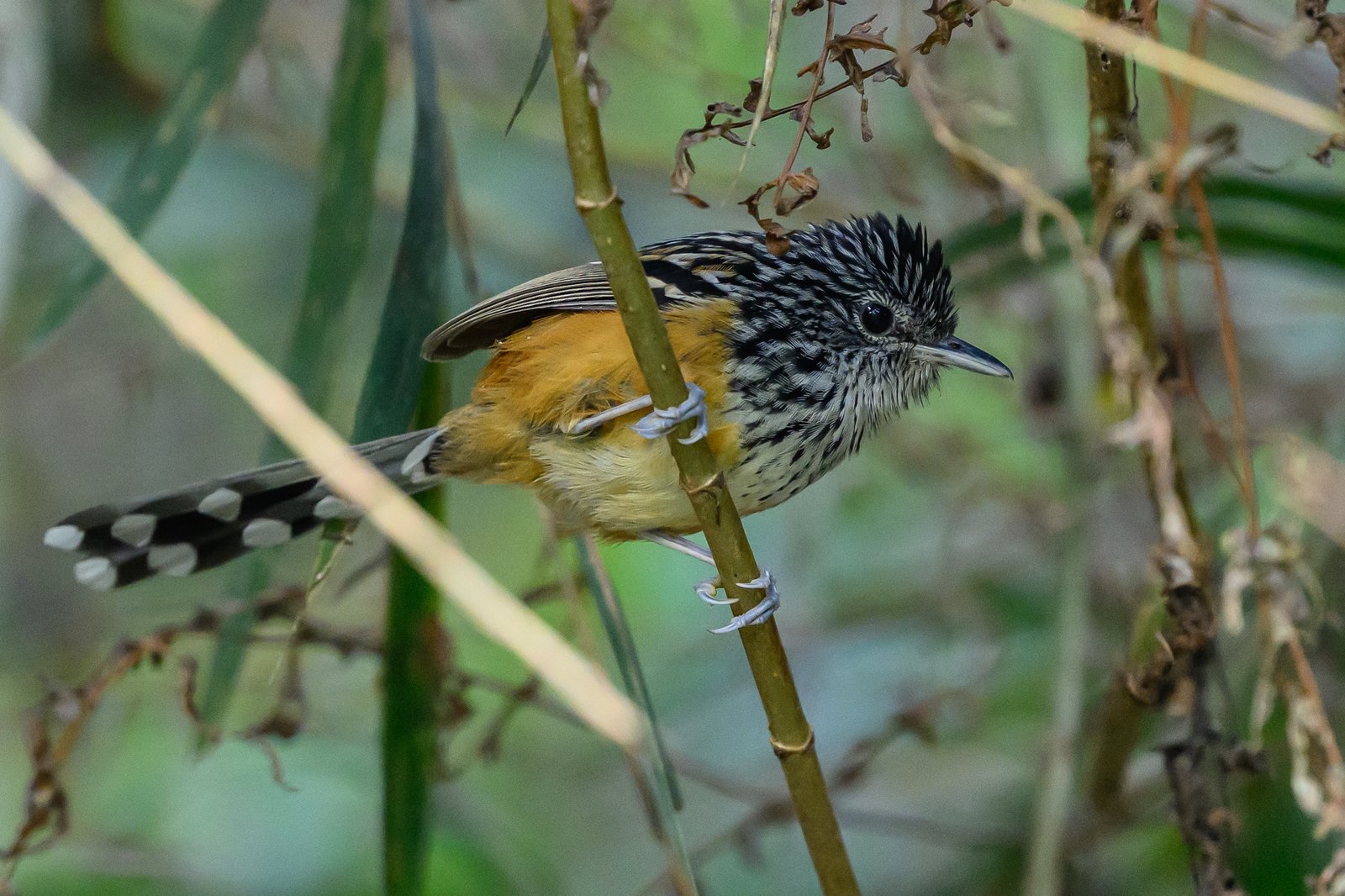
The East Andean Antbird is a streaked, long-tailed antbird of the Eastern Andes of Colombia, where it lives in Chusquea bamboo in montane forest. Until 2012 it was treated together with Streak-headed, Klages's and Santa Marta Antbirds as a single species; differences in song led to a split into four species. As currently understood it occurs only in Colombia.
Voice
The male sings a short series: two or three clear introductory notes followed by a few hoarse, buzzy paired notes; the female answers with a shorter series. The call is a short chip.
Recording: Jorge L. Peña — CC BY-NC-SA 4.0 · xeno-canto
Identification
15 cm, almost half of it tail. The male has a black crown with white streaks, a white supercilium and a mantle streaked black, white and grey with a rufous rump. The wings are black with white wingbars. The throat and breast are white with black streaks, the flanks and lower belly rufous. The long, graduated tail is grey-brown with white tips. The female has buff rather than white streaks on the head and mantle and a more buff breast.
Confusion species
Streak-headed Antbird Drymophila striaticeps lives in the Central and Western Andes and further south to Bolivia and closely resembles this species; the song is the best feature. Klages's Antbird Drymophila klagesi lives in the Serranía de Perijá, in Venezuela and in the north of the Eastern Andes, mostly lower, and likewise has a different song. Santa Marta Antbird Drymophila hellmayri occurs only in the Sierra Nevada de Santa Marta.
Habitat
Stands of Chusquea bamboo in and at the edge of humid montane forest and cloud forest, also in bamboo-rich thickets and secondary growth, roughly between 1500 and 2700 m. It searches for insects and spiders among bamboo leaves and stems, usually low above the ground, in pairs or family groups. The nest is a cup low in dense bamboo.
Where the bird is most at home, classified by the vegetation units of the Andes and the west coast.


Range and movements
Colombia: in the Eastern Andes, on both slopes, locally from Santander south to Cundinamarca. Ecuador, Peru and Bolivia: absent. Absent from the Galápagos. Not known outside the guide area.
- Resident
- dark = core range, pale = thinly spread
How and when to look
Search bamboo along forest edges and trails in the montane forest of the Eastern Andes, for example in the forests above Bogotá or in Santander. The birds respond to each other's duet and then come to the edge of the bamboo.
Conservation status
Least Concern. The range is small and montane forest in the Eastern Andes is heavily fragmented, but the species tolerates forest edges and secondary growth with bamboo.
Scientific name
Drymophila caudata | (Sclater, 1855)
Sclater described the species in 1855 as Formicivora caudata; because it was later moved to another genus, the author and year stand in brackets. The genus Drymophila was introduced in 1824 by Swainson. The genus name combines Greek drumos, 'wood, copse', and philos, 'fond of'. The species name comes from Latin caudatus, 'tailed', for the long tail. The specimen the first description was based on came from Bogotá, Colombia.