All species › Passerines › Antbirds › Klages's Antbird
Klages's Antbird | Drymophila klagesi
Klages' miervogel | Tiluchí de Klages | Trovoada-de-klages
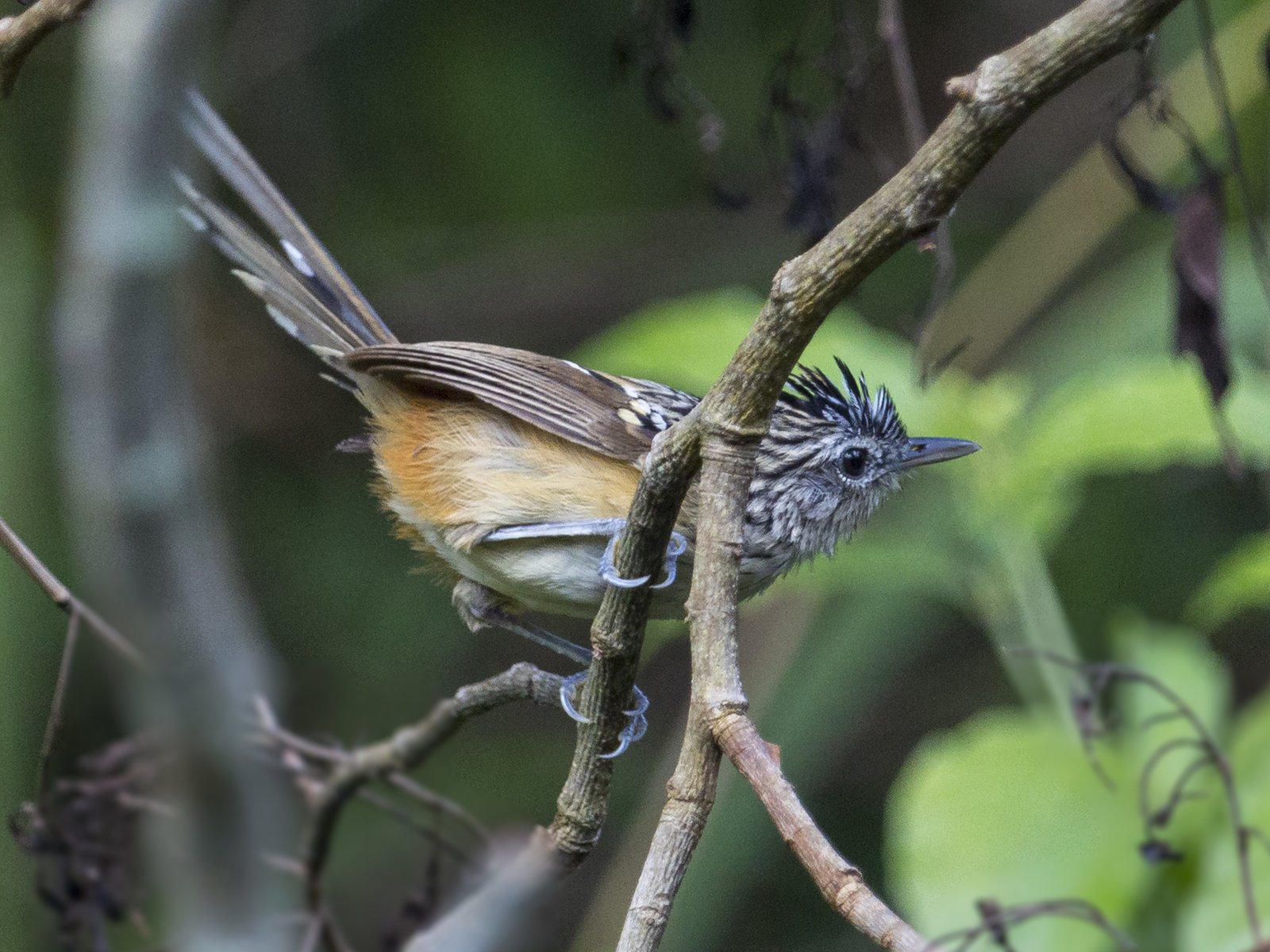
Klages's Antbird is a small, long-tailed antbird with black-and-white streaked plumage and orange-tawny flanks that almost always lives in bamboo. It belongs to a group of closely related species that were formerly treated together as a single species, the Long-tailed Antbird, and have been separated mainly on the basis of their songs. In the guide area it occurs only in north-eastern Colombia.
Voice
The male's song starts with two clear, rhythmic notes, followed by two buzzy, wheezy phrases. The female often adds a soft, descending series of notes partway through.
Recording: Fabrice Schmitt — CC BY-NC-SA 4.0 · xeno-canto
Identification
15 cm, with a long, graduated tail with broad white tips. The male has a black crown and back with thin white streaks, a rufous rump and black wing coverts with two white wing bars. The face, throat and breast are white with thin black streaks; the flanks and undertail coverts are bright orange-tawny. The female has the same pattern in duller colours: crown and nape black streaked rufous, upperparts olive-brown streaked black and a buff-tinged breast with fainter streaks.
Confusion species
East Andean Antbird Drymophila caudata in the East Andes of Colombia and Streak-headed Antbird Drymophila striaticeps in the Central and West Andes have nearly identical plumage; song and range are the best features. Santa Marta Antbird Drymophila hellmayri occurs only in the Sierra Nevada de Santa Marta.
Habitat
Understorey and mid-storey of evergreen montane forest and secondary forest, especially in bamboo thickets, less often in vine tangles and shrubby forest edges. In Colombia up to about 1800 m, in Venezuela roughly between 500 and 1500 m. It lives in pairs and searches for insects and other small arthropods among bamboo leaves and twigs.
Where the bird is most at home, classified by the vegetation units of the Andes and the west coast.


Range and movements
Colombia: only in the north-east, in the Serranía de Perijá and in the Andes of Norte de Santander. Absent from Ecuador, Peru, Bolivia and the Galápagos. Outside the guide area in the Andes of western Venezuela east to Lara and in the coastal mountains of northern Venezuela.
- Resident
- dark = core range, pale = thinly spread
How and when to look
In the Serranía de Perijá and in Norte de Santander, look for bamboo thickets along forest edges and listen in the morning for the song with its wheezy phrases; pairs often sing in duet.
Conservation status
Least Concern. The population appears stable and the species also uses secondary forest, but in Colombia it is local and dependent on forest with bamboo, which is declining through deforestation in the Perijá and the Andes of Norte de Santander.
Scientific name
Drymophila klagesi | Hellmayr & Seilern-Aspang, 1912
Hellmayr & Seilern-Aspang described the species in 1912 and placed it straight away in the genus where it still stands. The genus Drymophila was introduced in 1824 by Swainson. The genus name combines Greek drumos, 'wood, copse', and philos, 'fond of'. The species name honours the American collector Samuel Milton Klages (1875–1957), who collected in tropical America from 1898 to 1926. The specimen the first description was based on came from Los Palmales, Sucre, Venezuela.