All species › Passerines › Antbirds › Santa Marta Antbird
Santa Marta Antbird | Drymophila hellmayri
Santamartamiervogel | Tiluchí de Santa Marta | Trovoada-de-santa-marta
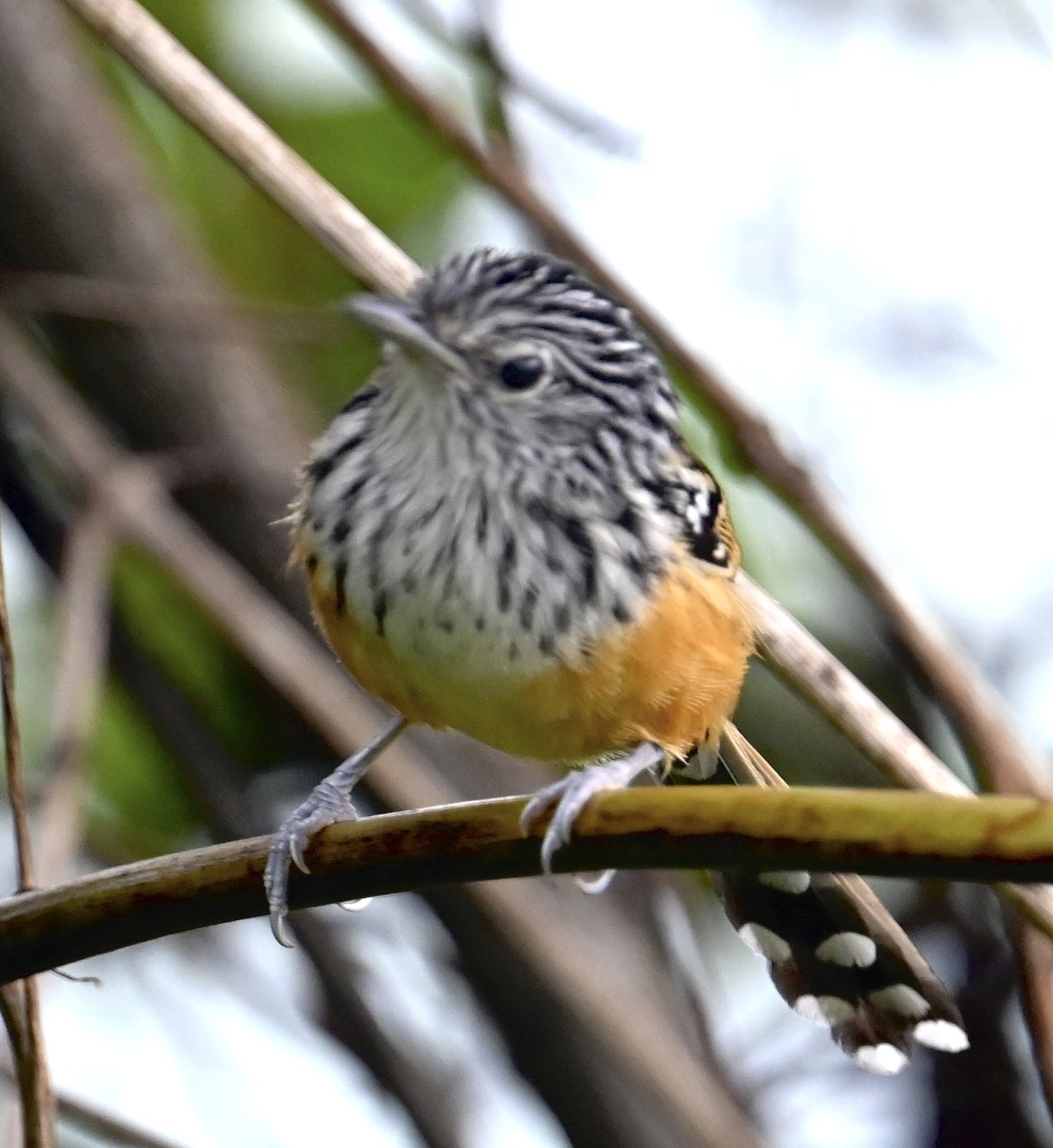
The Santa Marta Antbird is a long-tailed, black-and-white streaked antbird found only in the Sierra Nevada de Santa Marta in northern Colombia. Like its relatives it lives in bamboo and dense shrubbery along forest edges. It was split from the Long-tailed Antbird in 2012 on the basis of song and plumage.
Voice
The song consists of a few clear introductory notes followed by a series of raspy, buzzy notes; rhythm and pitch differ from those of the related species. Pairs often sing in duet.
Recording: Bram Vogels — CC BY-NC-SA 4.0 · xeno-canto
Identification
15 cm, with a long, graduated tail with white tips. The male is black above with white streaks, with a rufous rump and white wing bars; the throat and breast are white with black streaks, and the flanks and undertail coverts are rufous-tawny. The female has a rufous-streaked crown, olive-brown upperparts streaked black and a buff-tinged breast with fainter streaks.
Confusion species
No other Drymophila occurs in the Sierra Nevada de Santa Marta. Klages's Antbird Drymophila klagesi in the Serranía de Perijá and East Andean Antbird Drymophila caudata in the East Andes have nearly identical plumage, but sing differently.
Habitat
Bamboo thickets, shrubby edges of humid montane forest, clearings and dense second growth on the slopes of the Sierra Nevada de Santa Marta, roughly between 900 and 2200 m. It forages in pairs for insects among the leaves of bamboo and shrubs, low to mid-height above the ground.
Where the bird is most at home, classified by the vegetation units of the Andes and the west coast.


Range and movements
Colombia: only in the Sierra Nevada de Santa Marta (Magdalena, La Guajira and Cesar). Absent from the rest of Colombia and from Ecuador, Peru, Bolivia and the Galápagos. Endemic to the guide area.
- Resident
- dark = core range, pale = thinly spread
How and when to look
Along the road from Minca up to the San Lorenzo ridge, look for bamboo and dense forest edges; the birds usually make themselves heard first and then move low through the bamboo.
Conservation status
Near Threatened. The species has a small range in a single mountain massif, where much forest has been cleared for farming, coffee and pasture. It partly persists in second growth and bamboo along forest edges.
Scientific name
Drymophila hellmayri | Todd, 1915
Todd described the species in 1915 and placed it straight away in the genus where it still stands. The genus Drymophila was introduced in 1824 by Swainson. The genus name combines Greek drumos, 'wood, copse', and philos, 'fond of'. The species name honours the Austrian ornithologist Carl Eduard Hellmayr (1878–1944). The specimen the first description was based on came from Cincinnati, Sierra Nevada de Santa Marta, Colombia.