All species › Passerines › Antbirds › Streak-headed Antbird
Streak-headed Antbird | Drymophila striaticeps
Chapmans miervogel | Tiluchí cabeciestriado | Trovoada-de-cabeça-estriada
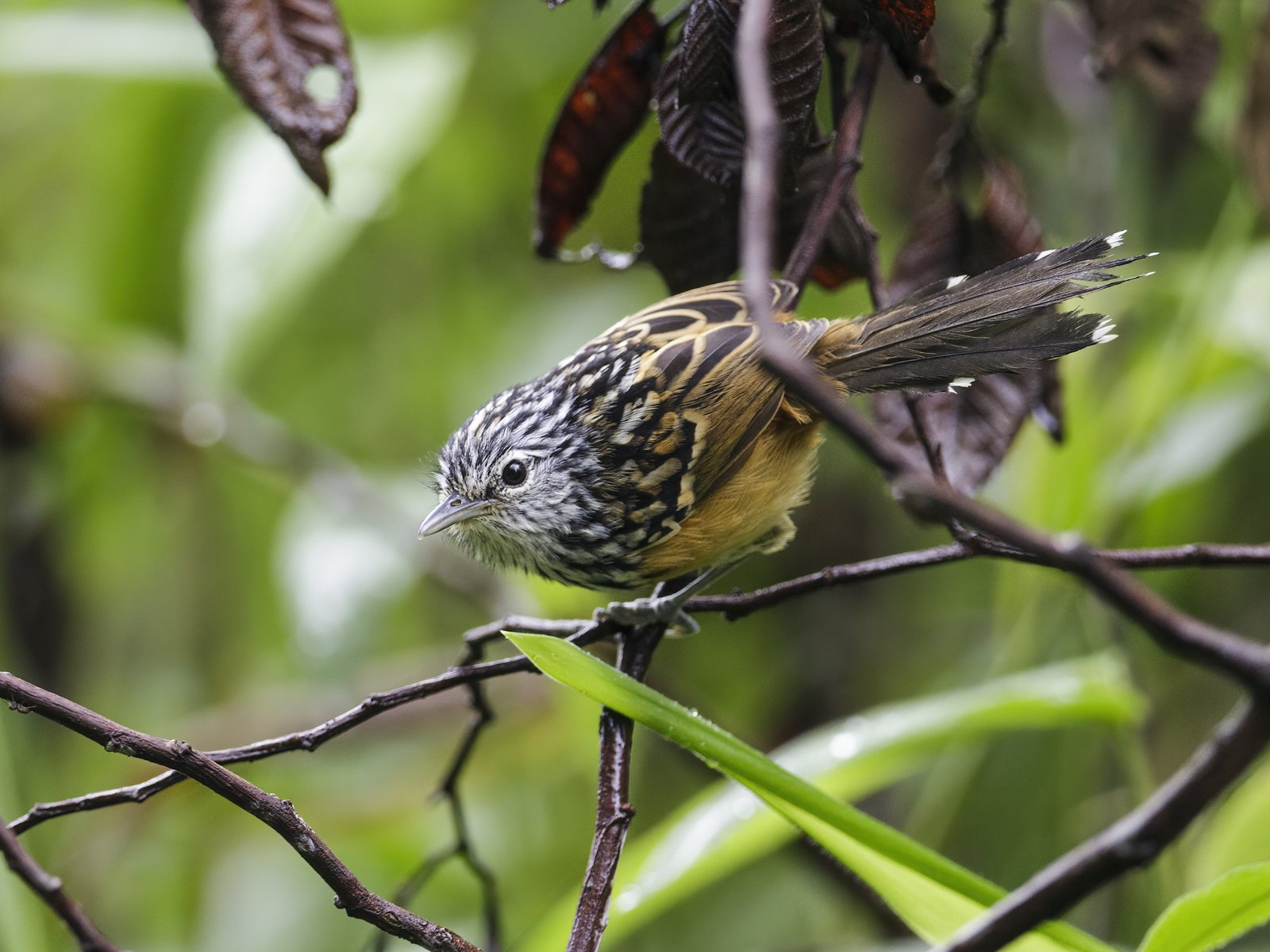
The Streak-headed Antbird is the most widespread of the long-tailed, streaked antbirds of the Andes and occurs from Colombia to Bolivia. It is closely tied to bamboo, above all Chusquea, in montane forest. Pairs make themselves heard with a duet of a buzzy male song and a descending reply from the female.
Voice
The male sings a loud, sharp introductory note followed by a series of buzzy notes; the female replies with a descending, less buzzy series. Calls: a sharp, ringing note and paired series of descending, mewing whistles.
Recording: Jacob Wijpkema — CC BY-NC-SA 4.0 · xeno-canto
Identification
15 cm, with a long, graduated tail with white tips. The male has a black crown and back with white streaks, a white interscapular patch, a deep rufous rump and black wing coverts with white tips. The face, throat and breast are white with broad black streaks, the belly is unstreaked white, and the flanks and undertail coverts are rufous. The female has a crown streaked cinnamon-rufous and black, lacks the white interscapular patch and is rufous-buff where the male is white.
Confusion species
Klages's Antbird Drymophila klagesi in the Perijá and Norte de Santander and East Andean Antbird Drymophila caudata in the East Andes of Colombia have nearly identical plumage; song and range are the best features. Striated Antbird Drymophila devillei lives in bamboo in the Amazonian lowlands and lower foothills, is smaller and has a shorter tail.
Habitat
Understorey and mid-storey of evergreen montane forest and secondary forest, closely tied to bamboo thickets, less often in vine tangles and shrubby forest edges. In Colombia between about 1200 and 3150 m, in Ecuador and Peru mainly between 1500 and 2600 m. It forages in pairs for insects among bamboo leaves, usually not far above the ground.
Where the bird is most at home, classified by the vegetation units of the Andes and the west coast.


Range and movements
Colombia: in the West and Central Andes and south into Nariño. Ecuador: on the western slope south to the centre of the country and along the eastern slope. Peru: along the eastern slope of the Andes, from the north to the south-east. Bolivia: on the eastern slope in the north-west (La Paz). Absent from the Galápagos. Endemic to the guide area.
- Resident
- dark = core range, pale = thinly spread
How and when to look
In montane forest with plenty of Chusquea bamboo, listen for the duet, for example along forest edges on the eastern slope in Ecuador and Peru. The birds often stay inside the bamboo, but respond to each other's song and then come to the edge.
Conservation status
Least Concern. Widespread and locally fairly common; the species also uses bamboo in secondary forest and old clearings, but disappears where forest is entirely converted to farmland.
Scientific name
Drymophila striaticeps | Chapman, 1912
Chapman described the species in 1912 and placed it straight away in the genus where it still stands. The genus Drymophila was introduced in 1824 by Swainson. The genus name combines Greek drumos, 'wood, copse', and philos, 'fond of'. The species name comes from Latin striatus, 'striated', and -ceps, 'headed', for the streaked head. The specimen the first description was based on came from Salento, Quindío, Colombia.