All species › Passerines › Antbirds › Allpahuayo Antbird
Allpahuayo Antbird | Percnostola arenarum
Allpahuayomiervogel | Hormiguero de Allpahuayo | Formigueiro-de-allpahuayo
The Allpahuayo Antbird was described only in 2001 and is named after the Allpahuayo-Mishana reserve near Iquitos, where it was discovered. It is endemic to the department of Loreto in north-eastern Peru and lives almost exclusively in forest on white sand. It is closely related to the Black-headed Antbird.
Voice
A calm series of monotone whistles that slows slightly, often introduced by a higher, stuttered note. Calls: a descending whine, a harsh tchah, a rising melodic note and a rising and falling rattle.
Recording: Ross Gallardy — CC BY-NC-SA 4.0 · xeno-canto
Identification
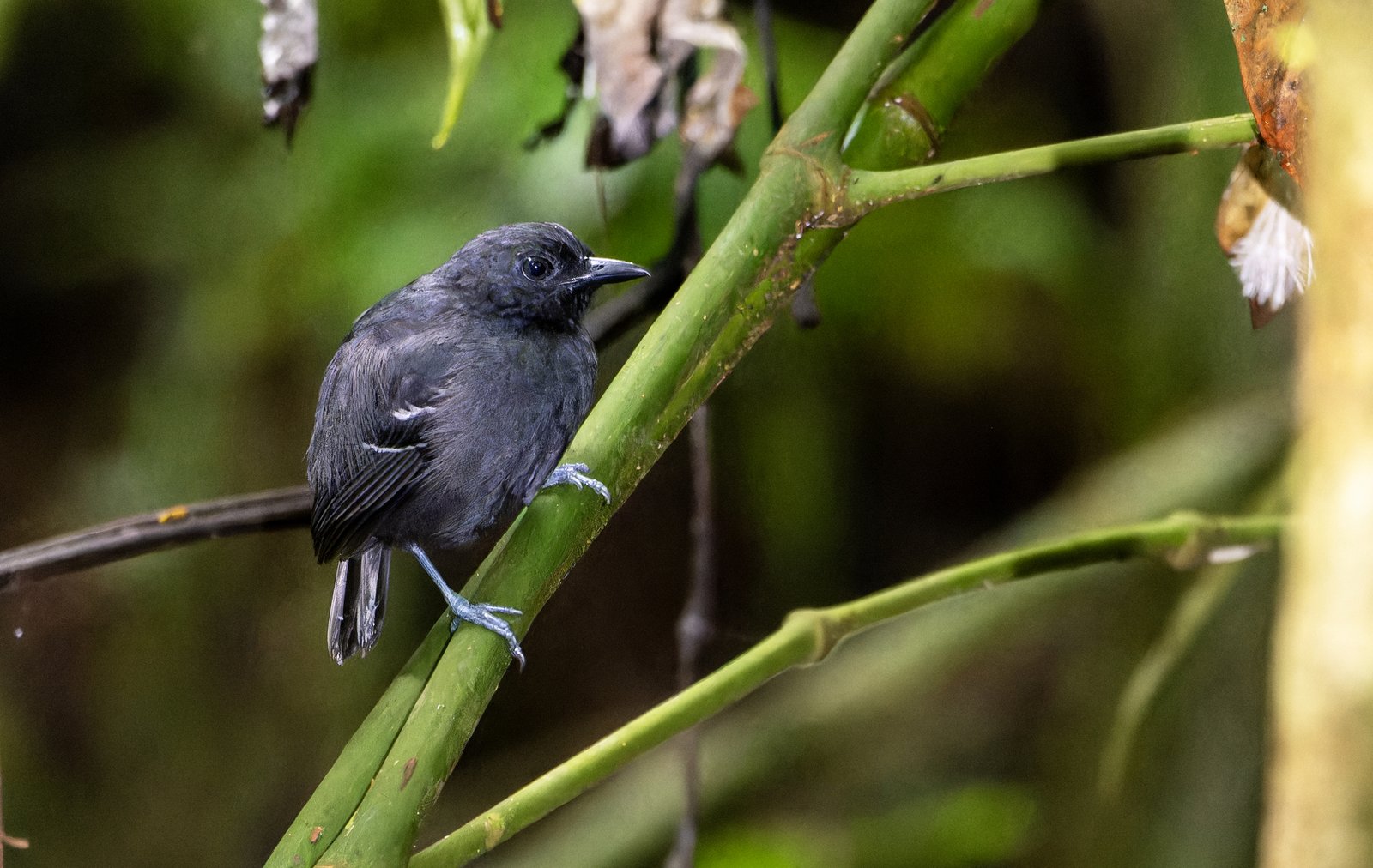
14 cm. The male is dark grey, darkest on the forecrown, with a blackish chin and throat and black wing coverts with white edges and tips that form two or three wing bars. The bill is black. The female has a dark grey crown and upperparts, black wing coverts with rusty buff tips and rusty buff underparts, darker on the breast and with a white belly centre; the lower mandible is bluish grey.
Confusion species
Black-headed Antbird Percnostola rufifrons occurs locally in Loreto north of the Amazon; the male has a black crown, and the female a black crest, olive-grey face and whitish throat instead of entirely grey upperparts. Spot-winged Antbird Myrmelastes leucostigma has white spots on the wing coverts, a shorter tail and lives along streams in taller forest. Black-faced Antbird Myrmoborus myotherinus has a black mask and a shorter tail.
Habitat
Understorey of varillal: low forest with dense undergrowth on white sand. The western subpopulation lives in taller irapayal forest on sandy and clay soils. From about 100 to 250 m. It searches for insects on or just above the ground. The nest has not been described.
Where the bird is most at home, classified by the vegetation units of the Andes and the west coast.

Range and movements
Peru: only in Loreto, mainly in the Nanay and Itaya drainages near Iquitos, with a smaller subpopulation along the Río Morona in the west. Absent from Colombia, Ecuador, Bolivia and the Galápagos. Endemic to the guide area.
- Resident
- dark = core range, pale = thinly spread
How and when to look
The Allpahuayo-Mishana reserve, a short distance from Iquitos, is the best-known site. Listen early in the morning in varillal along the trails for the series of whistles; the birds stay in the dense undergrowth.
Conservation status
Vulnerable. The range is small and the population is estimated at 600 to 1700 mature individuals, with a declining trend. The largest population lies close to Iquitos and is under pressure from illegal settlement, logging and hunting.
Scientific name
Percnostola arenarum | Isler, Álvarez A, Isler & Whitney, 2002
Isler, Álvarez A, Isler & Whitney described the species in 2002 and placed it straight away in the genus where it still stands. The genus Percnostola was introduced in 1860 by Cabanis & Heine. The genus name comes from Greek perknos, 'dark, dusky', and stolē, 'dress', for the dark plumage. The species name comes from Latin arena, 'sand', meaning 'of the sands', for the white-sand forests where the species lives. The specimen the first description was based on came from Mishana, Río Nanay, Loreto, Peru.