All species › Passerines › Antbirds › Black-headed Antbird
Black-headed Antbird | Percnostola rufifrons
Roetkopmiervogel | Hormiguero cabecinegro | Formigueiro-de-cabeça-preta
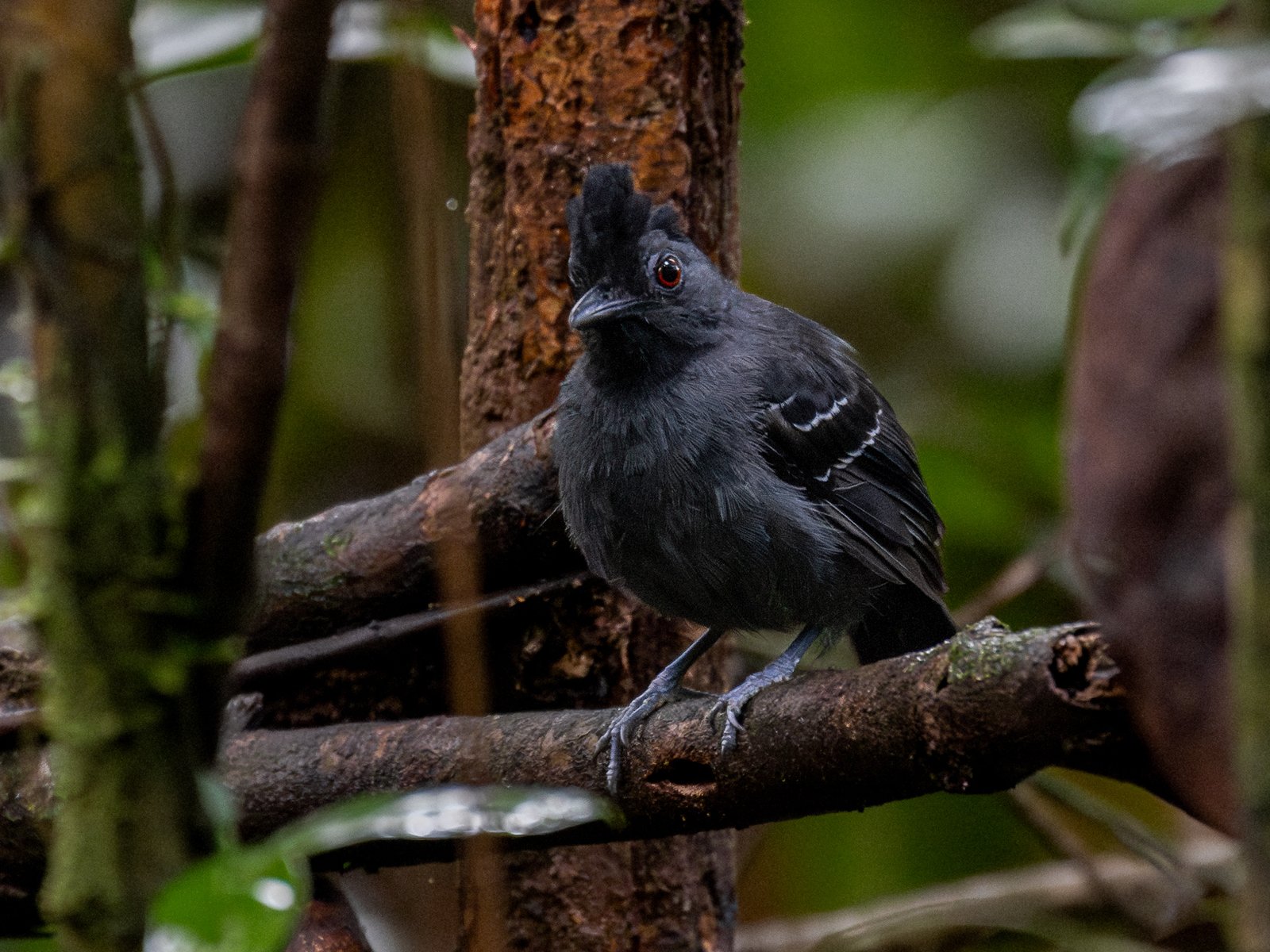
The Black-headed Antbird is an antbird of north-eastern South America that occurs only at the edges of the guide area: in the far east of Colombia and, widely separated from that, with its own subspecies in north-eastern Peru. The scientific name rufifrons (red forehead) refers to the female of the nominate form. It regularly follows army ant swarms.
Voice
In Peru a series of monotone whistles at moderate pace with a stuttered introductory note; in the north of the range a loud whistled pa, peer-peer. Calls: a short screeching note, a downslurred complaining note and a short rattle.
Recording: JAYRSON ARAUJO DE OLIVEIRA — CC BY-NC-SA 4.0 · xeno-canto
Identification
14–15 cm. The male is grey with a black crown and throat and black wing coverts with white edges and tips. The female is olive-brown above with cinnamon-rufous underparts. In eastern Colombia (subspecies minor) the male has no crest and the female a rufous-brown crest. In Peru (jensoni) the male has broader, pale grey edges to the crown feathers and the female a black crest, dark olive-grey face and whitish throat. The iris is grey in both subspecies.
Confusion species
Allpahuayo Antbird Percnostola arenarum near Iquitos is very closely related; the male has a grey rather than black crown, the female a grey crown and back. Spot-winged Antbird Myrmelastes leucostigma has white spots on the wing coverts and a shorter tail. Black-faced Antbird Myrmoborus myotherinus has a black mask with a grey crown.
Habitat
Dense undergrowth in terra firme forest and mature secondary forest, especially at treefalls and shrubby forest edges; also in forest on sandy or lateritic soils. In the lowlands, in Colombia up to about 300 m. It forages alone, in pairs or family groups on or up to 2 m above the ground, pumping its tail; it follows army ants to catch flushed insects, but gives way there to the professional ant-followers.
Where the bird is most at home, classified by the vegetation units of the Andes and the west coast.


Range and movements
Colombia: in the far east, along the borders with Venezuela and Brazil. Peru: very locally in Loreto north of the Amazon. Absent from Ecuador, Bolivia and the Galápagos. Beyond the guide area in southern Venezuela, northern Brazil and the Guianas.
- Resident
- dark = core range, pale = thinly spread
How and when to look
In Peru the sites of jensoni are few; ask about recent records in the area north of Iquitos. In eastern Colombia it pays to wait at army ant swarms in terra firme forest.
Conservation status
Least Concern. Large range and probably stable population. Fairly uncommon in Colombia; the Peruvian subspecies is very local and patchily distributed, and therefore more sensitive to forest loss.
Scientific name
Percnostola rufifrons | (Gmelin, 1789)
Gmelin described the species in 1789 as Turdus rufifrons; because it was later moved to another genus, the author and year stand in brackets. The genus Percnostola was introduced in 1860 by Cabanis & Heine. The genus name comes from Greek perknos, 'dark, dusky', and stolē, 'dress', for the dark plumage. The species name comes from Latin rufus, 'red', and frons, 'forehead'. The specimen the first description was based on came from Cayenne, French Guiana.