All species › Passerines › Antbirds › Undulated Antshrike
Undulated Antshrike | Frederickena unduliger
Marmermierklauwier | Batará ondulado | Borralhara-ondulada
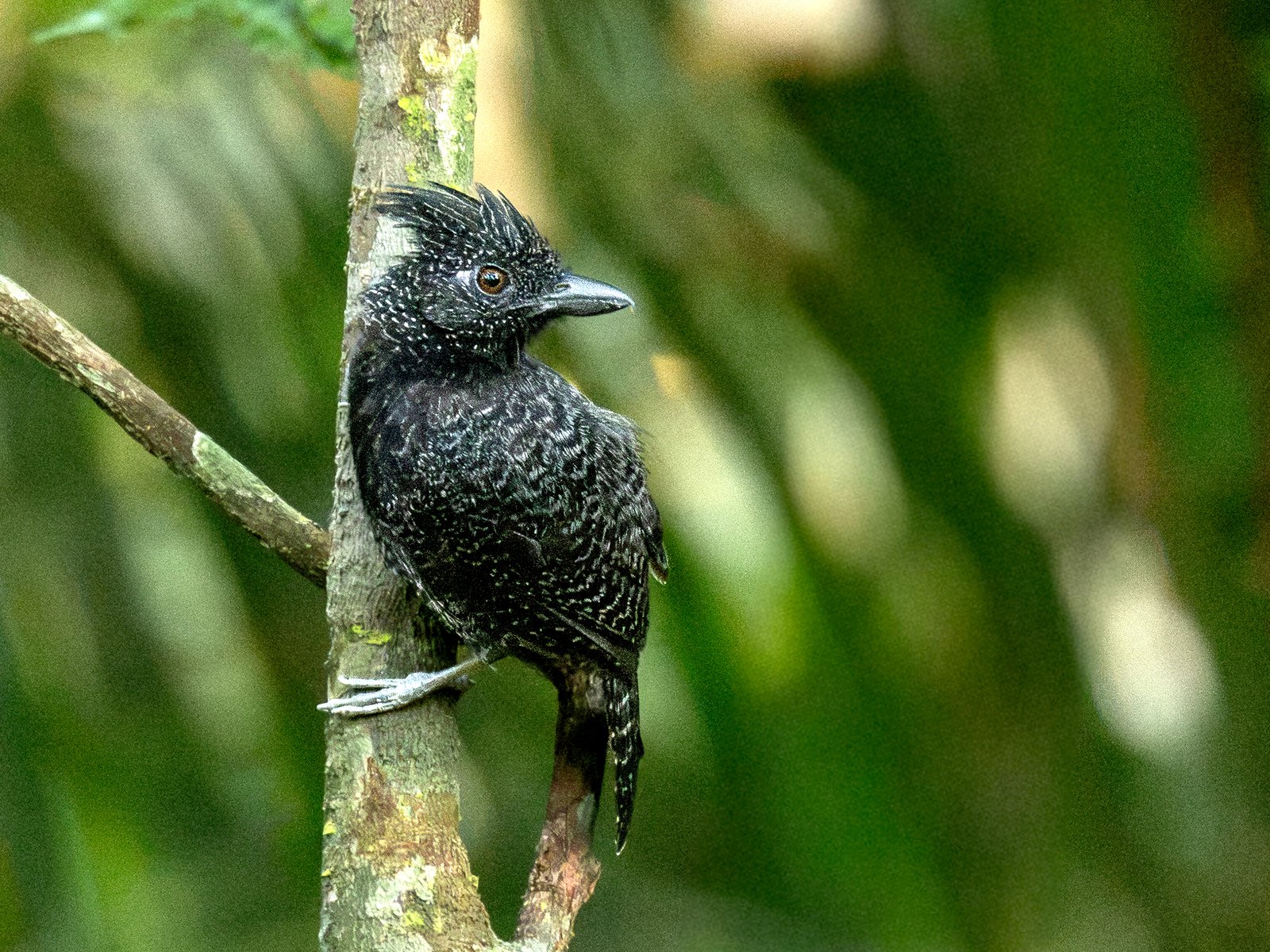
The Undulated Antshrike is a large, crested antshrike of the dense understorey of Amazonian lowland forest. The male is black with fine, wavy white bars, the female cinnamon with black wavy lines. The species lives hidden in pairs and is noticed mainly by its song.
Voice
The song is a short series of 8–13 connected, whistled wuiw notes that rise in strength and pitch. The usual call is a long, nasal, downslurred snarl of about one second.
Recording: Jerome Fischer — CC BY-NC-SA 4.0 · xeno-canto
Identification
22–25 cm, bulky, with a crest, a heavy, black, hooked bill and a brown to pale yellow iris. The male is black with irregular, narrow white bars over the whole body except the throat. The female is cinnamon with wavy black bars, a rufous crest barred black and a black tail with narrow grey bars. Females in the east of the range are paler and less barred. The legs are black.
Confusion species
Fulvous Antshrike Frederickena fulva is nearly identical and lives north of the Amazon and the Marañón. Fasciated Antshrike Cymbilaimus lineatus and Bamboo Antshrike Cymbilaimus sanctaemariae are smaller, with more regular, finer barring and a less heavy bill; Fasciated Antshrike has a red iris and more often lives higher up in vines.
Habitat
Dense, vine-covered understorey of humid lowland forest, mainly terra firme, preferably at openings such as treefalls and along streams; up to about 1100 m. Usually absent from disturbed forest. It searches dense vegetation for large insects and other arthropods. Little is known about the nest.
Where the bird is most at home, classified by the vegetation units of the Andes and the west coast.


Range and movements
Peru: in the east, south of the Amazon and the Marañón. Bolivia: in the north-west, in Pando, northern La Paz and Beni. Absent from Colombia, Ecuador and the Galápagos. Outside the guide area in western Brazil.
- Resident
- dark = core range, pale = thinly spread
How and when to look
In the early morning, listen in terra firme forest in Madre de Dios or Pando for the rising series of whistles, then search low down at treefalls and vine tangles. The bird sometimes responds to sound but often stays in cover.
Conservation status
Not Evaluated in this species concept; in the broad sense, together with Fulvous Antshrike, Least Concern. Uncommon to rare; numbers are thought to be declining through deforestation, but the species occurs in several large protected areas.
Scientific name
Frederickena unduliger | (Pelzeln, 1868)
Pelzeln described the species in 1868 as Thamnophilus unduliger; because it was later moved to another genus, the author and year stand in brackets. The genus Frederickena was introduced in 1918 by Chubb. The genus name honours Frederick Vavasour McConnell (1868–1914), English ornithologist, explorer in British Guiana and collector. The species name combines Latin undula, 'small wave', and -ger, 'bearing', for the wavy barring. The specimen the first description was based on came from upper Rio Negro, Amazonas, Brazil.