All species › Passerines › Antbirds › Black-capped Antwren
Black-capped Antwren | Herpsilochmus atricapillus
Zwartkopmiersluiper | Tiluchí plomizo | Chorozinho-de-chapéu-preto
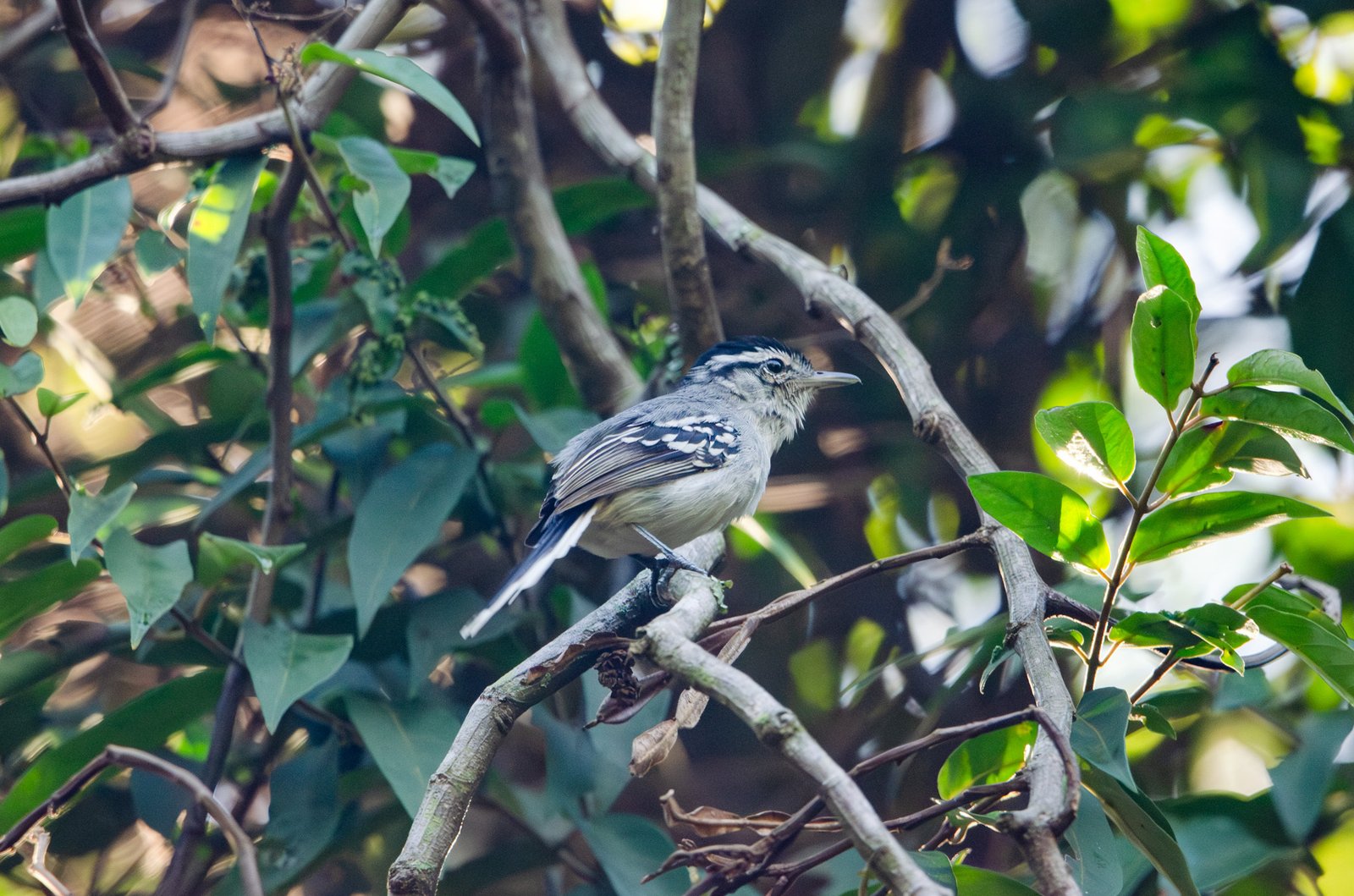
The Black-capped Antwren is a small grey-and-white antwren with a black crown and a long white supercilium. In the guide area it lives only in Bolivia, in dry and semi-humid forest at the foot of the Andes and in the east of the country. Pairs search high in the trees for insects, often with mixed flocks.
Voice
The song is a series of short notes that accelerates into a dry trill; male and female often sing in alternation. Calls are short, nasal notes.
Recording: Jacob Wijpkema — CC BY-NC-SA 4.0 · xeno-canto
Identification
11.5 cm, slender, with a fairly long tail. The male has a black crown, a long white supercilium and a black eyestripe. The back is grey with black and a concealed white back patch; the wings are black with two white wingbars and white edges. The tail is black with white tips. The underparts are white to pale grey. The female has a black crown with white or buff spots and a pale buff wash to the breast.
Confusion species
Large-billed Antwren Herpsilochmus longirostris is larger with a longer bill; the female has a rufous head. Male Black-bellied Antwren Formicivora melanogaster has a black throat and belly. Rusty-backed Antwren Formicivora rufa has a rufous back and lives lower in scrub.
Habitat
Mid-levels and canopy of dry and semi-humid deciduous forest, Chiquitano forest, gallery forest and forest edge, also in dry Andean valleys; mainly below 1500 m. It searches in pairs for insects and spiders in foliage and vines, often with mixed flocks. The nest is an open cup suspended in a horizontal fork of a branch.
Where the bird is most at home, classified by the vegetation units of the Andes and the west coast.


Range and movements
Bolivia: in the east and south, mainly in Santa Cruz, also in La Paz, Chuquisaca and Tarija. Absent from Colombia, Ecuador, Peru and the Galápagos. Outside the guide area in eastern and central Brazil, Paraguay and northern Argentina.
- Resident
- dark = core range, pale = thinly spread
How and when to look
Search dry forest around Santa Cruz de la Sierra and in the Chiquitanía; follow mixed flocks in the canopy and listen for the accelerating trill.
Conservation status
Least Concern. Fairly common in suitable forest; tolerates some disturbance and also occurs in secondary forest.
Scientific name
Herpsilochmus atricapillus | Pelzeln, 1868
Pelzeln described the species in 1868 and placed it straight away in the genus where it still stands. The genus Herpsilochmus was introduced in 1847 by Cabanis. The genus name combines Greek herpō, 'to creep about', and lokhmē, 'thicket, copse'. The species name combines Latin ater, 'black', and capillus, 'hair of the head', so 'black-capped'. The specimen the first description was based on came from Rio Paraná, São Paulo, Brazil.