All species › Passerines › Antbirds › Creamy-bellied Antwren
Creamy-bellied Antwren | Herpsilochmus motacilloides
Roombuikmiersluiper | Tiluchí motaciloide | Chorozinho-de-barriga-creme
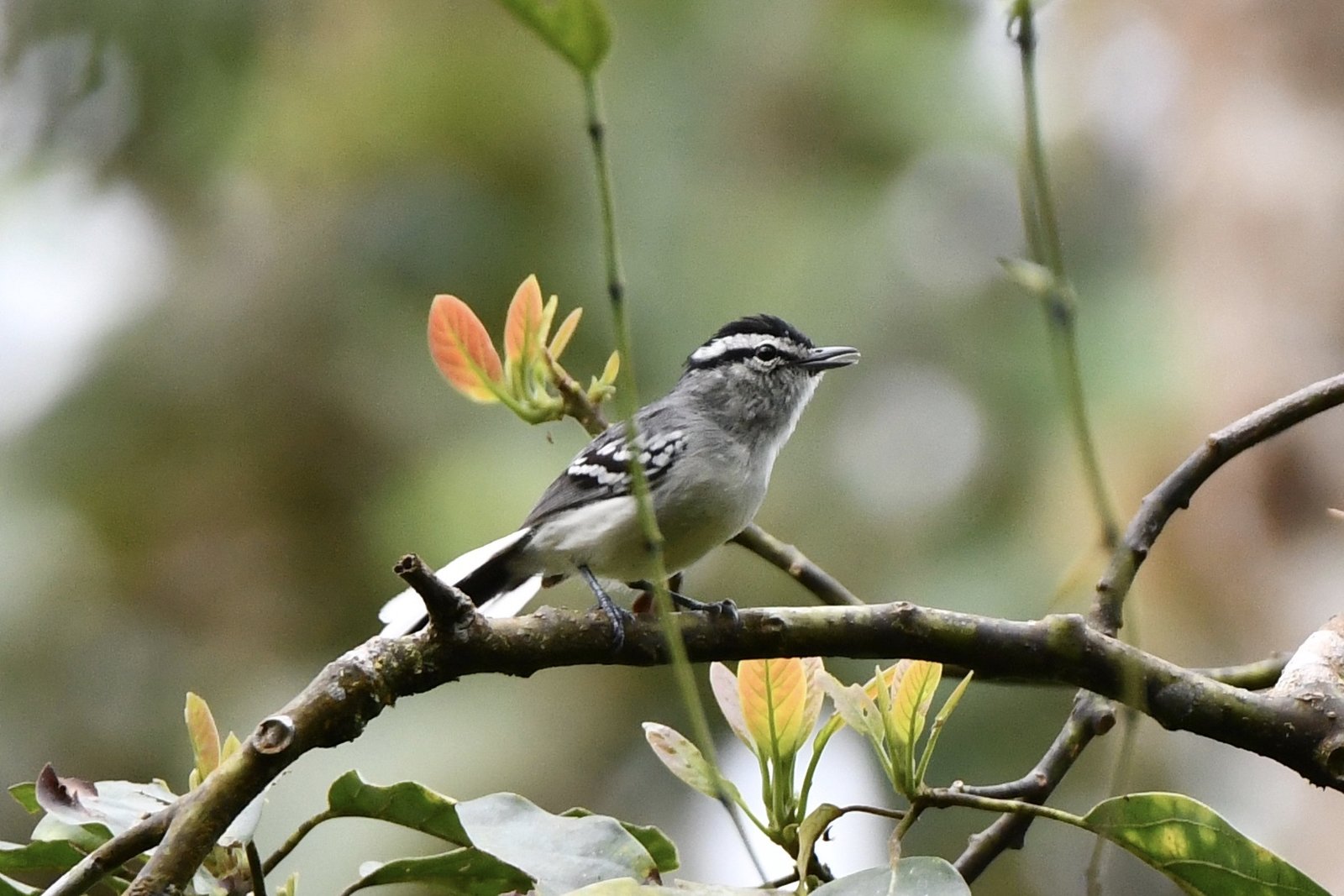
The Creamy-bellied Antwren is a small antwren found only in Peru, on the east slope of the Andes in the centre of the country. It lives in the canopy of montane forest and travels with mixed flocks. The name refers to the cream-tinged belly.
Voice
The song is a series of short notes that accelerates and ends in a dry trill. Calls are short, nasal notes.
Recording: Nick Athanas — CC BY-NC-SA 3.0 · xeno-canto
Identification
11.5 cm, slender, with a fairly long tail. The male has a black crown, a white supercilium and a black eyestripe. The back is grey with black; the wings are black with white wingbars and edges. The tail is black with white tips. The throat is white, the rest of the underparts whitish with a creamy-yellow tinge, especially on the belly. The female has a white-spotted crown and a slightly warmer breast.
Confusion species
Yellow-breasted Antwren Herpsilochmus axillaris has yellow underparts, an olive back and, in the female, a rufous crown. Ash-throated Antwren Herpsilochmus parkeri has a grey throat and lives further north, in San Martín. Rusty-winged Antwren Herpsilochmus frater has rufous edges to the flight feathers and lives lower.
Habitat
Canopy and upper mid-levels of humid montane forest and forest edge on the east slope of the Andes, about 1000 to 2200 m. It searches in pairs for insects in foliage, usually with mixed flocks of tanagers and other insectivores. Little is known about the nest.
Where the bird is most at home, classified by the vegetation units of the Andes and the west coast.


Range and movements
Peru: on the east slope of the Andes in the centre of the country, from Huánuco through Pasco and Junín to Ayacucho and Cusco. Absent from Colombia, Ecuador, Bolivia and the Galápagos. Does not occur outside Peru.
- Resident
- dark = core range, pale = thinly spread
How and when to look
Follow mixed flocks in the canopy along mountain roads in Pasco and Junín, for example around Oxapampa and Satipo, and listen for the accelerating trill.
Conservation status
Least Concern. It has a small range but is locally fairly common within it; deforestation on the Andean slope may reduce numbers.
Scientific name
Herpsilochmus motacilloides | Taczanowski, 1874
Taczanowski described the species in 1874 and placed it straight away in the genus where it still stands. The genus Herpsilochmus was introduced in 1847 by Cabanis. The genus name combines Greek herpō, 'to creep about', and lokhmē, 'thicket, copse'. The species name combines the wagtail genus Motacilla with Greek -oidēs, 'resembling'. The specimen the first description was based on came from Maraynioc, Junín, Peru.