All species › Passerines › New World sparrows › Black-capped Sparrow
Black-capped Sparrow | Arremon abeillei
Kapucijnergors | Cerquero coroninegro | Tico-tico-de-cabeça-preta
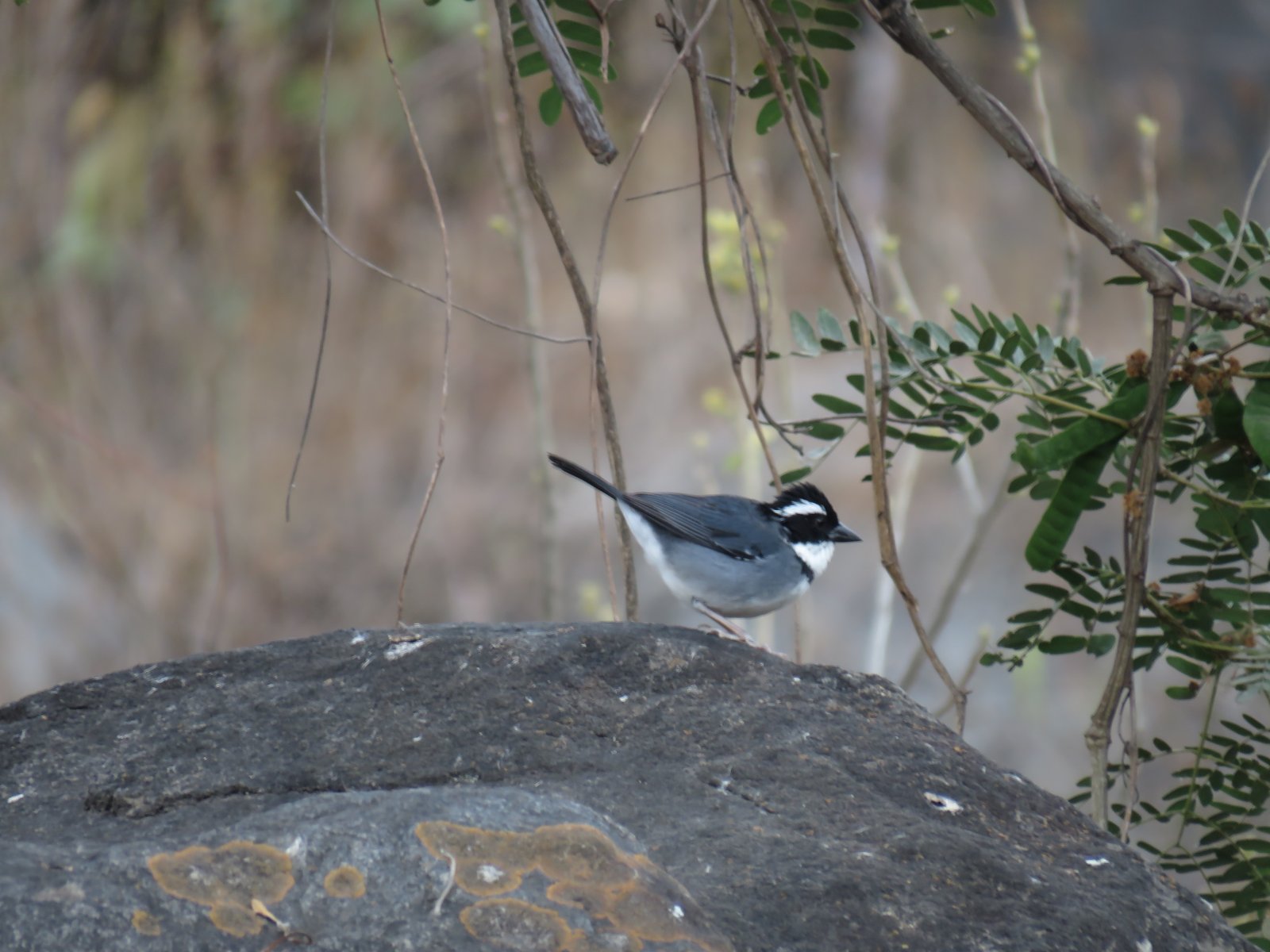
The Black-capped Sparrow is a small sparrow of the dry forests of south-western Ecuador and north-western Peru. With its black crown, white supercilium and black breast band it resembles the Orange-billed Sparrow, but it has a black bill and a grey back. It lives in pairs on the ground in the undergrowth.
Voice
The song is a short series of very high, thin notes. The call is a high tsit.
Recording: andro_.m — CC BY-NC-SA 4.0 · xeno-canto
Identification
15 cm. The bill is black. The crown and sides of the head are black, with a narrow white supercilium behind the eye. The nape and back are grey, the wings greyish brown with olive-green edges; birds from the Marañón Valley have a more olive-green back. The throat is white, with a narrow black breast band; the rest of the underparts are white with grey flanks. The sexes are alike. Juveniles are duller and browner.
Confusion species
Orange-billed Sparrow Arremon aurantiirostris has an orange bill and an olive-green back and lives in humid forest. Black-striped Sparrow Arremonops conirostris has a grey head with black stripes, an olive-green back and no breast band. Tumbes Sparrow Rhynchospiza stolzmanni has a grey head with rufous stripes, no breast band and lives in more open scrub.
Habitat
Undergrowth of dry deciduous and semi-humid forest, especially along dry stream beds and in shady ravines, from sea level to about 1800 m. It forages on the ground for insects and seeds. Little is known about the nest.
Where the bird is most at home, classified by the vegetation units of the Andes and the west coast.


Range and movements
In Ecuador in the west, from Manabí south to El Oro and Loja. In Peru in the north-west, in Tumbes, Piura, Lambayeque and Cajamarca, and in the dry Marañón Valley. Absent from Colombia, Bolivia and the Galápagos. Does not occur outside the guide area.
- Resident
- dark = core range, pale = thinly spread
How and when to look
Search the dry forest of Loja, for example at the Jorupe reserve near Macará. Pairs forage low in the shade of dense undergrowth; listen for their high calls in the early morning.
Conservation status
Least Concern. The dry forest of the Tumbesian region is heavily fragmented by logging, grazing and farming, which affects the species locally.
Scientific name
Arremon abeillei | Lesson, 1844
Lesson described the species in 1844 and placed it straight away in the genus where it still stands. The genus Arremon was introduced in 1816 by Vieillot. The genus name comes from Greek arrhēmōn, 'silent, without speech'. The species name honours Grégoire Abeillé (1798–1848), French physician, ornithologist and collector. The specimen the first description was based on came from Guayaquil, Ecuador.